Guides
How long does SEO take? Google's own timelines (2026)
Google's own estimates for 23 search steps, typical and slowest, checked against its help pages, our own site and real client timelines.
· Updated · 6 min read

In this story
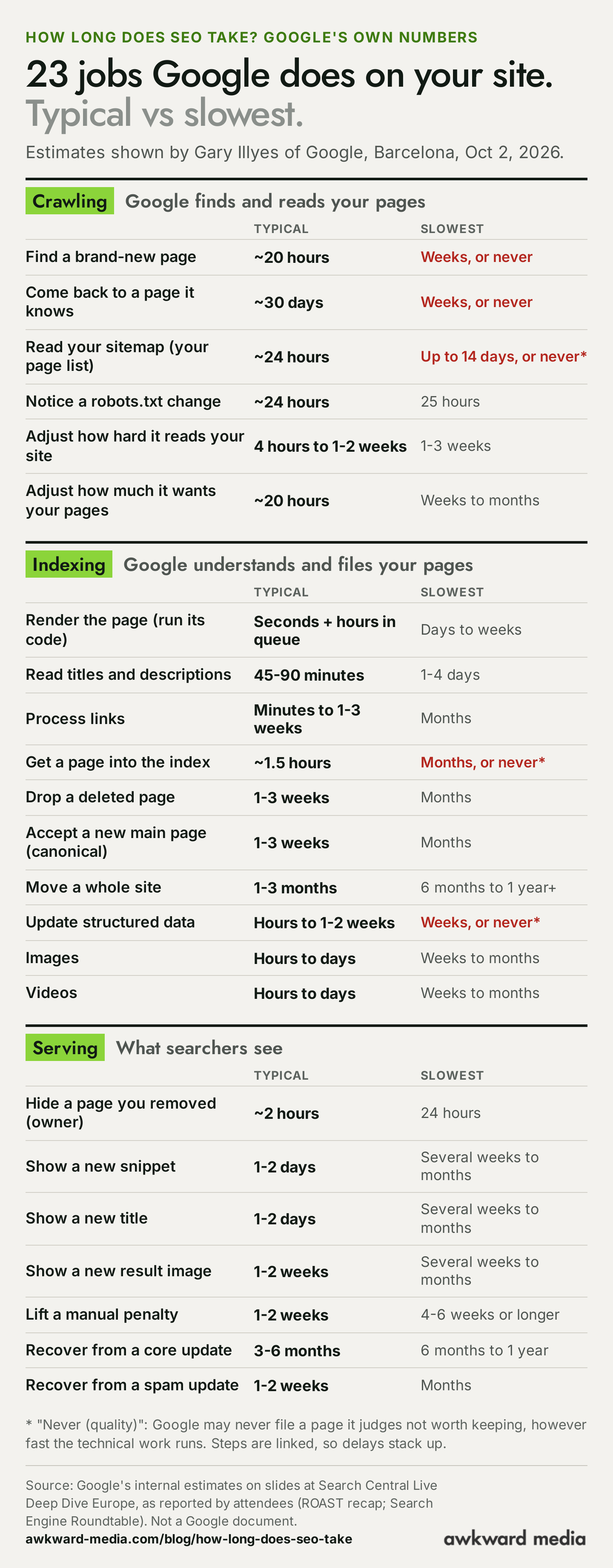
On October 2, 2026, in Barcelona, Gary Illyes put up a slide with a question on it: "How long does it take to…". Illyes is an analyst on Google's Search team, and he was closing three days of Search Central Live Deep Dive Europe, a conference Google's Search team runs for people who work on websites. What followed were four slides of timings for 23 jobs Google does behind every search, from finding a brand-new page to recovering from one of its big ranking updates. Each job had a typical time and a slowest time. Each slide carried the same small footnote: the times were "estimations based on internal analysis."
John Campbell, head of innovation and AI at the UK agency ROAST and one of the event's speakers, called it "the highlight of the day" and wrote every row down. Within a week the numbers were all over the trade press and LinkedIn. At least one of the most shared versions on LinkedIn kept the typical column and dropped the slowest one.
That's a shame, because the slow column is the one a business owner needs. If you've ever asked "how long does SEO take?" and been told "it depends", these slides are the closest thing to a straight answer Google has ever given in public. This article lays out all 23 timings, typical and slowest, in plain words. It sets each one beside what Google's own help pages say, shows you what happened to our own website while Google worked through it this month, and then answers the question you actually care about: when does the phone start ringing?
The short answer: how long SEO takes
SEO, short for search engine optimisation, is the work of getting your business to show up when people search for what you do. How long it takes depends on which part of it you mean. By Google's own estimates, and by what we see across our clients:
- Google finds a new page in about 20 hours, typically. At the slowest, weeks, or never.
- Once Google has read a page, filing it so it can show in results takes about an hour and a half. At the slowest, months, or never, when Google decides the page isn't good enough.
- A change to a page you already have waits for Google to come back, which typically happens about 30 days after its last visit.
- A new title on your listing shows up in 1 to 2 days once Google has seen it.
- Moving a website to new addresses settles in 1 to 3 months, and can take a year or more at the slowest.
- Recovering from one of Google's big ranking updates takes 3 to 6 months, and at the slowest you wait for the next one.
- Rankings that bring calls: on our client work, first movement usually shows within 20 days, and agreed searches reach page one of Google within 60. Bigger, broader gains build over 3 to 12 months.
Each of those deserves an explanation, because "20 hours" and "never" are very different promises.
Where these numbers come from, and what they are not
Google has not published the slides. Search Engine Journal noted on October 4 that they weren't on Google's Search Central events page. What we have are attendees' accounts. Campbell's day 3 recap on the ROAST website, dated October 2, is the fullest record, and it is the one Search Engine Journal's Matt G. Southern reported on October 4 and Search Engine Roundtable's Barry Schwartz on October 5. Schwartz also posted photos of the slides, and Estela Franco, a web performance architect at Shopify who spoke at the event, shared her own on LinkedIn. We read the recap, both trade reports and The SEO Handbook's redrawing of the slides from attendees' photos in full before writing a word. Their figures agree, row for row.
Three things you should know before you lean on any of these numbers:
- They're estimates, not promises. The footnote on the slides says so. Nobody has said what "typical" means: an average, a middle value or a judgement. No sample size or time period was given.
- Illyes himself played them down. After Schwartz published them, Illyes told him the slides were "an exercise to see if the audience can relate to the numbers we pulled internally."
- The steps are linked. Campbell reports Illyes's caveat: a page can't be filed until it has been read, so delays stack up. The 1.5 hours for indexing starts after the 20 hours for discovery, not instead of it.
"Mind that this was an exercise to see if the audience can relate to the numbers we pulled internally and put in those slides." Gary Illyes, Google, to Search Engine Roundtable, October 2026
With that said, these are still the only numbers of their kind to come from inside Google. The SEO trade has spent twenty years guessing at them. It's worth reading them carefully.
Google's 23 timelines, typical and slowest
Google's work on your website happens in three stages. First it has to find and read your pages (crawling). Then it has to understand and file them in its index, the giant catalogue it searches when someone types a query (indexing). Then it decides what to show people (serving). The slides followed those three stages, and so do the tables below. We've put each job in plain words, with Google's own name for it in brackets.
Stage 1: Google finds and reads your pages (crawling)
Crawling is Google's software, called Googlebot, visiting your website and reading it, the way a person would click through it, only much faster.
| What Google is doing | Typical | Slowest |
|---|---|---|
| Finding a brand-new page (discovery) | About 20 hours | Weeks, or never |
| Coming back to a page it already knows (refresh) | About 30 days | Weeks, or never |
| Reading your sitemap, the list of pages you hand Google (sitemap processing) | About 24 hours | Up to 14 days, or never (quality) |
| Noticing a change to robots.txt, the file that tells Google what it may read | About 24 hours | 25 hours |
| Changing how hard it can read your site without overloading it (crawl capacity) | 4 hours to 1-2 weeks | 1-3 weeks (in recovery) |
| Changing how much it wants to read your site (crawl demand) | About 20 hours | Weeks to months |
Two rows here matter most to an owner. A new page is usually found within a day. But a page Google already knows, say your services page after you rewrite it, typically waits around 30 days for the next visit. So if you change a page and check your ranking a week later, you may be measuring nothing: Google may not have seen the change yet. Campbell also notes that Google can cut back how hard it reads your site "in seconds" if your server struggles, which is one reason slow, unreliable hosting costs you more than page speed.
Stage 2: Google understands and files your pages (indexing)
Being read is not the same as being filed. A page only shows up in search once it is in Google's index.
| What Google is doing | Typical | Slowest |
|---|---|---|
| Running the page's code to see it as a visitor does (rendering) | Seconds to render, hours in the queue | Days to weeks |
| Reading the page's tags, such as its title and description (meta annotations) | 45-90 minutes | 1-4 days |
| Processing the links on and to the page (link annotations) | Minutes to 1-3 weeks | Months |
| Getting a page into the index, start to finish (indexing, end to end) | About 1.5 hours | Months, or never (quality) |
| Dropping a page you deleted (removal) | 1-3 weeks | Months |
| Accepting which of two near-identical pages is the main one (canonical change) | 1-3 weeks | Months (conflicting signals) |
| Moving a whole site to new addresses (site move) | 1-3 months | 6 months to 1 year or more |
| Updating structured data, the hidden labels that tell Google what a page is about | Hours to 1-2 weeks | Weeks, or never (quality) |
| Images | Hours to days | Weeks to months |
| Videos | Hours to days | Weeks to months (deep analysis) |
The recap defines "end to end" as the point when "all the critical processes finish successfully." It adds that a small site move "can be done in a few weeks." That last line matters if you're about to rebuild your website: a small business site doesn't have to spend three months in limbo, but a careless move can spend a year there. It's why we treat a website migration as its own job, not an afterthought of the redesign.
Stage 3: what people see in search (serving)
| What Google is doing | Typical | Slowest |
|---|---|---|
| Hiding a page you asked to remove in Search Console (owner removal) | About 2 hours | 24 hours |
| Showing a new snippet, the grey text under your link | 1-2 days | Several weeks to months |
| Showing a new title, the blue headline of your listing | 1-2 days | Several weeks to months |
| Showing a new picture beside your listing (text result image) | 1-2 weeks | Several weeks to months |
| Lifting a penalty a Google reviewer placed by hand (manual action removal) | 1-2 weeks | 4-6 weeks, or much longer for dormant sites |
| Recovering after a core update, Google's big periodic ranking changes | 3-6 months | 6 months to 1 year (the next core update) |
| Recovering after a spam update | 1-2 weeks (continuous) | Months (batch refreshes) |
Campbell also noted that core updates take 2 to 4 weeks to roll out, and spam updates 1 to 2 days. Rolling out and recovering are different clocks. If a core update knocked you down, the fix may be done in a month while the recovery takes six.
Why the slowest column matters more than the typical one
A typical time tells you what usually happens. The slowest time tells you when to stop waiting and start asking questions. For an owner paying for SEO, that's the more useful number.
"Never" is about quality, not queues
The word "never" appears five times in the slowest column. Three of them come with the word "quality" in brackets: reading your sitemap, getting a page into the index, and updating structured data. As Campbell put it, fast technical fixes "don't help if Google doesn't think the page is worth it." A page that says what fifty other pages already say, in the same words, can wait forever. A page with something only you can say, your prices, your photos, your own process, the towns you actually cover, is the kind Google files.
This is why SEO content writing and on-page work aren't decoration on top of the technical side. They decide whether the technical side pays off at all.
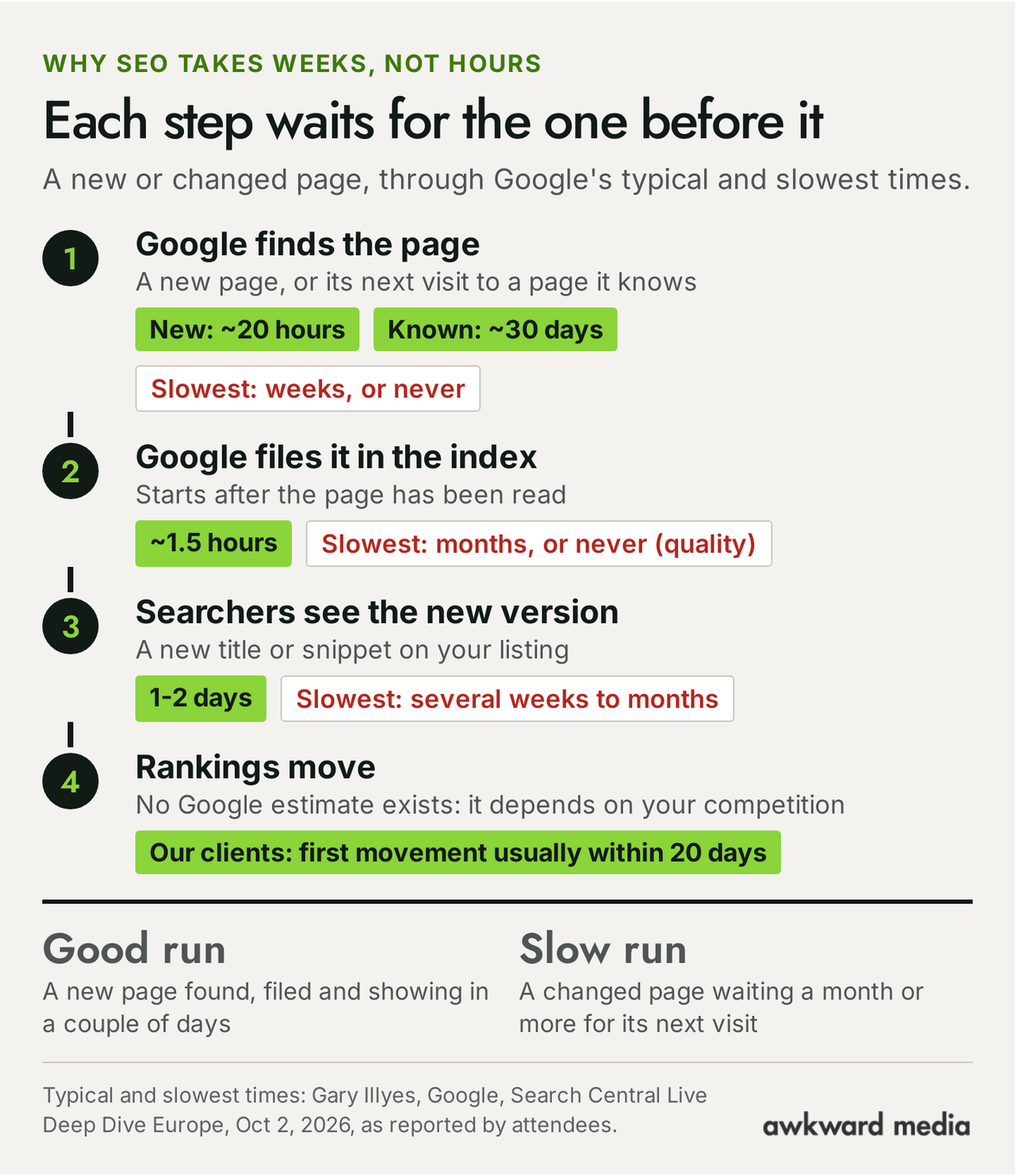
Delays stack up
Picture a new service page. Google finds it in about 20 hours, files it about 1.5 hours after reading it, and shows a new title a day or two after that. On a good run, that's a page in Google within a couple of days. Now picture the slow run: found in weeks, filed in months. Each step waits on the one before it.
When a page is still missing well past the slowest time for its stage, it is more likely stuck than slow, and that's worth finding out why. An SEO audit is the usual way to find out.
What Google's own help pages say
The slides are new. Google's help pages have given rougher timings for years. We read each page live this week and set the two side by side, so you can see where the slides narrow things down and where Google's documents are the only word.
| Job | Barcelona slides (typical, slowest) | Google's published help pages |
|---|---|---|
| Google re-reading a page you changed | About 30 days; weeks, or never | "Crawling can take anywhere from a few days to a few weeks." (Ask Google to recrawl your URLs) |
| Asking Google to index one page in Search Console | Not on the slides | "Indexing typically takes only a day or so, but can take much longer in some cases." The same page says it "can take up to a week or two." (URL Inspection tool help) |
| A change to robots.txt | About 24 hours; 25 hours | Google "generally caches the contents of robots.txt file for up to 24 hours." (robots.txt documentation) |
| Moving a site | 1-3 months; 6 months to a year or more | "A small to medium-sized website can take a few weeks for most pages to move, and larger sites take longer." (Site moves) |
| Recovering from a core update | 3-6 months; the next core update | "Some changes can take effect in a few days, but it could take several months." (Core updates) |
| A new Google Business Profile ranking | Not on the slides | "Rankings for new businesses can take up to a month to appear in search results." (Business Profile help) |
| Verifying a Google Business Profile | Not on the slides | "Wait up to 5 business days to be verified." (Business Profile help) |
| An edit to your Business Profile | Not on the slides | "Edits usually take up to 10 minutes to review, but sometimes it can take up to 30 days." (Business Profile help) |
Two things stand out. First, the slides and the help pages mostly agree where they overlap, and the slides put a sharper number on the vague ones. Site moves are the exception: the slides' typical 1 to 3 months is longer than the help page's "few weeks", though the recap adds that a small site move can be done in a few weeks. Second, nothing from Google, on slides or on paper, says how long it takes to rank. Every timing above is about getting into the race. Where you finish depends on your competition, and no Google document will put a number on that. That part comes from experience, so here's ours.
Our own website, in real time
We rebuilt awkward-media.com from the ground up this month. That makes us our own test case. Google was first handed the new site's list of pages on October 10. Since then we've read Google's own record for every page each day: whether it's in the index, and when Google last visited. Here's what it showed.
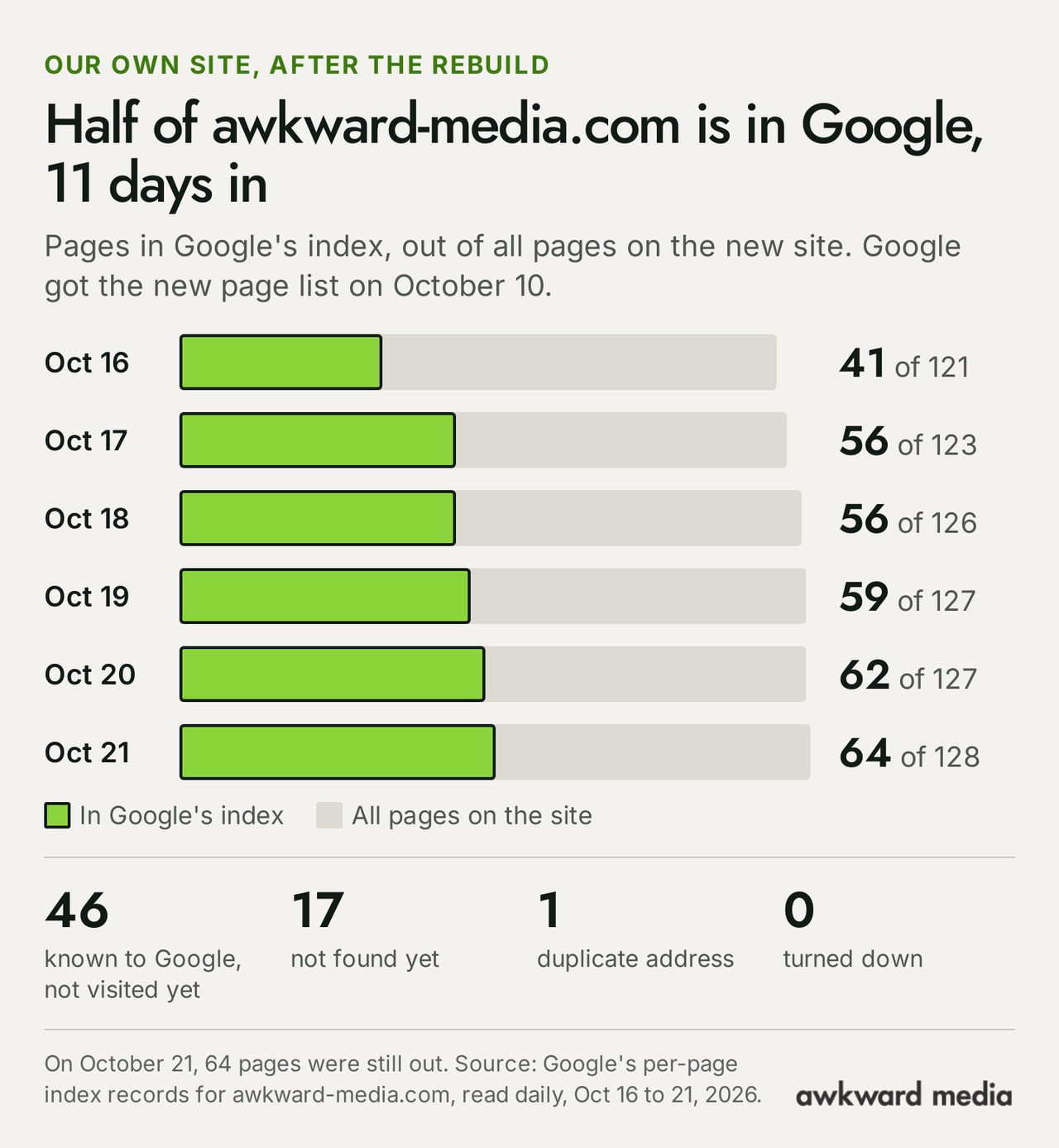
On October 21, 64 of our 128 pages were in Google's index. Of the 64 still out, 46 were known to Google but not yet visited, 17 hadn't been found yet, and one was a duplicate address Google preferred in a slightly different form. None had been turned down. That last number is the one we watch: "not visited yet" is a queue, "turned down" is a quality problem.
The fastest page
Our guide to how to rank higher on Google Maps went live on October 20 at about 2:30 in the afternoon, Toronto time. Google fetched it about three hours later, and it was in the index the next day. That's faster than the slides' typical 20 hours for discovery. A new page linked from pages Google already visits often gets found quickly.
The slowest pages
Five blog posts dated October 12, and all but three of our case studies, have been known to Google since we handed over the page list. Eleven days later, Google hasn't visited them yet. Our SEO consultant cost guide, live since October 17, hadn't been visited after four days either. All of that sits well inside the slides' slowest case for discovery, "weeks". Nothing is broken. The queue is long.
Why is it long? Google's last-visit dates show it fetching about 14 of our pages a day, and spending a good share of those visits re-reading pages it already has. For a site of 128 pages, that's a queue of days and weeks, not hours. So we've changed how we work while it lasts. Big rebuilds go ahead. Small tweaks to pages Google already has are saved up and shipped together every few days, and each round adds links from pages Google has filed to pages it hasn't, so the visits it does make lead somewhere new. That's the slides' "delays stack up" in practice, and it's the kind of thing a technical SEO plan is for.
When will my phone ring? Google Maps versus regular results
No owner hires an SEO agency to get pages indexed. You hire one so that people who need what you sell find you and call. Google's slides stop at the point where a page can be shown. Calls come from where it's shown, and that depends on which part of Google you're talking about.
Google Maps: usually the fastest
For a local business, the map box of three businesses at the top of the results, and Google Maps itself, is where most calls start, because the call button sits right there. Map rankings run on your Google Business Profile, your website and how well known your business is across the web. Google says a brand-new profile can take up to a month to show in local rankings. For an established business with a verified profile, the map is often the first place movement shows. One orthodontist we work with reached the top three on Google Maps within 20 days, and by day 60 was holding the top three for customers searching seven miles away (more on our dental SEO page). If the map is where your customers look, start with our guide on ranking higher on Google Maps, our Google Maps ranking service and Google Business Profile optimisation.
Regular Google results: weeks for the first moves, months for the full picture
The blue links below the map run on your website. Here the slides' clock applies in full: new pages found in about a day, changed pages re-read about every 30 days, titles updated a day or two after that. So the first ranking moves usually come in weeks, and the full effect of a site's work builds over months, as Google re-reads pages and other sites start linking to them. This is the slower, broader engine, and it's the one that reaches beyond your own neighbourhood, across a region or a whole country. That's why SEO services for the regular results and local SEO services for the map work best together rather than as an either-or.
AI answers: the same clock
Illyes closed the event with a message Campbell summed up in five words: "AI on Google is just SEO." Google's AI Overviews and AI Mode use the same crawling and indexing as the regular results. A page that isn't in the index can't be quoted in an AI answer either. So the timelines above are also the timelines for showing up in Google's AI answers. Getting named in them is now part of the same work: see our pages on AI Overviews SEO and ChatGPT SEO.
What it looked like for our clients
Here's what the clock looked like on real client work. These are a few from many, picked because each one shows a different stretch of the timeline. Not every business moves this fast. How crowded your market is, and what state your website starts in, decide that.
Maurice & Sons: seven #1 rankings in 21 days
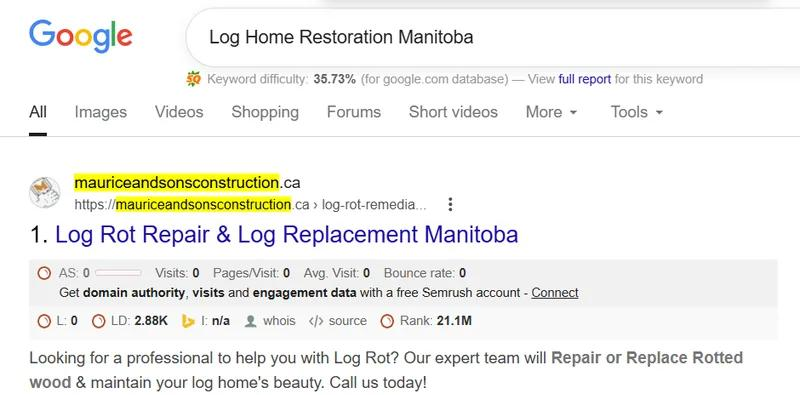
Maurice & Sons restores log homes in Manitoba. On March 10, 2026, 18 of the 19 searches we tracked for them couldn't find the business in Google's top 100. On March 31, seven of those searches had them at #1 and fifteen had them in the top three, and Google's AI Overview was naming them in its answers. The Maurice & Sons case study shows all 19, and our construction SEO page explains how this works for trades.
Shoreside Therapies: page one in 20 days
Shoreside Therapies is a therapy practice in Glendale, Wisconsin, near Milwaukee. Between March 10 and March 30, 2026, it entered Google at #1 for "marriage counseling near me", having not ranked at all, and moved from #6 to #1 for "couples therapy milwaukee". Four of the six searches in its case study didn't show Shoreside at all on day one. Practices like it are the subject of our therapist SEO page.

Pathways Dental Clinic: from outside the top 100 to #1 within 60 days
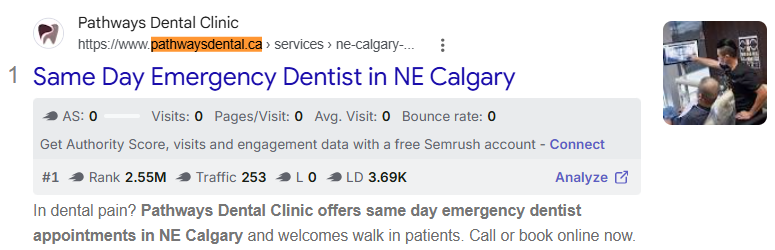
Pathways Dental Clinic in northeast Calgary reached #1 in Google's regular results within 60 days for "same day emergency dentist in NE Calgary" and "general dentistry in NE Calgary". It started outside the top 100 for both. In the screenshot below, the clinic's page is the first ordinary result, straight under the map box. More on how this works for practices on our dental SEO page, and for the city on our Calgary SEO page.
Grand Oaks Orthodontics: four times the searches in 90 days
Fast first moves are one thing. Breadth takes longer. Grand Oaks Orthodontics in Oakville, Ontario, ranked for 203 searches on day one. Ninety days later it ranked for 818, four times as many ways for a parent to find the practice, and the number of other websites linking to it had grown from 335 to 545. That's the months-long part of SEO, and the Grand Oaks case study shows it day 0 to day 90.
One of our clients put the experience in a review better than we could. Abdul Aziz wrote on Trustpilot in May 2026: "At first, I was like eh might be a gimmick but I did see results within 20 days and by the end of 30/40 days I have seen significant results." More like it on our reviews page, and every client story is on our case studies page.
How our two guarantees fit Google's clock
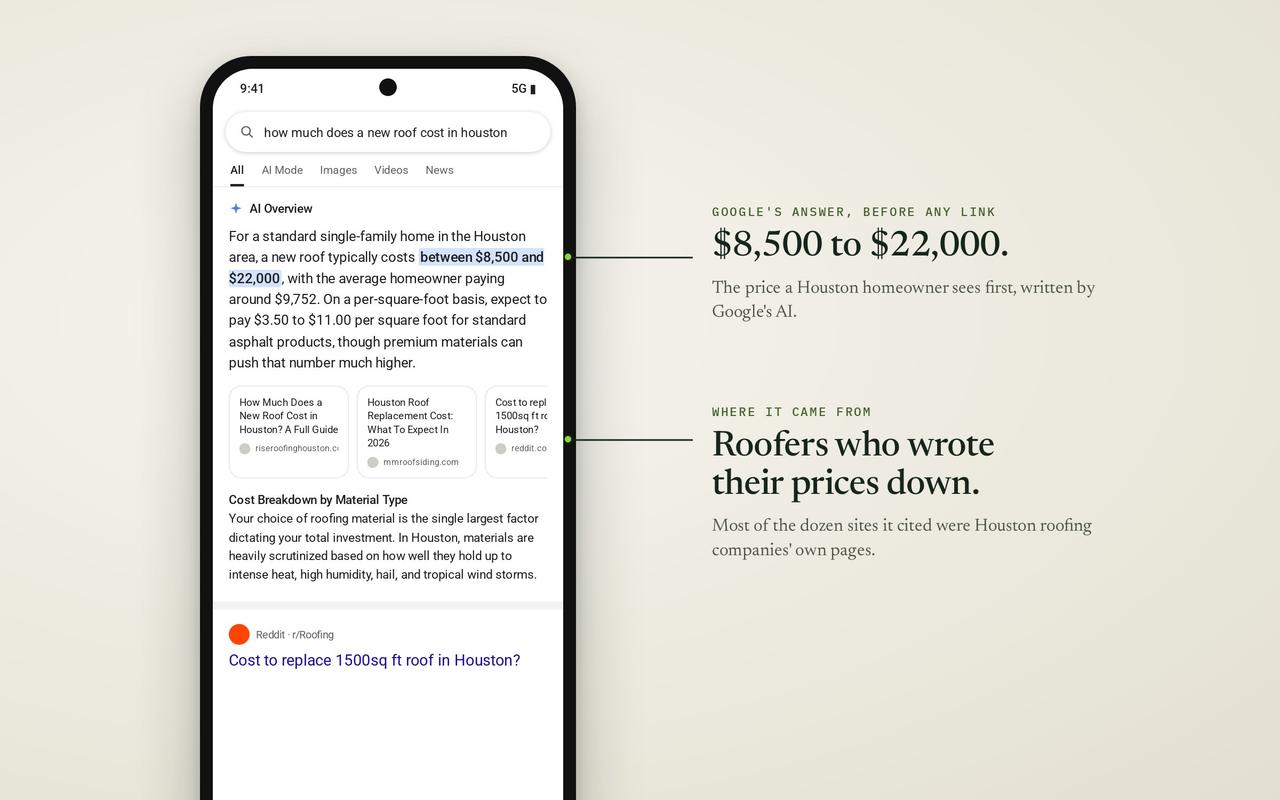
Ask Google's own AI answer "how long does SEO take?" this week and it says 3 to 6 months for measurable results and 6 to 12 months for significant growth. Then it leaves you there. We put our timeline in writing instead. There are two separate guarantees, and both are on our SEO guarantees page:
- The 20-day guarantee: "If you don't see visible improvement in your key metrics within the first 20 days, we refund $200 on top of returning your payment for that period." The key metrics are agreed with you before we start: your traffic, what that traffic is worth, how much authority your site and its pages carry, and how many other websites link to you, all measured against the day we begin.
- The 60-day guarantee: "If your qualifying keywords aren't on the first page of Google within 60 days, we keep working for free until they are." The qualifying keywords are the searches we agree together on your strategy call, based on your market and your competition.
Set those beside the slides and the reasoning is plain. Twenty days is enough time for Google to find new pages (about 20 hours), file them (hours), and show new titles (a day or two), and for the first movement to be measurable. Sixty days covers about two of Google's typical 30-day return visits to pages you already have. Neither guarantee depends on the slow column going our way. That's the point of having it in writing. You can see what's included and what it costs on our pricing page.
What slows SEO down, and what you can do about it
Most of what makes SEO slow sits in the slowest column of those slides, and most of it can be fixed. Here are the five causes we see most.
1. Google can't read the site properly
If pages only appear after code runs in the browser, Google has to queue them for rendering, which typically takes hours and at the slowest days to weeks. If the server is slow or falls over, Google backs off. Fixing what stops Google reading your site comes first in our plans, because every other job waits on it.
2. Pages that aren't worth filing
That's the "never (quality)" in the slides. Thin service pages, copied text and town pages that differ only by the town name are the usual suspects. One strong page per service, with your own detail, beats ten thin ones.
3. Nobody links to you
Links from other websites are how Google finds pages faster and decides which businesses to trust. The slides put link processing at minutes to three weeks, and months at the slowest. Real mentions in local press, trade directories and partners' sites shorten every other timeline. That's the job of link building.
4. Changing everything, all the time
Because Google typically comes back to a known page about every 30 days, rewriting the same page every week mostly resets the clock. Make a change, let Google see it, read the result, then change again.
5. A careless website move
A new website with new addresses is a site move in Google's eyes: 1 to 3 months typical, up to a year or more at the slowest. Redirecting every old address to its new one, page by page, is what keeps you near the fast end. If a redesign is coming, plan the move before the designer starts.
Is SEO worth it if it takes months?
It's a fair question, and "is SEO worth it" gets searched about as often as "how long does SEO take". Our answer is the honest one: it's worth it for businesses with enough trade to handle more enquiries, in a market where people search before they buy. That's why we work with established businesses already doing $20,000 a month or more.
Look at what the slides actually say. The slow parts of SEO are slow for everyone, including your competitors. A page Google has filed, trusts and keeps showing doesn't switch off at the end of the month the way an ad does. It keeps working, and now it works in more places: the map, the regular results, and the AI answers that draw on both. If you're weighing it against ads, our comparison of Google Local Services Ads and SEO walks through what you pay for and what you keep. And if you run a smaller shop, our local SEO guide for small business covers the steps you can take yourself, with more on small business SEO if you'd rather hand it over.
What to do this week
You don't need to learn any tools to use these timelines. Here are four things you can do, or forward to whoever runs your website, in plain words:
- Ask when Google last visited your most important page. Send this to your web person: "In Google Search Console, open the URL Inspection tool, paste in our main services page, and tell me the date of the last crawl and whether the page is indexed." If the last visit is more than about a month old, that page is overdue.
- After you change a page, ask Google to look again. The same tool has a "Request indexing" button. Google says indexing then "typically takes only a day or so." It's a request, not a guarantee, and there's a daily limit, so save it for pages that matter.
- Wait the typical time before judging a change. Give a new title a few days and a rewritten page a month before you decide it didn't work. If it's still missing past the slowest column, something is stuck: that's when to dig in.
- Check your Google Business Profile is verified and your edits went through. Google says edits usually take up to 10 minutes and sometimes up to 30 days. A pending edit is one more thing waiting in a queue.
If you'd rather someone else watched Google's clock for you, that's what we do. Start with a free strategy call: we'll show you where you appear on Google today, which pages Google has filed and which it hasn't, and what it would take to move up. Book it from our SEO services page, or read more about SEO consulting if you only want the plan.
Every fact in this story is linked to its source. Spot something out of date? Tell the editor and we will correct it.
Questions readers ask
Frequently asked questions
How long does SEO take to show results?
The first movement usually shows within weeks: on our client work, within 20 days, and agreed searches reach page one within 60. Bigger gains across many searches build over 3 to 12 months. Google's own estimates, shown in Barcelona in October 2026, put discovering a new page at about 20 hours and re-reading a known page at about 30 days, so the first weeks are mostly Google catching up with your changes.
How long does it take Google to index a new page?
Typically about 20 hours for Google to find it and about 1.5 hours to file it once read, by the estimates Gary Illyes of Google showed in October 2026. At the slowest, finding a page can take weeks, and filing it months, or never if Google judges the page not worth keeping.
How long until my website appears on Google?
A new website's pages are often found within a day or two, if something links to them or you hand Google a sitemap, the list of your pages. Appearing for the searches that bring customers takes longer: weeks for the first rankings, months for competitive ones.
Why is Google not indexing my pages?
Usually one of three reasons: Google hasn't visited yet (a queue), it can't read the page properly (a technical problem), or it read the page and decided it isn't worth filing (a quality problem). Search Console's URL Inspection tool tells you which. If a page is still missing well past the slowest times above, it's stuck rather than slow.
How do I get Google to index my site faster?
Link new pages from pages Google already visits, submit a sitemap in Search Console, keep your server fast and reliable, and use the URL Inspection tool's "Request indexing" button for your most important pages. Google says indexing then typically takes "a day or so", though it's a request, not a guarantee.
How long does it take to rank on Google Maps?
For an established business with a verified Google Business Profile, map rankings often move first, within weeks. One orthodontist we work with reached the top three on Google Maps within 20 days, and was showing in the top three seven miles out by day 60. Google says a brand-new business can take up to a month to appear in local rankings.
How long does Google Business Profile verification take?
Google's help page says to wait up to 5 business days after you complete the verification steps. Edits to a verified profile usually take up to 10 minutes to review, and sometimes up to 30 days.
How long does it take for a new page title to show on Google?
Typically 1 to 2 days after Google has re-read the page, by Google's October 2026 estimates, and several weeks to months at the slowest. Remember the re-read itself typically comes about 30 days after Google's last visit, unless you request it.
How long does a website move or redesign take to settle in Google?
Google's estimate for a site move is 1 to 3 months typical, and 6 months to a year or more at the slowest. Its help page says a small to medium-sized site can take a few weeks for most pages to move. Redirecting every old address to its new one keeps you at the fast end.
How long does it take to recover from a Google core update?
Typically 3 to 6 months, by Google's October 2026 estimates, and at the slowest you wait for the next core update, 6 months to a year. Google's core updates page says some changes take effect in a few days but confirming site-wide improvement "could take several months".
Is SEO worth it if it takes months?
For an established business in a market where people search before they buy, yes. Rankings you earn keep working after the month ends, and the same work now shows you on the map, in the regular results and in Google's AI answers. We work with businesses already doing $20,000 a month or more, because they have the trade to handle the enquiries.
Is SEO dead now that Google answers with AI?
No. Google's Gary Illyes closed the October 2026 Barcelona event with the message, as attendees reported it, that "AI on Google is just SEO": Google's AI features use the same crawling and indexing as the regular results. A page that isn't in Google's index can't be quoted in an AI answer.
What is the 80/20 rule in SEO?
It's a rule of thumb, not a Google rule: a small share of your pages and searches usually brings most of your visits and calls. In practice it means fixing and strengthening the few pages that sell your main services before writing lots of new ones.
About the author