Guides
How to rank higher on Google Maps in 2026: what moves you up, and what holds you back
Why two customers five miles apart see different businesses on Google Maps, and the steps that move yours up, tested live in October 2026.
· Updated · 6 min read

In this story
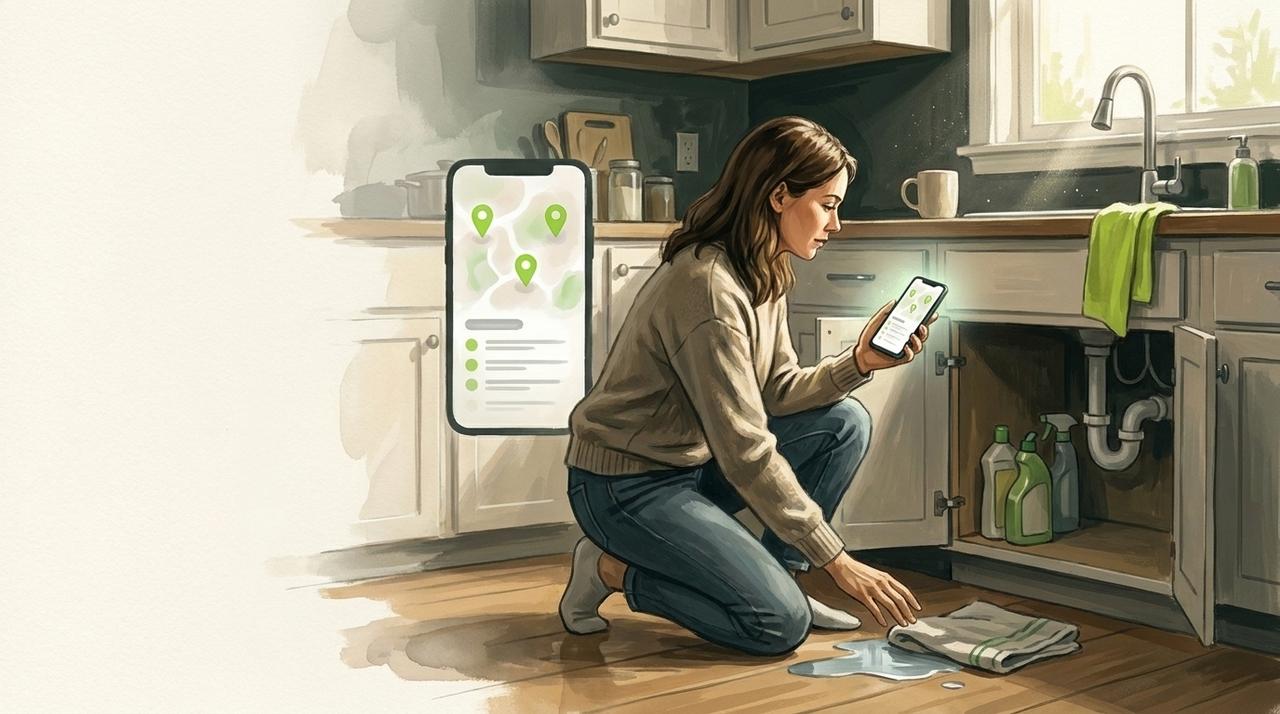
Picture a homeowner in Denver at two in the morning, standing on the bottom step of his basement stairs while a copper pipe drips into a growing puddle. He types "plumber" into Google Maps. Whoever comes up first gets the call. He isn't comparing websites. He's comparing three names, three star ratings and how fast someone can be at his door.
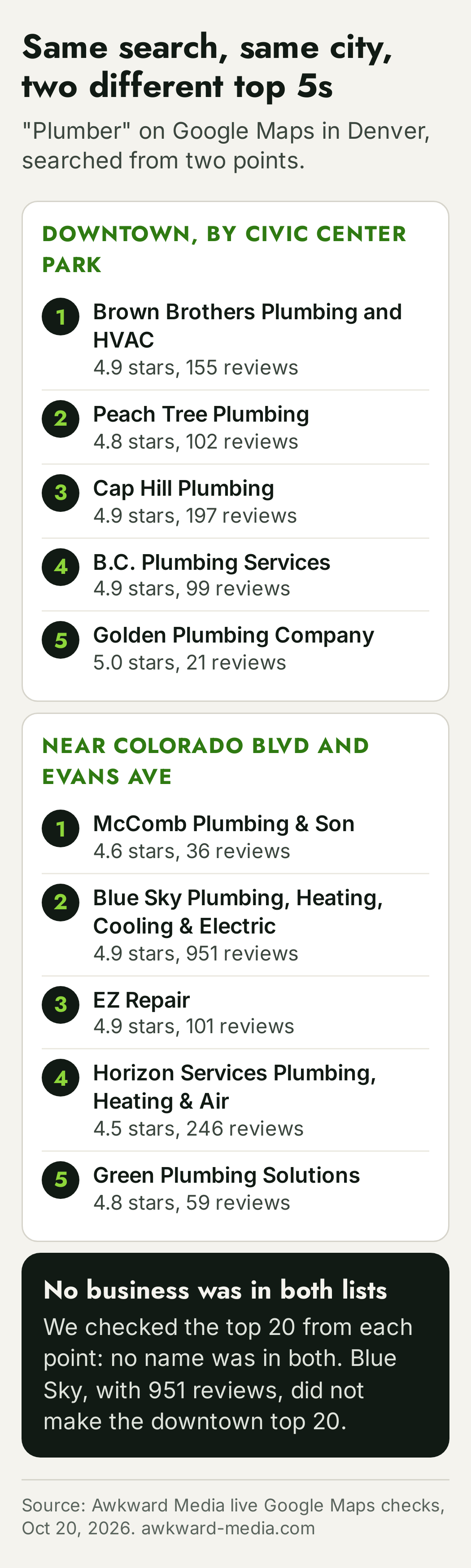
Which three names he sees depends on where he is standing. On October 20, 2026, we ran that exact search, "plumber", from two points in Denver about five miles apart: one downtown by Civic Center Park, one near Colorado Boulevard and Evans Avenue. The two top fives had nothing in common. Not one business made the top 20 from both spots. Blue Sky Plumbing, Heating, Cooling & Electric, with 951 Google reviews, was second near Evans Avenue and missing from the downtown top 20 entirely. Downtown, a plumber with 21 reviews sat fifth.
That is the first thing to understand about ranking higher on Google Maps. There is no single "rank". There is a rank on every street. The work is to make your business the obvious answer on as many of those streets as possible, for as many of the things you do as possible. This guide explains how that works, in plain words, for owners who have never had to think about it. Everything a reader could click or check was checked live in October 2026.
The short answer: how to rank higher on Google Maps
Google ranks local businesses on three things: how well your business matches the search (relevance), how far you are from the person searching (distance), and how well known you are (Google calls it prominence). You can't move your building, so the work goes into the other two. In practice, ranking higher on Google Maps comes down to five jobs:
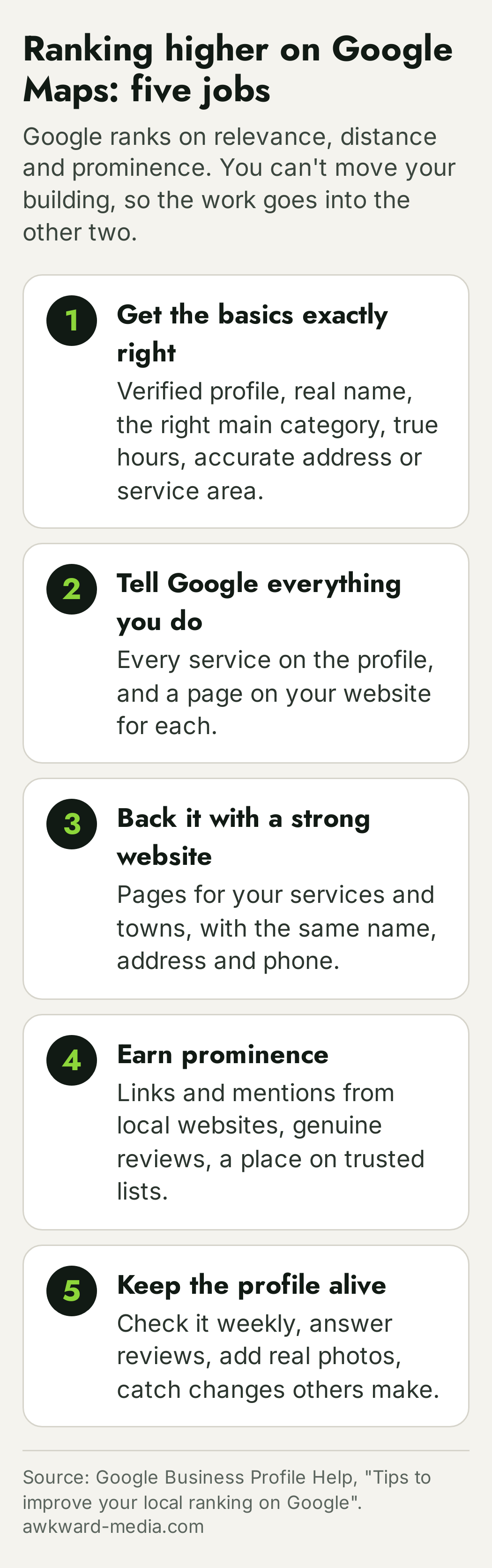
- Get the basics exactly right: a verified Google Business Profile with your real name, the right main category, true hours and an accurate address or service area.
- Tell Google everything you do: every service listed on the profile, and a page on your website for each one.
- Back the profile with a strong website: pages for the services and towns you want to be found for, with the same name, address and phone number as your profile.
- Earn prominence: links and mentions from other local websites, a steady flow of genuine reviews, and a place on the lists people trust.
- Keep the profile alive: check it weekly, answer reviews, add real photos, and catch the changes Google and the public make to your listing.
The rest of this guide takes each of those in turn, shows the evidence behind it, and covers what to do if your business isn't showing up at all.
What Google itself says decides the map
Google publishes one page on this, in its Business Profile help centre, titled "Tips to improve your local ranking on Google". It is short, and two lines on it matter more than the rest.
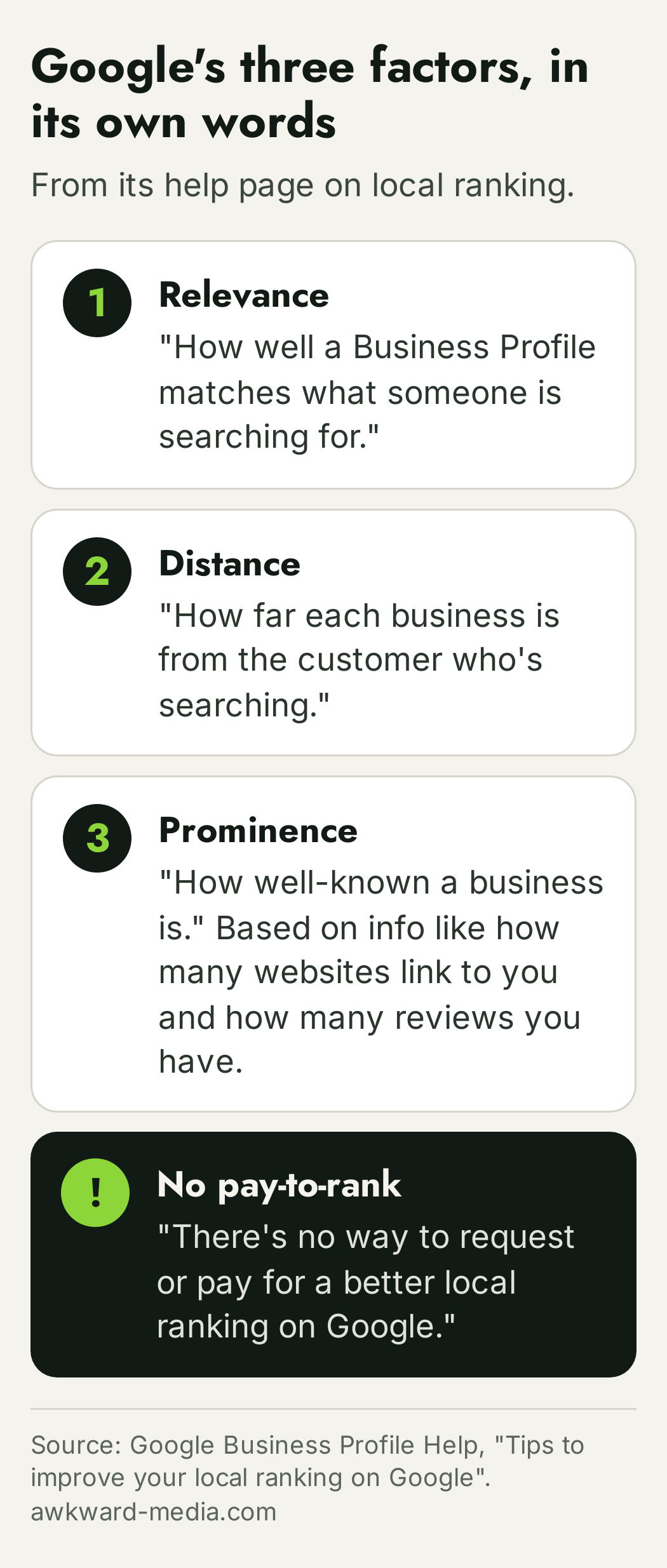
The first: "There's no way to request or pay for a better local ranking on Google." Anyone who offers to buy you a spot on the map is selling something Google says does not exist. Paid ads can appear above the map results, marked "Sponsored", but they are ads, and they disappear when the budget does.
The second: "Local results are mainly based on relevance, distance, and popularity." The page then explains each one under the headings Relevance, Distance and Prominence:
- Relevance is "how well a Business Profile matches what someone is searching for." Google's advice is to "provide complete and detailed business info."
- Distance is "how far each business is from the customer who's searching."
- Prominence "means how well-known a business is," and is "based on info like how many websites link to your business and how many reviews you have."
Notice what is on that last list. Links from other websites come first. Reviews come second. Google also says elsewhere on the page that "more reviews and positive ratings can help your business's local ranking." Reviews matter. They are one input among several, and they are the one owners can see and count, which is why they get talked about more than the others. The Denver search above is the reminder: the plumber with 951 reviews didn't make the downtown list at all.
Distance: the factor you can't change, and why your rank moves across town
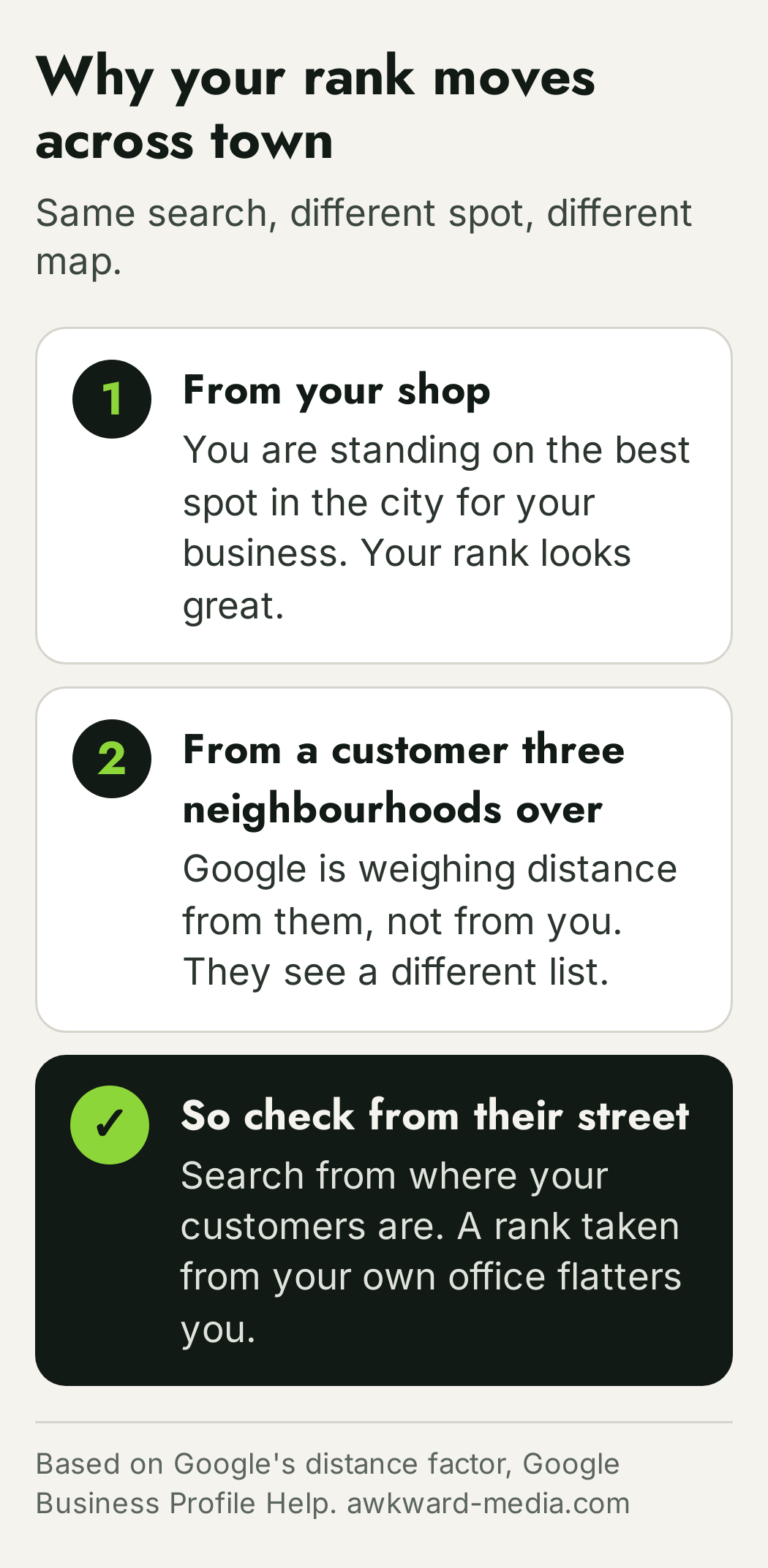
Distance explains the Denver result, and most of the confusion owners have about their own ranking. When you search your trade from your shop, you are standing on the best spot in the city for your business. A customer three neighbourhoods over sees a different map. That's why an owner can honestly say "we're number one on Google Maps" while a customer across town can't find them.
A few things follow from this:
- Check your ranking from where your customers are, not from your desk. A rank taken from your own office flatters you.
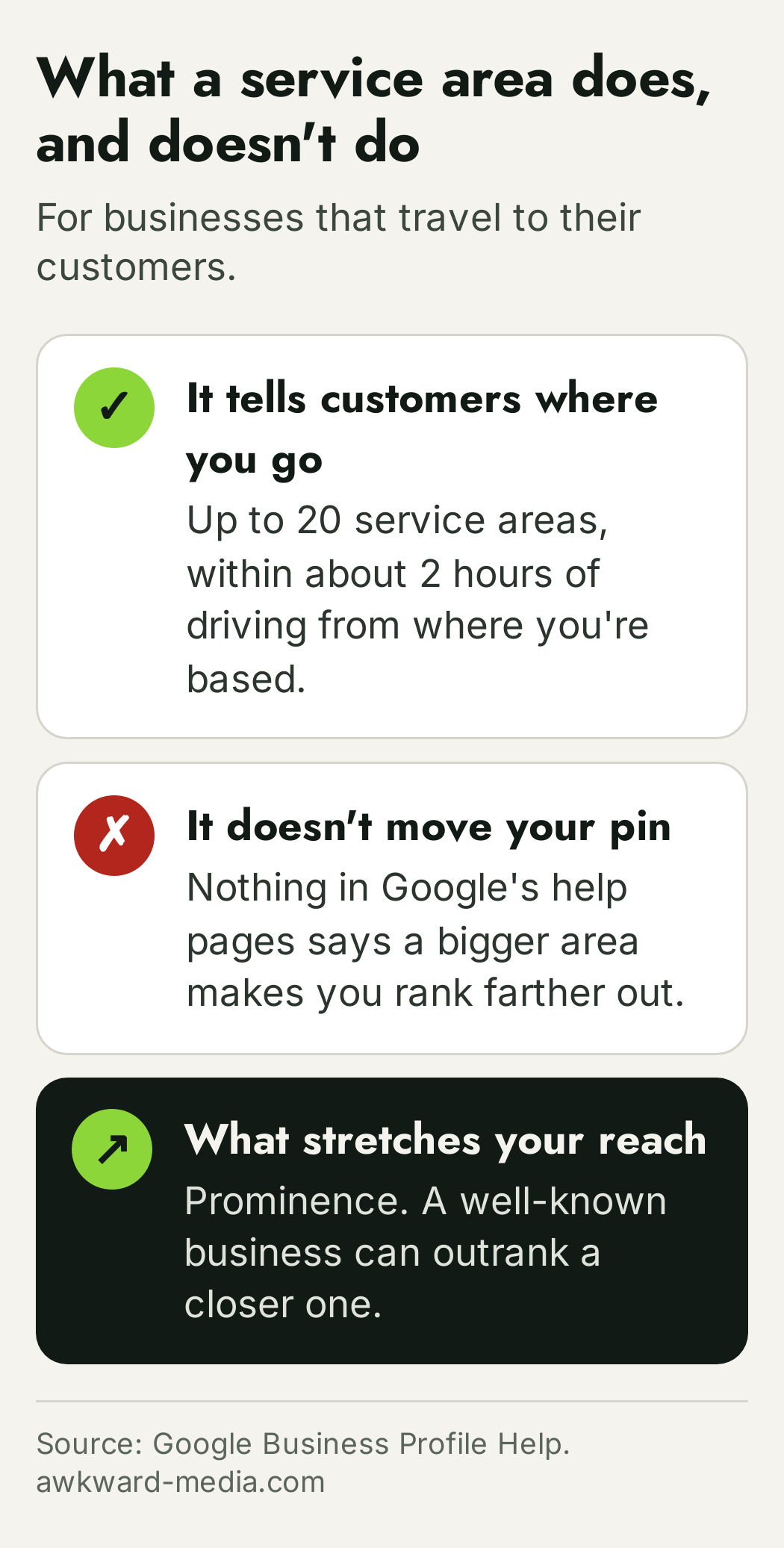
- Your service area doesn't move your pin. Google lets a business that travels to customers list up to 20 service areas, and asks that the whole area stay within "about 2 hours of driving time" from where the business is based (Google Business Profile Help). Nothing in Google's help pages says a bigger service area makes you rank farther out. It tells customers where you go.
- Prominence is what stretches your reach. Among businesses that match a search, a well-known business can outrank a closer one. That's the lever behind ranking five, twenty or fifty miles from your address, and the reason the rest of this guide spends so much time on it.
Specialists measure this with a "grid": the same search run from dozens of points laid over a map, each point showing where the business ranked from there. You'll see one further down. It turns "where do we rank?" into a picture of exactly which streets you win and which you don't.
What 47 local search experts rank highest
Google doesn't publish its formula. The closest thing to a public consensus is the Local Search Ranking Factors survey, started in 2008 and run since 2017 by Darren Shaw of Whitespark, an Edmonton local search firm. For the 2026 edition, published November 6, 2025, 47 specialists who rank businesses for a living scored 187 possible factors. These are expert judgements, not Google data, but they are the judgements of people who watch maps move every day.
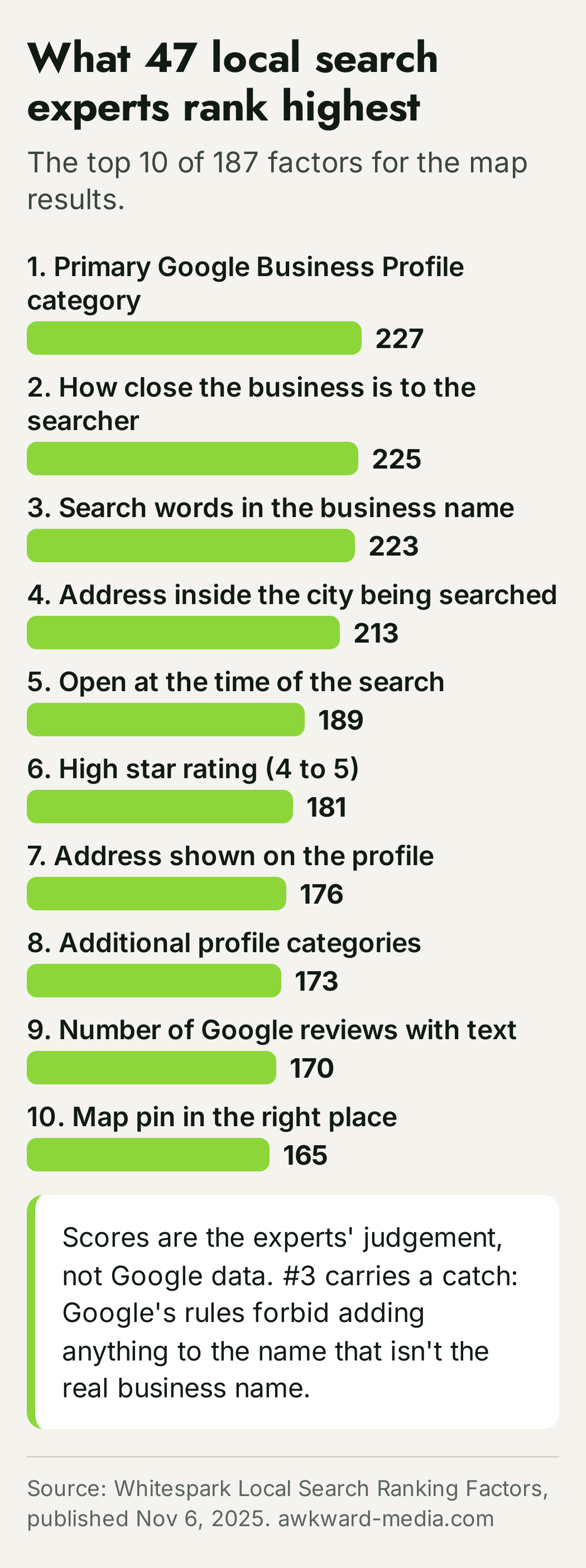
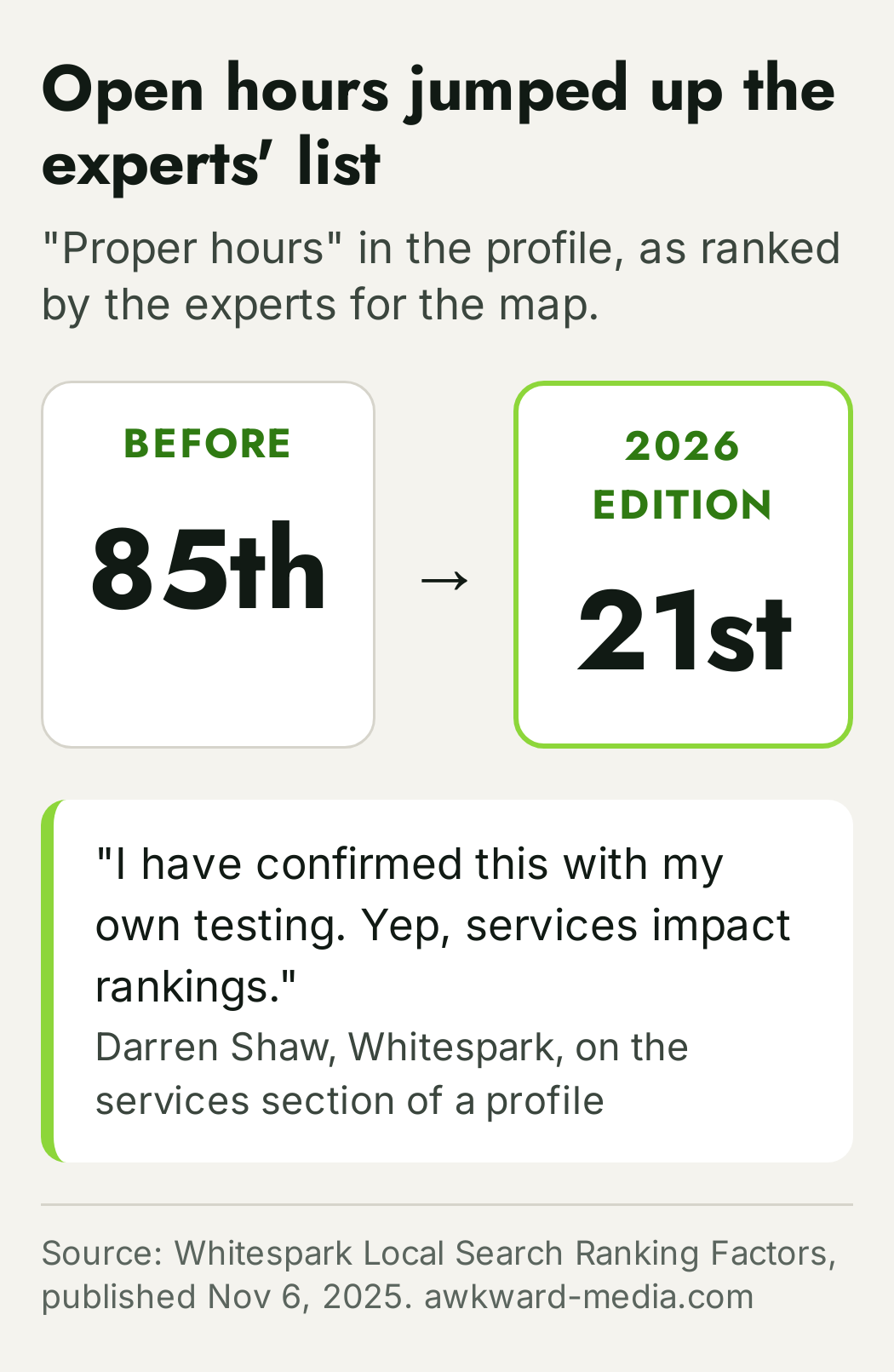
Three things stand out. The single most important factor in the experts' view is your primary category, the one line on your profile that tells Google what kind of business you are. Second is distance, which you already know you can't change. And fifth, new to the survey this edition, is whether your business is open at the time of the search. Shaw writes that proper hours on the profile rose 64 places in the ranking, from 85th to 21st, and that the services section of a profile now clearly affects rankings: "I have confirmed this with my own testing. Yep, services impact rankings."
Number three needs a warning, and we come back to it below: keywords in the business name help rankings, and Google's rules forbid adding them.
Step 1: Get the foundations exactly right
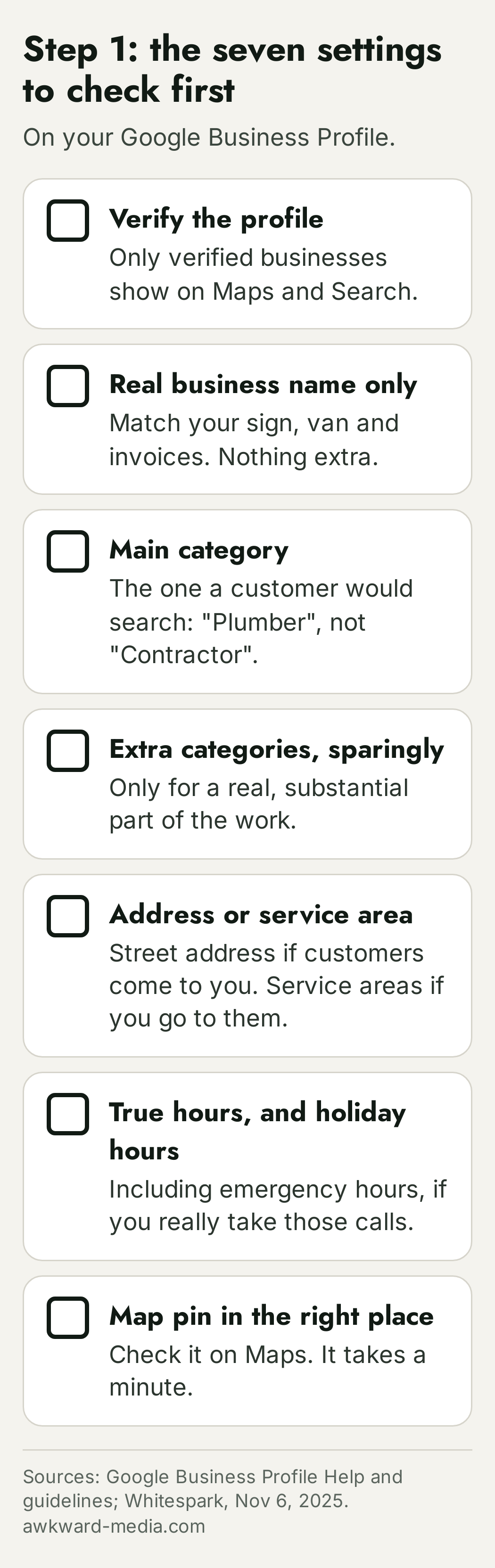
Most of the top ten factors live on your Google Business Profile, the free listing that powers your spot on Maps and in the map box on Google search. If you haven't claimed yours, start at google.com/business. If you have, these are the settings to check first.
Verify the profile
Only verified businesses show their information on Maps and Search, Google says. Google picks the verification method for you: phone or text, email, a live video call or mail. Reviews "take up to 5 business days" after you finish (Google).
Use your real business name, and nothing else
Your name on Google should match your sign, your van and your invoices. Google's guidelines are blunt: "Including unnecessary information in your business name isn't permitted, and could result in the suspension of your Business Profile" (Google guidelines).
Choose the main category carefully
Pick the one category that describes your core business as a customer would search for it: "Plumber", not "Contractor", if plumbing is what you sell. It is the single strongest signal on the profile in the experts' scoring.
Add extra categories sparingly
Google asks owners to "choose the fewest number of categories it takes to describe your overall core business." Add a second or third only when it is a real, substantial part of the work, such as "Water heater installation service" for a plumber who does a lot of them.
Get the address or service area right
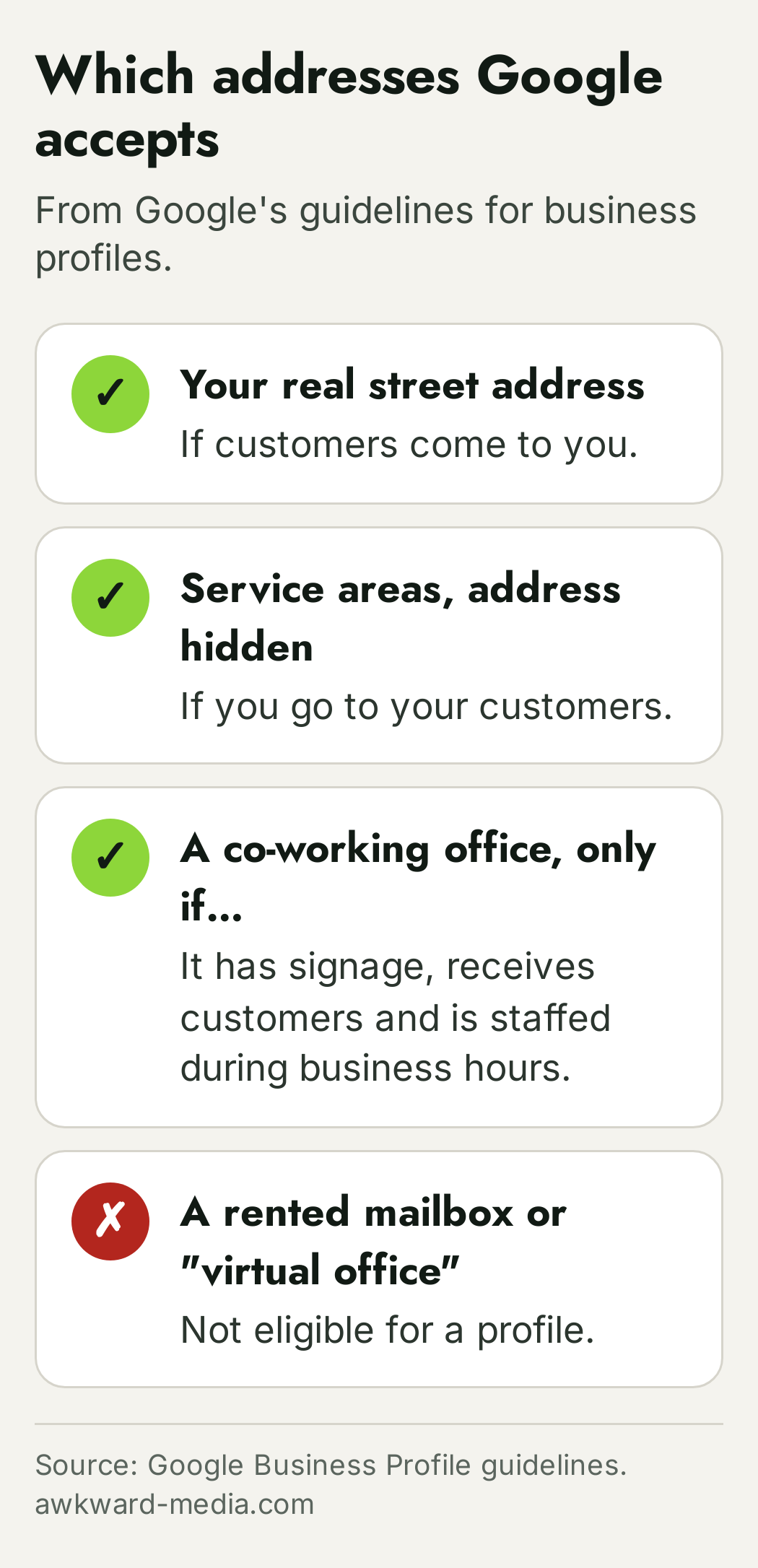
If customers come to you, show the real street address. If you go to them, hide the address and set service areas. A rented mailbox or "virtual office" isn't eligible for a profile, and an office in a co-working space only counts if it has signage, receives customers and is staffed during business hours (Google guidelines).
Set true hours, and holiday hours
If your profile says you're closed, Google is less likely to show you to someone searching right now. If you take emergency calls overnight, say so. If you don't, don't pretend: a customer who calls at 2 a.m. and gets voicemail leaves a review about it.
Put the map pin in the right place
Open your profile on Maps and look at where the pin sits. If it's on the wrong side of the block or in a field behind the building, move it. It is number ten on the experts' list, and it takes a minute.
Step 2: Tell Google everything you do
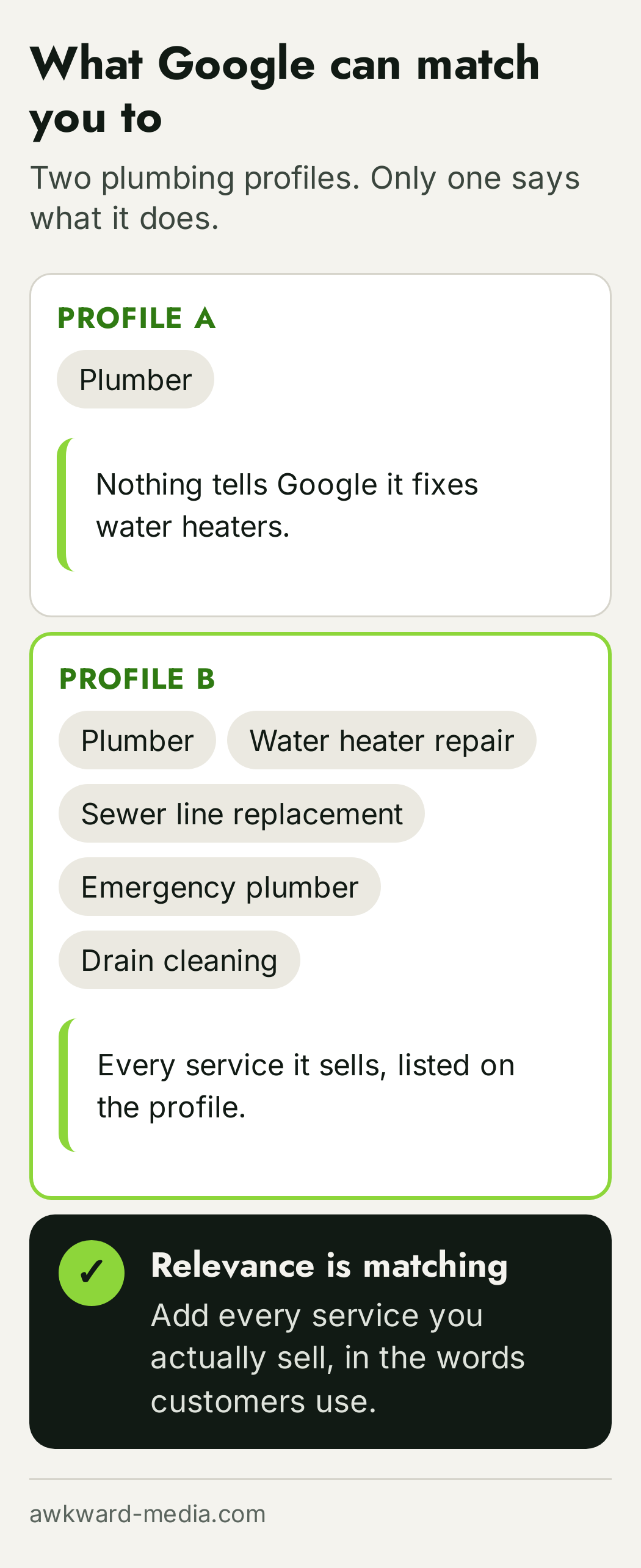
Relevance is about matching. A plumber whose profile only says "Plumber" will struggle to show up for "water heater repair", "sewer line replacement" or "emergency plumber", because nothing on the profile tells Google they do those things.
Fill in the services list
Your profile has a services section. Add every service you actually sell, using Google's suggested names where they fit and your own where they don't. This is the change Shaw says he has confirmed in his own testing.
Write a plain description
Say what you do, where you do it and who for, in the words customers use. Skip slogans. A description is not a place to repeat your city name ten times.
Add real photos, regularly
Photos of real jobs, your crew and your vans tell customers you exist and do the work. The experts list "geo-tagged photos", the old trick of hiding location data inside image files, as the top myth of 2026: it doesn't help.
List products if you sell them in store
Retailers in eligible countries can show in-store products on their profile, and Google says they "might show in local search results" (Google).
This is the work our Google Business Profile optimization service does for clients, field by field.
Step 3: Back the profile with a website that says the same thing
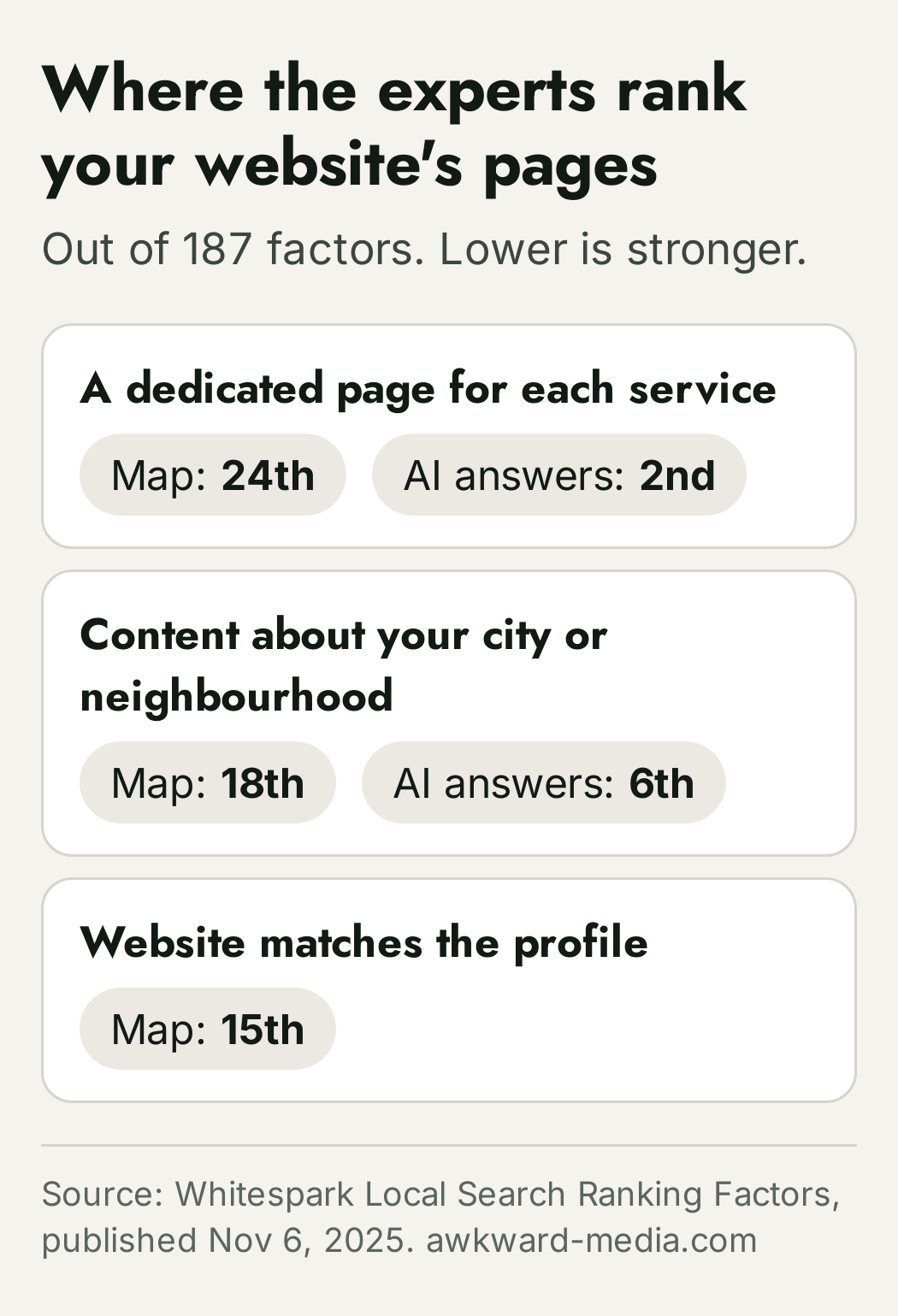
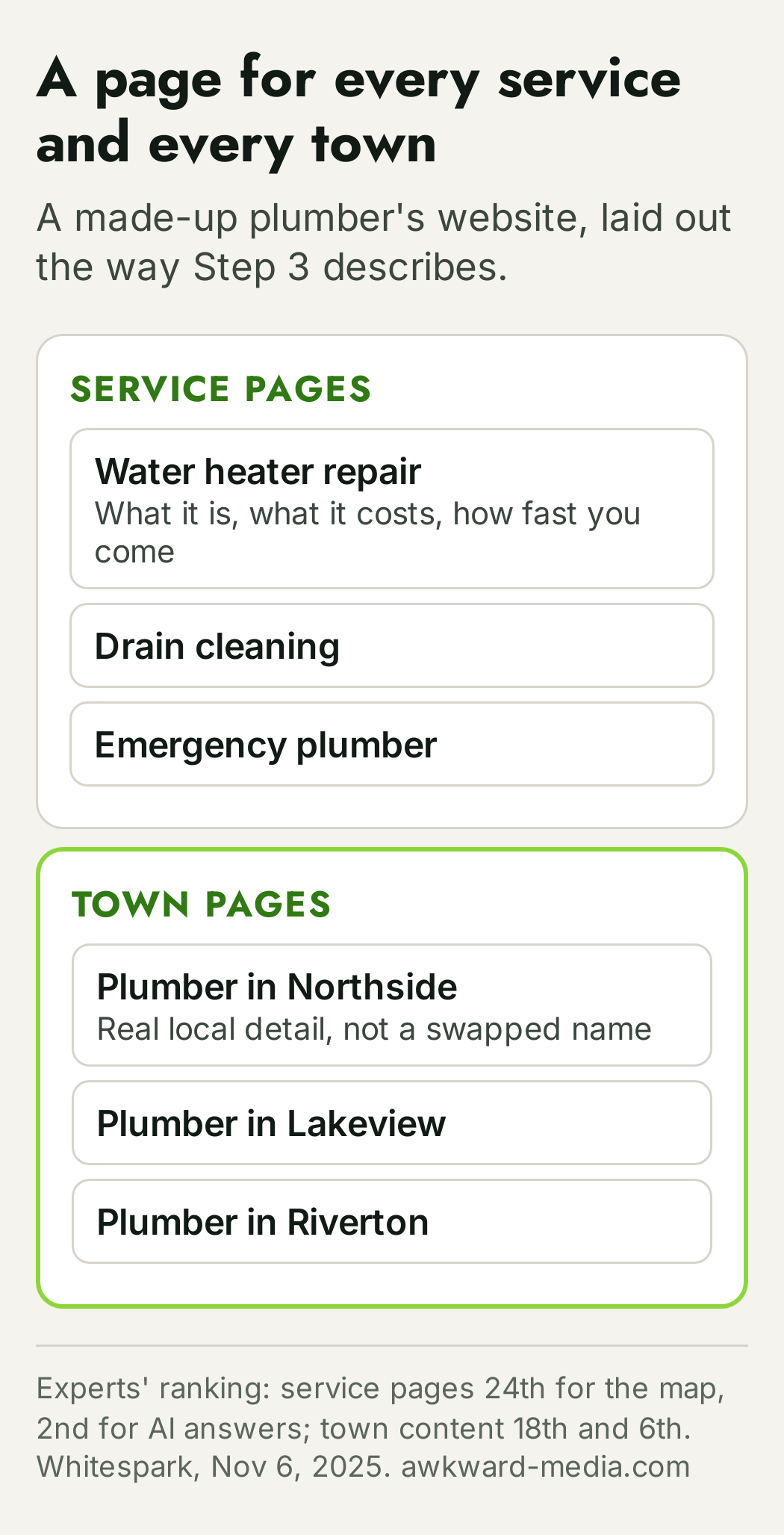
Your profile links to your website, and Google reads both. A profile that says "water heater repair" pointing to a website that never mentions water heaters is a weaker match than one pointing to a page about exactly that. In Whitespark's survey, a dedicated page for each service ranked 24th for the map and second for showing up in AI answers.
One page per service
Each main service gets its own page that explains it properly: what it is, what it costs or how pricing works, how fast you come, the questions customers ask. This is ordinary, valuable website work, the same on-page SEO and content writing that helps you rank in Google's regular results too. Done well, it now pays off in more places: the map, the regular results and the AI answers. For lawyers, the same idea means one page for each practice area, which our law firm SEO guide walks through step by step.
Pages for the towns you serve
If you serve several towns, a page for each, with real local detail, gives Google a reason to connect you to them. The experts scored the "city or neighbourhood relevance of your content" 18th for the map and 6th for AI answers. A page that only swaps the town name is not that.
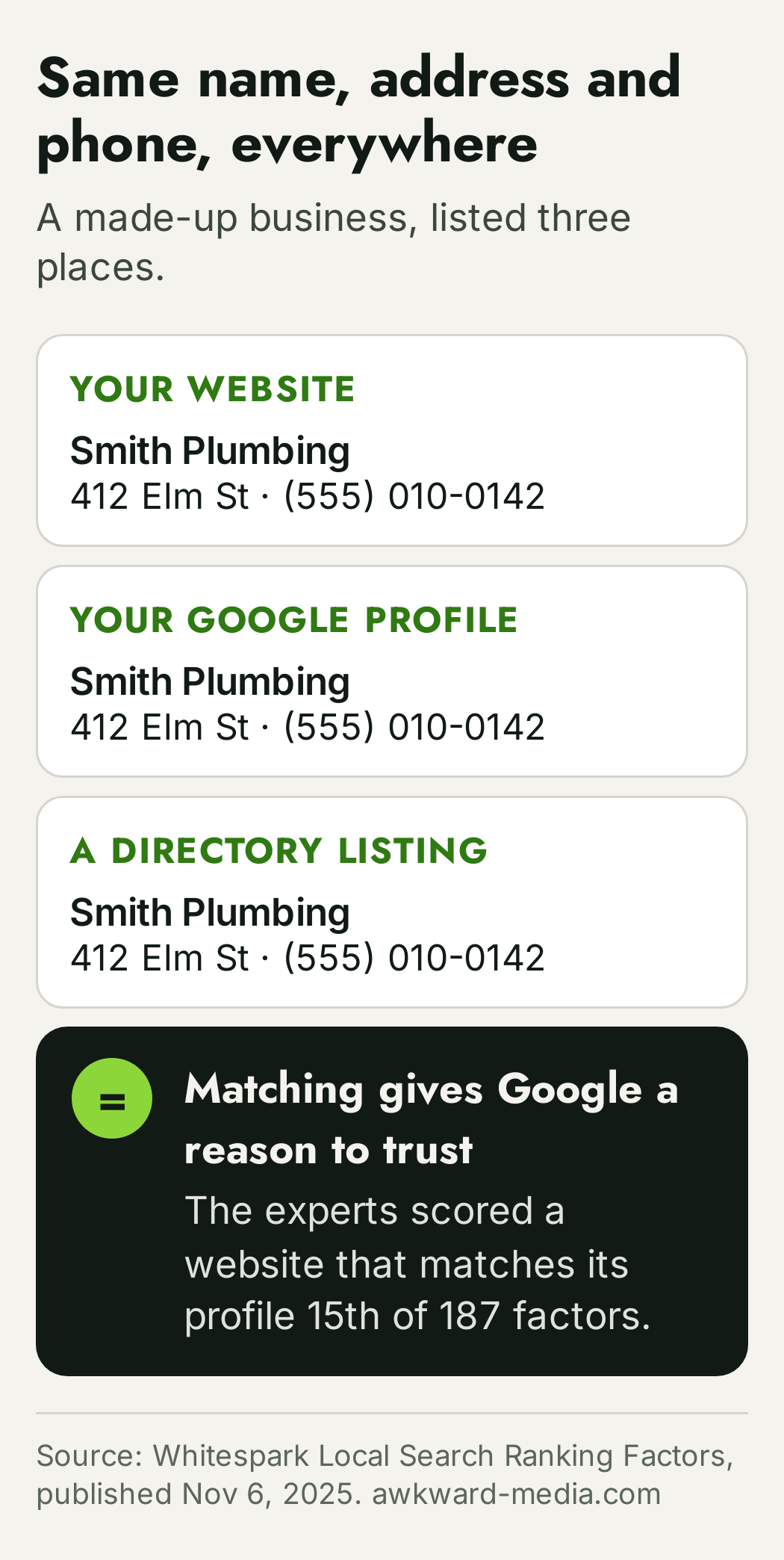
Same name, address and phone everywhere
Your website, your profile and the directories that list you should show the same business name, address and phone number. When they disagree, Google has less reason to trust any of them. Specialists call this NAP matching (name, address, phone), and the experts scored a website that matches its profile 15th.
A site that loads fast and works on a phone
A customer searching from a phone won't wait for a slow site, and a broken page loses them after the click you worked to earn. Our technical SEO work covers this side.
All of this together is what we mean by local SEO. Our step-by-step guide to local SEO for small business goes through the website side in more detail.
Step 4: Earn prominence, which is more than reviews
Prominence is how well-known you are, online and off. Google names links and reviews as examples. The experts add mentions in local news and on industry sites, listings on trusted directories, and how often people search for your business by name. Reviews are the part everyone can see, so here is the honest version of how they fit.
Reviews: one readable signal among many
We use review counts in our own audits because they are public and countable, which makes them a handy way to compare a business with the three ahead of it. They are not the whole picture. Look at this business we've worked with, on Google Maps for "Funeral Cremation":
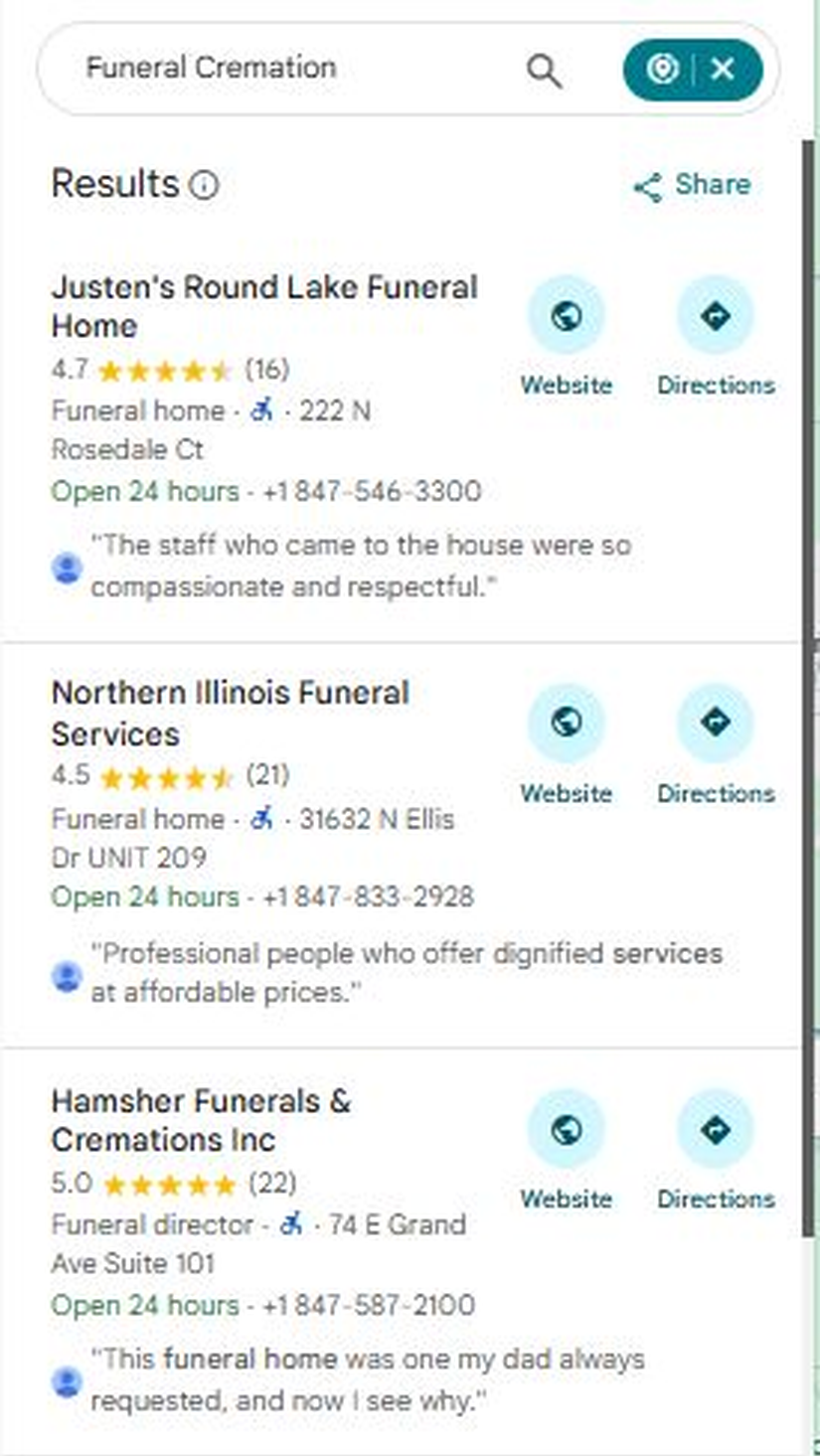
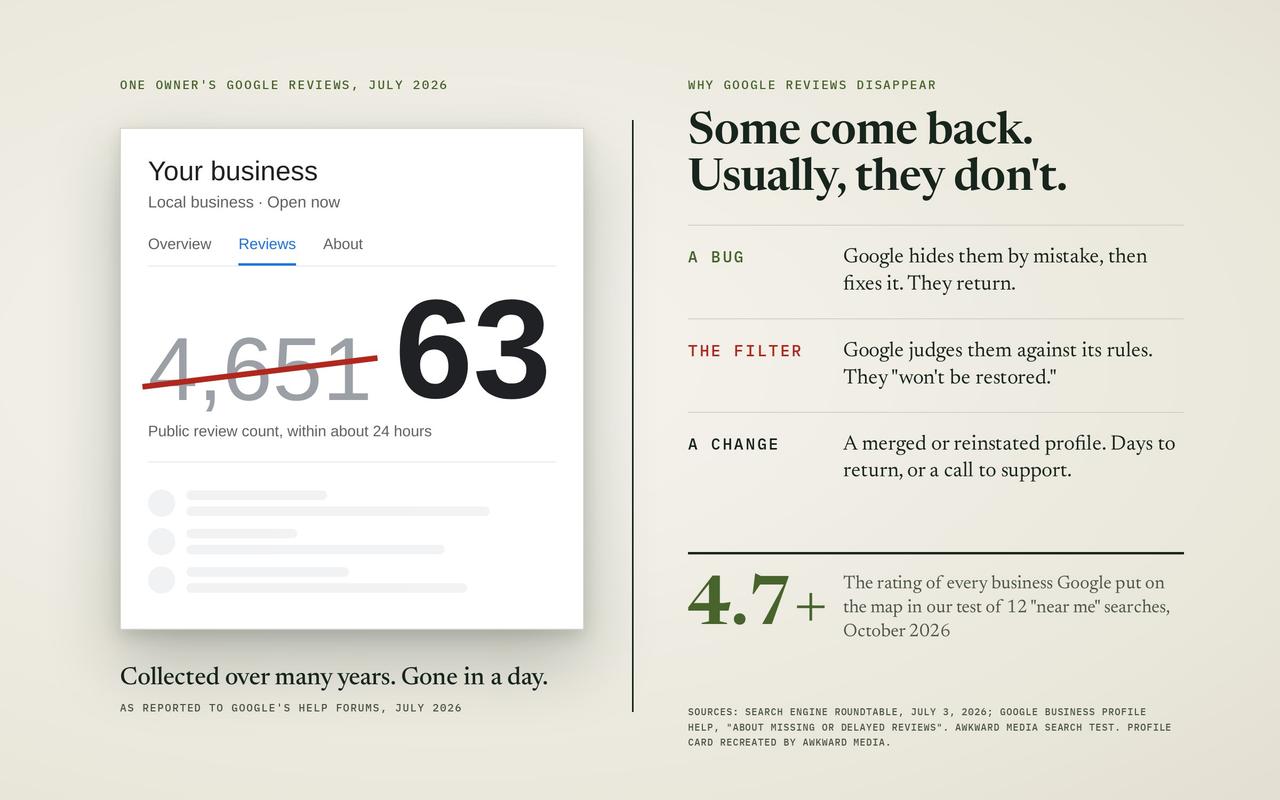
Justen's Round Lake Funeral Home is first with 16 reviews, ahead of two funeral homes with more reviews, one of them rated a perfect 5.0. Reviews didn't put them there on their own. Getting more genuine reviews is still worth doing, steadily rather than in bursts: the experts rank "sustained influx of reviews over time" 14th. Google's own advice is to send customers a review link or QR code and reply to them personally. It also warns that offering anything in exchange for a review breaks its policy (Google). Our pieces on why Google reviews disappear and what to do about a bad review you can't remove cover the rest.
Links and mentions from local websites
A link from your city's chamber of commerce, a local news story, a supplier's "where to buy" page or a sponsorship of the youth soccer league is evidence that you are a real, known business in that place. Google puts links first in its own description of prominence. This is slow, unglamorous work, and it is a big part of why one business reaches farther across town than another. It is what our link building and off-page SEO services do.
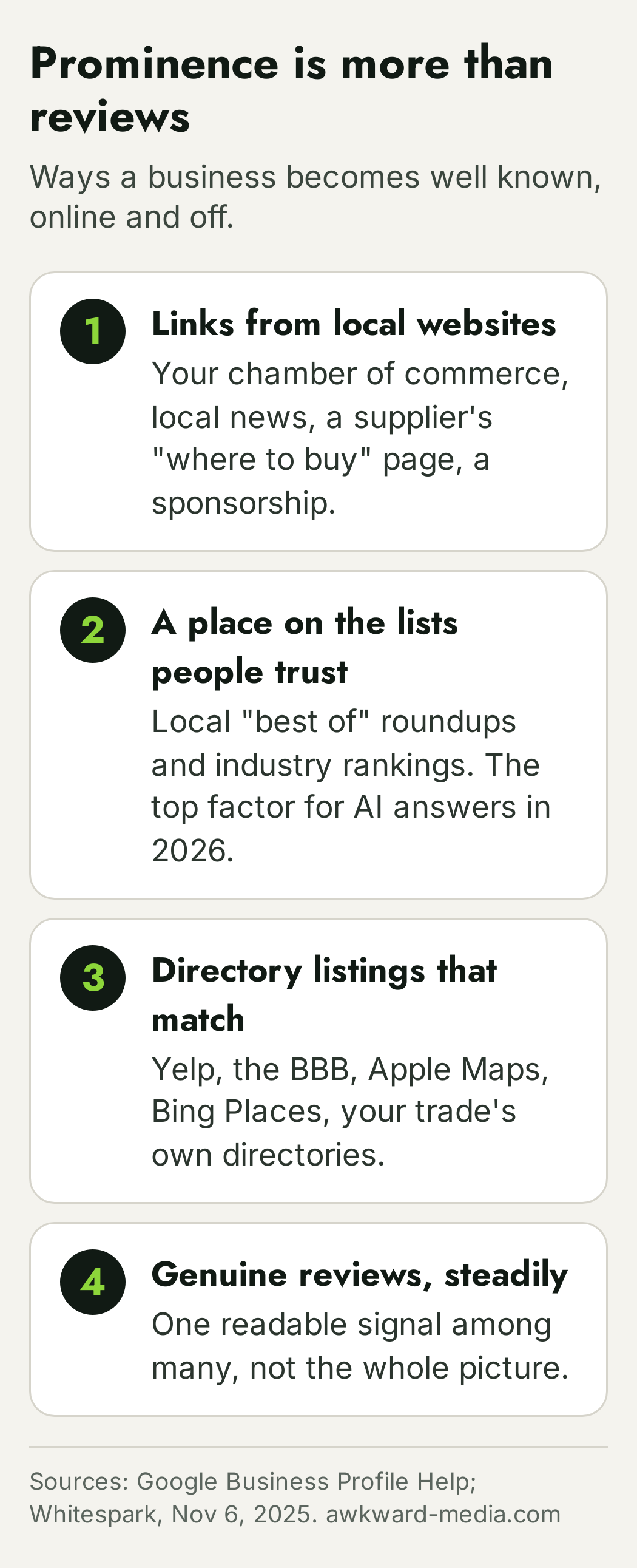
A place on the lists people trust
The single highest-rated factor for showing up in AI answers, in the 2026 survey, was being on "expert curated best of and similar lists": the local "best plumbers in Denver" roundups and industry rankings that AI assistants read and repeat. They are also mentions on other websites, the kind of prominence Google describes.
Directory listings that match
Yelp, the Better Business Bureau, Apple Maps, Bing Places and your trade's own directories. They matter less than they used to in the experts' scoring, but a wrong phone number on a big directory still sends calls to nowhere.
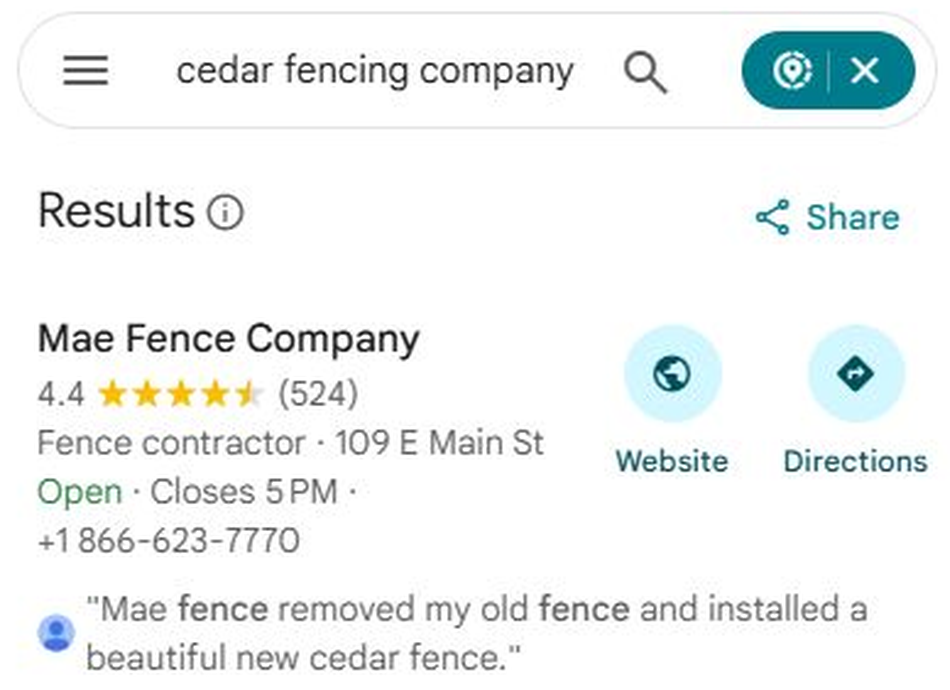
Here is what prominence looks like when it works. Mae Fence Company is a fence contractor. In August 2026, 20 days into our work with their Fulton location, we searched "cedar fencing company" from a point 20 miles away. Before we started, they didn't show up for that search at all. This time they came up first on Google Maps.
Step 5: Keep the profile alive
A Google Business Profile is not a form you fill in once. Google and the public can change it, and customers judge it by how current it looks.
Watch for changes you didn't make
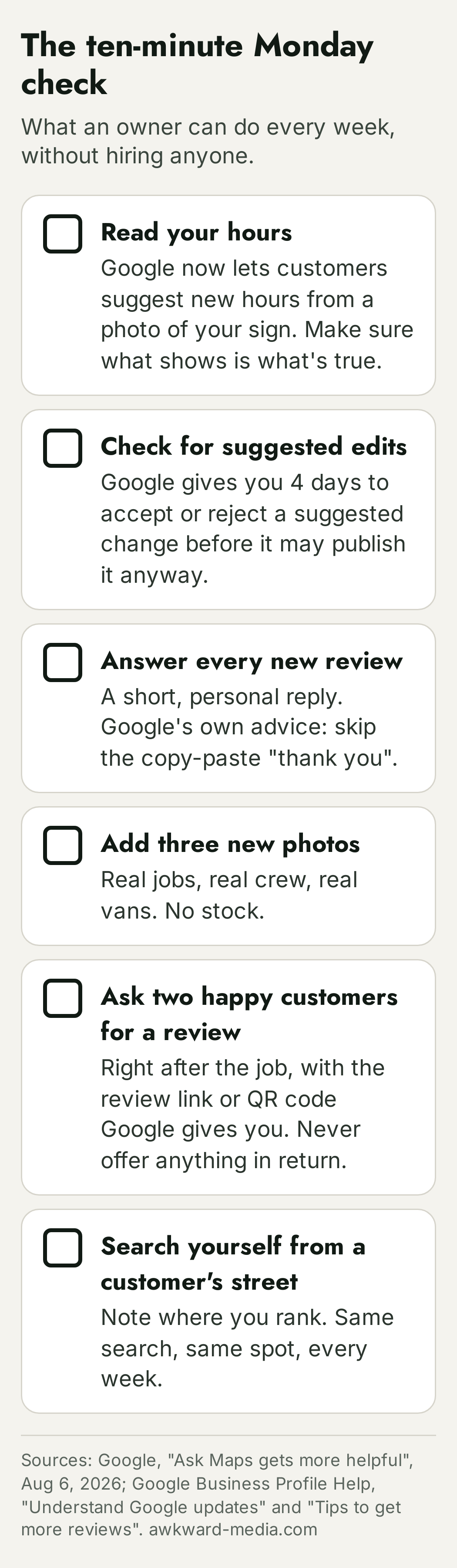
Google collects information about your business from users and other sources and may update your profile. When a suggested change needs your review, Google says you have 4 days to accept or reject it. "If you don't respond within 4 days, Google may automatically publish the update" (Google). In August 2026 Google added a way for people to suggest new hours by uploading a photo of a storefront sign, in the US (Google). Hours sit near the top of the experts' list. Check them.
Reply to every review
Google's advice is to keep replies short, personal and specific, and to skip the identical "thank you" for everyone. Replies are public. Future customers read them.
Expect edits to take time
Google says edits to a profile "usually take up to 10 minutes to review, but sometimes it can take up to 30 days" (Google), and that changes can take up to 3 days to show in search results. Make one change, wait, and check, rather than rewriting the whole profile at once.
Here's the routine we'd hand any owner who wants to do this themselves:
What doesn't work, and what gets you suspended
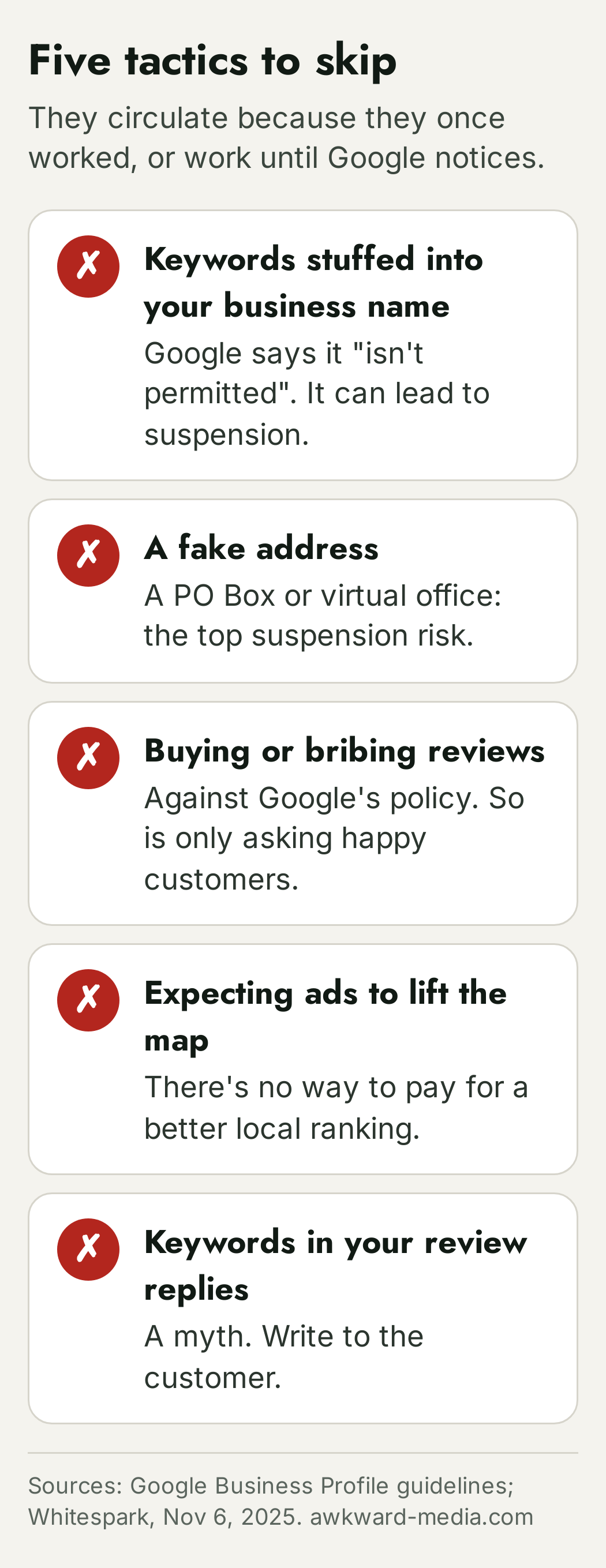
Some tactics still circulate because they once worked, or because they work until Google notices. These are the ones to avoid.
Stuffing keywords into your business name
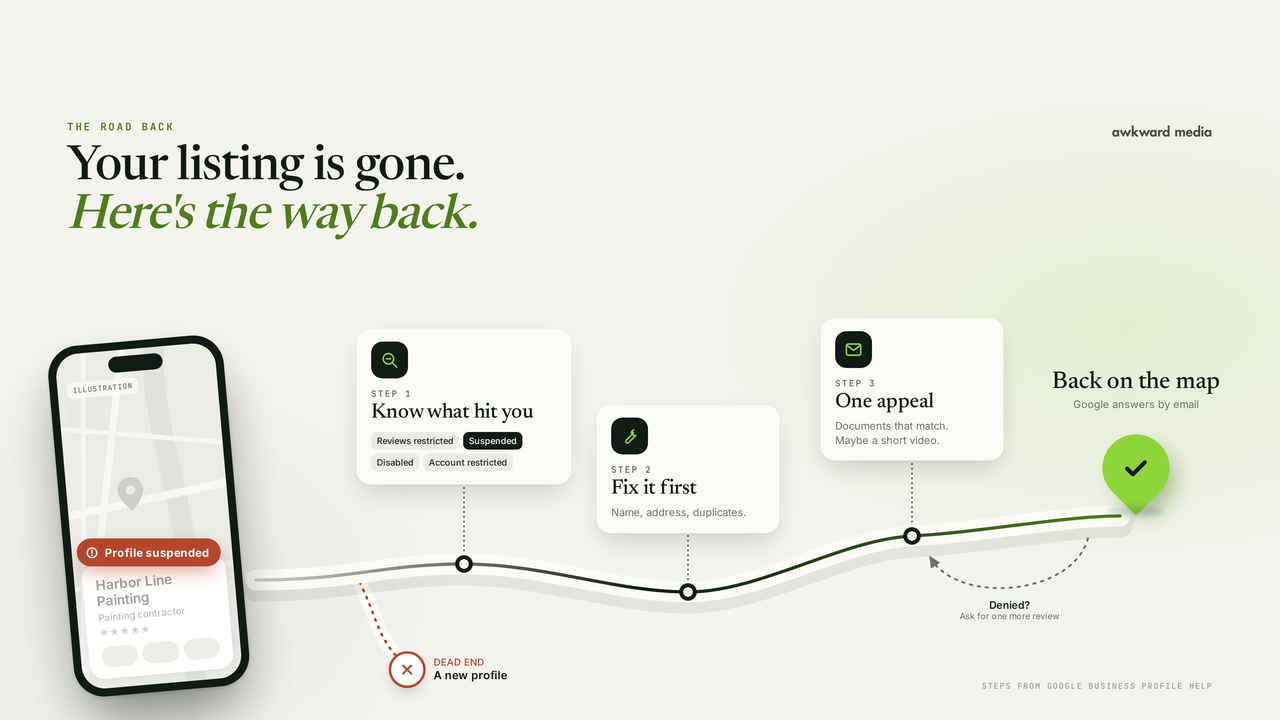
"Smith Plumbing" renamed "Smith Plumbing Emergency Plumber Denver 24/7" may climb for a while. The experts rank keywords in the name third. Google's guidelines say it "isn't permitted" and can lead to suspension. The climb isn't worth the fall. If it has already happened to you, our guide to getting a suspended profile back explains the appeal.
A fake address
The top suspension risk in Whitespark's survey is an address that is "a PO Box, UPS Mail Store, Virtual Office, or Other False Address". A second profile for the same business at a different address is the same problem.
Buying or bribing reviews
Google says offering "free or discounted goods or services" for reviews violates its policy. Reports of "review gating", only asking happy customers to review, are also on the experts' suspension list.
Expecting ads to lift the map
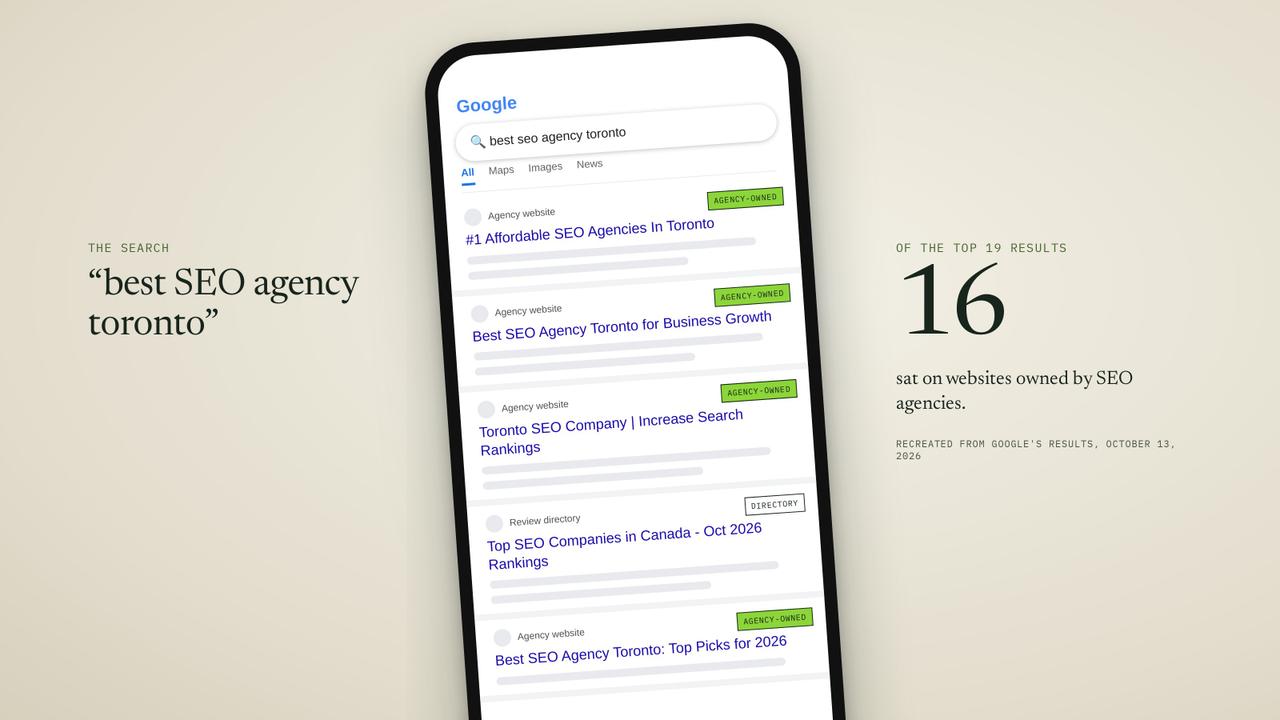
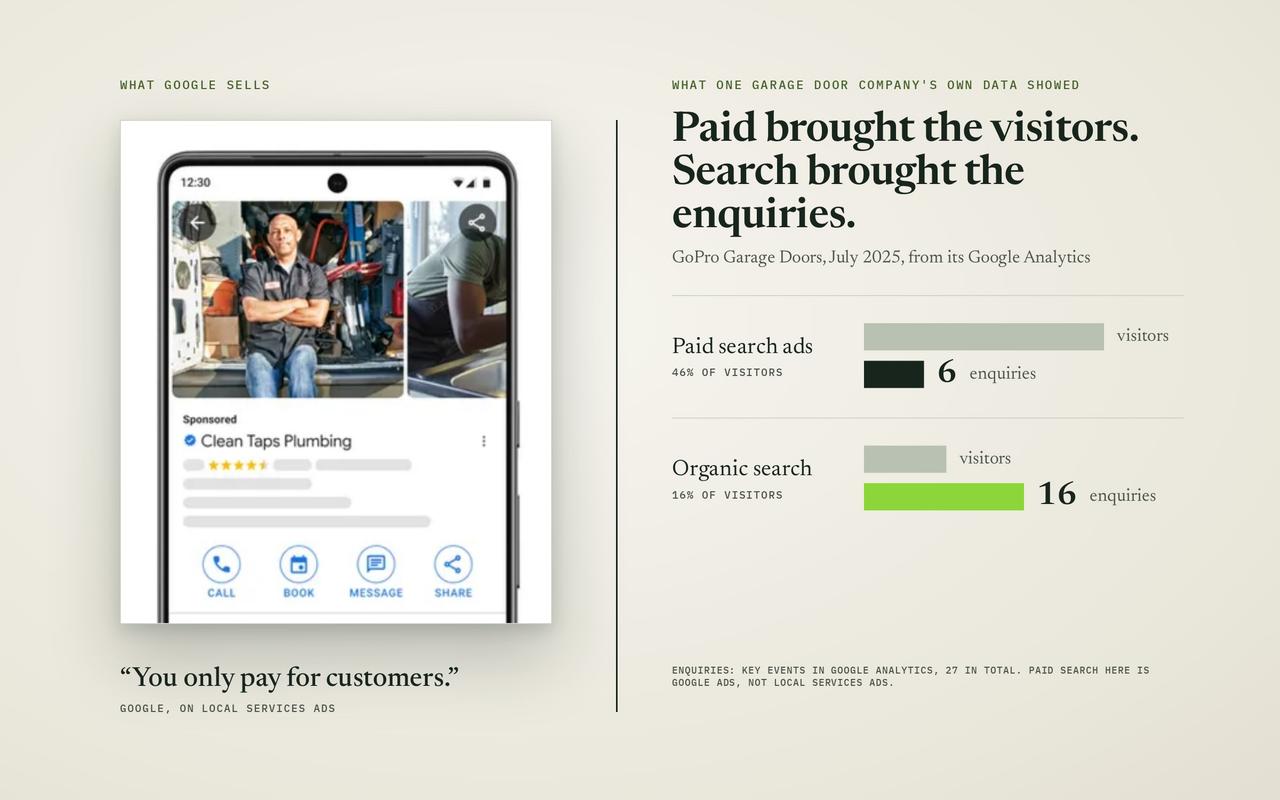
Google says there's no way to pay for a better local ranking, and the experts rank "participation in AdWords or other paid Google products" among the myths. Ads and Local Services Ads have their place, and our comparison of Local Services Ads and SEO explains when. They don't change where your profile ranks underneath them.
Keywords in your review replies
Writing "thanks for choosing us for your Denver water heater repair" in every reply is another myth in the 2026 survey. Write to the customer, not to Google.
Why your business isn't showing up on Google Maps
If you can't find your business at all, ranking higher is the second problem. The first is finding out which kind of missing you are. Run these three tests in order, on your phone.
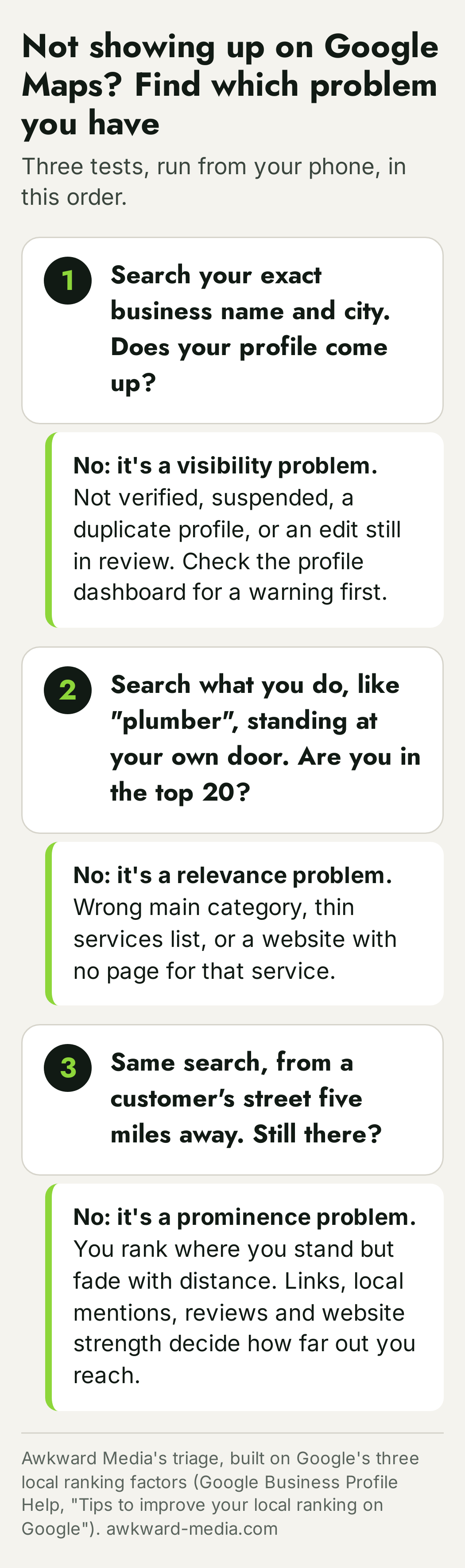
You haven't verified, or verification is still in review
"Only verified businesses can show their business info on Maps and Search," Google says (Google). Check the profile for a "Get verified" button.
The profile is suspended or disabled
A suspended profile "won't show to other users on Google until you resolve the issue". Google sends a notice to the account that manages the profile. The appeal is done once, with evidence such as a business licence or a utility bill whose name and address match the profile (Google).
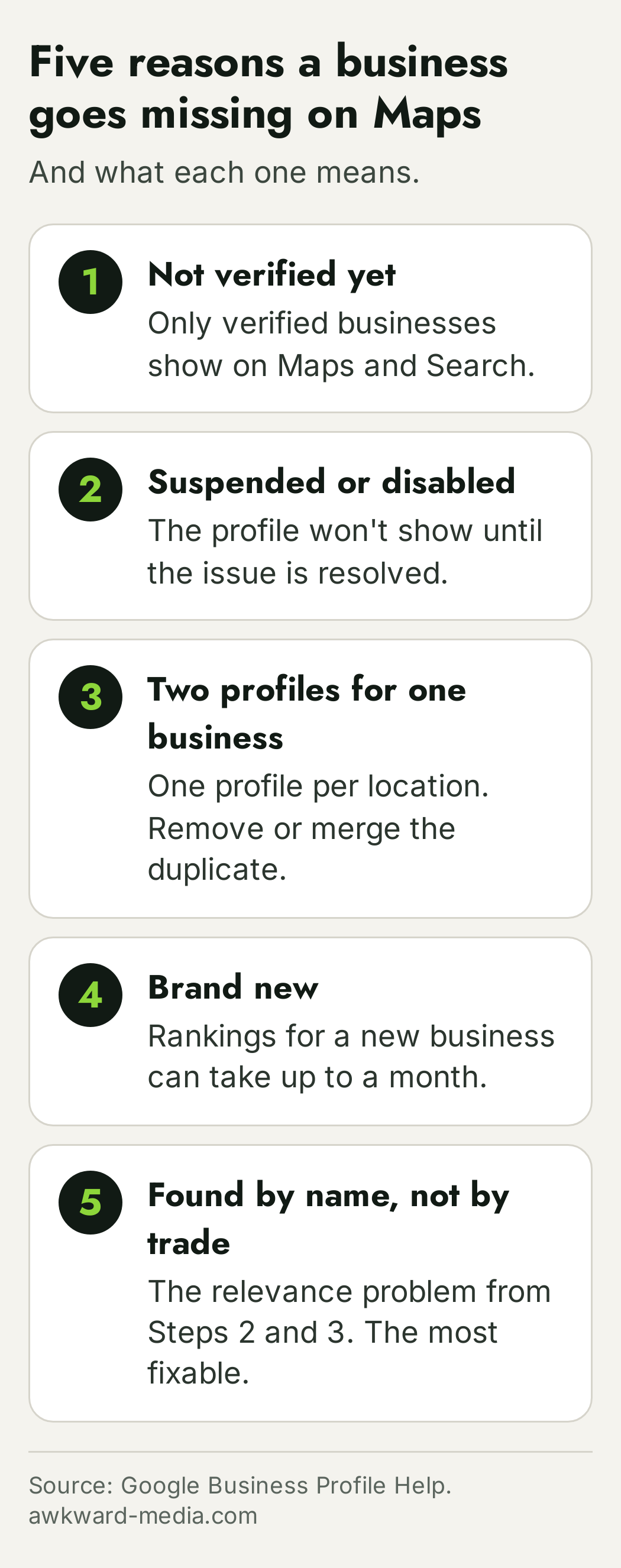
There are two profiles for one business
Google allows one profile per location and says duplicates "can cause problems with how your information displays on Google Maps and Search." A duplicate created by a former employee or an old agency is common. Remove or merge it.
The business is new
Google says "rankings for new businesses can take up to a month to appear in search results." If you verified last week, wait before you change anything.
You show up for your name, but not for your trade
That's the relevance problem from Step 2 and Step 3: the wrong main category, an empty services list, or a website with no page for the thing people search. It is the most common case we see, and the most fixable.
How long it takes to rank higher on Google Maps
Google publishes its own waiting times for the steps it controls. They're worth knowing, because the most common mistake is changing things again before the last change has had time to show.
| What happens | How long Google says it takes, and where |
|---|---|
| Verification review | Up to 5 business days Source: Verify your business |
| Review of an edit to your profile | Usually up to 10 minutes, sometimes up to 30 days Source: Business Profile edits |
| An edit showing up in search results | Up to 3 days Source: Find your business |
| Service area changes showing | Up to 48 hours, if approved Source: Service areas |
| Rankings for a new business | Up to a month Source: Find your business |
| Your window to reject a change suggested by Google or the public | 4 days, then Google may publish it Source: Google updates |
Moving up the ranking itself is another matter, and nobody honest can give you a date for every market. What we can tell you is what we put in writing to our own clients, as two separate guarantees. The first: if you don't see visible improvement in your key metrics within the first 20 days, we refund $200 on top of returning your payment for that period. By key metrics we mean your website traffic, what that traffic is worth, your site's authority and the number of sites linking to you, agreed before we start. The second: if your qualifying keywords aren't on the first page of Google within 60 days, we keep working for free until they are. By qualifying keywords we mean the searches we agree on together on your strategy call. The full terms are on our SEO guarantees page.
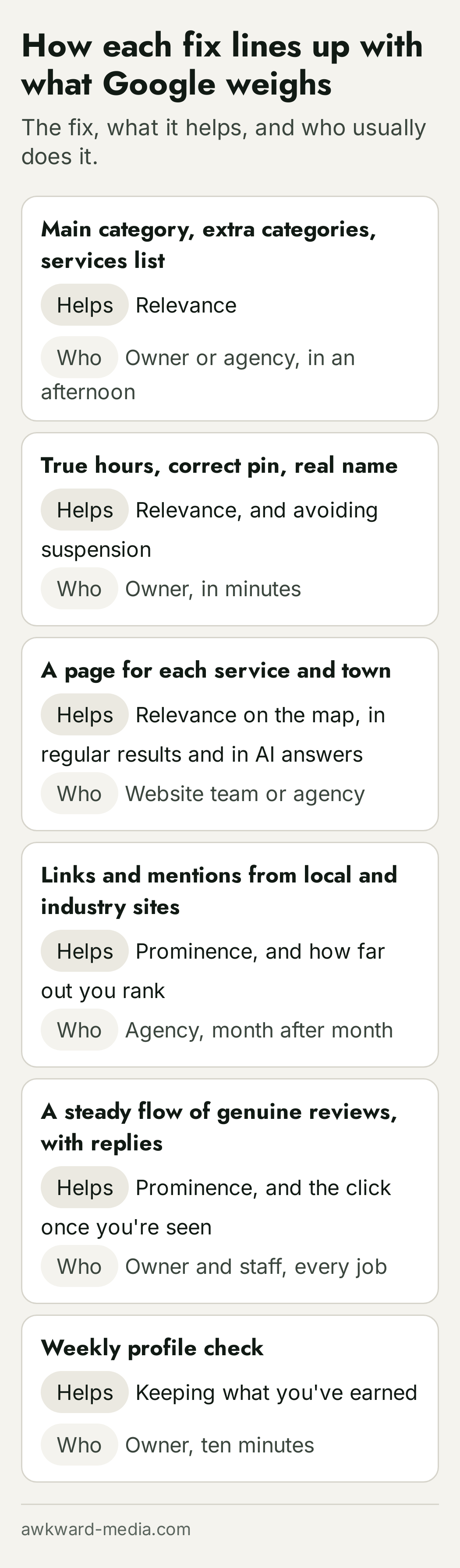
And here is how each fix lines up with what Google is weighing:
How far from your address can you rank?
Farther than most owners think, and less far than some agencies promise. Distance never stops counting, so the honest answer is: as far as your prominence carries you against the businesses closer to each searcher. In a thin market, that can be a long way. In a dense city full of competitors, every mile is fought for.
A grid shows it best. This is one from August 2023 for Asheville Area Movers, a moving company we worked with in Asheville, North Carolina, for the search "local movers". Each dot is a point the search was run from. The number in it is where they ranked from there.
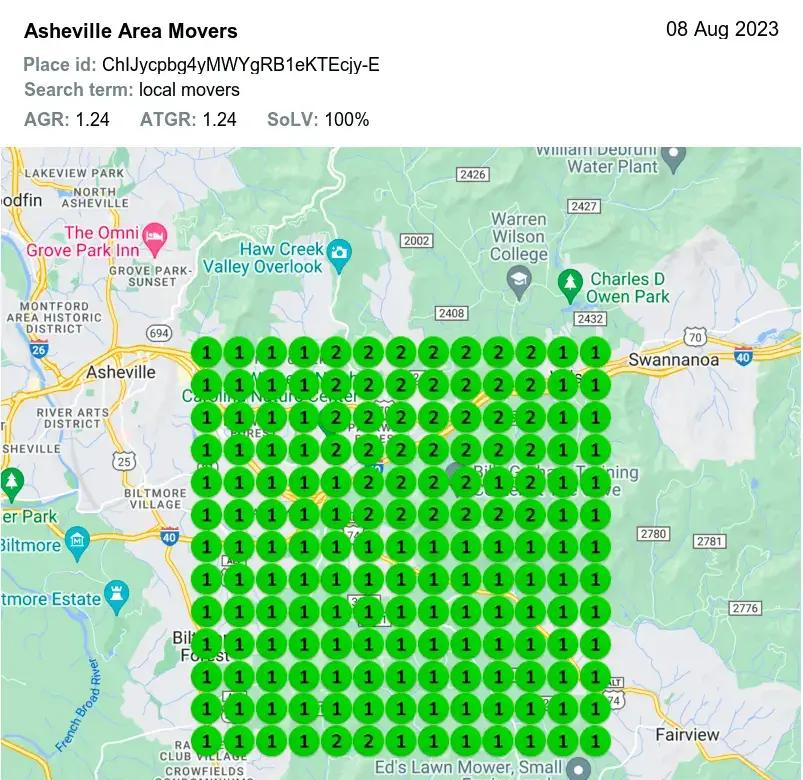
That is what "dominating an area" looks like when it's measured instead of claimed. Mae Fence, above, shows the long-range version: first from 20 miles out, for a search they hadn't shown up for before. If reaching the towns beyond your own is the goal, our free 50-Mile Radius Playbook lays out how we approach it, and the Map Pack expansion service is that work done for you. Businesses with several locations face a different version of the same problem, covered on our multi-location SEO page.
Ask Maps: Google's AI now answers inside the map
On March 12, 2026, Google launched Ask Maps, a chat built into Google Maps and powered by its Gemini AI. Miriam Daniel, who runs Google Maps, wrote that it "answers complex, real-world questions a map could never answer before", drawing on "over 300 million places" and reviews from Maps' community. It rolled out first in the US and India on phones (Google). In August, Google added food ordering, hotel searches and the ability to suggest edits to a business by chatting.

For a local business, this adds a door rather than replacing one. Someone can now ask "who can fix a leaking water heater tonight near me?" and get an answer that names businesses, instead of a list to scroll. The same things that rank you on the map, a complete profile, real reviews that describe the work, a website that answers questions clearly, are what an AI has to work with when it picks names. Google also retired the old public questions-and-answers box on profiles at the end of 2025 and now answers those questions with AI; our local SEO guide covers what that changed. More on how AI answers pick businesses in our pieces on Google's AI Overviews, AI Overviews SEO and ChatGPT SEO.
What it looks like when it works
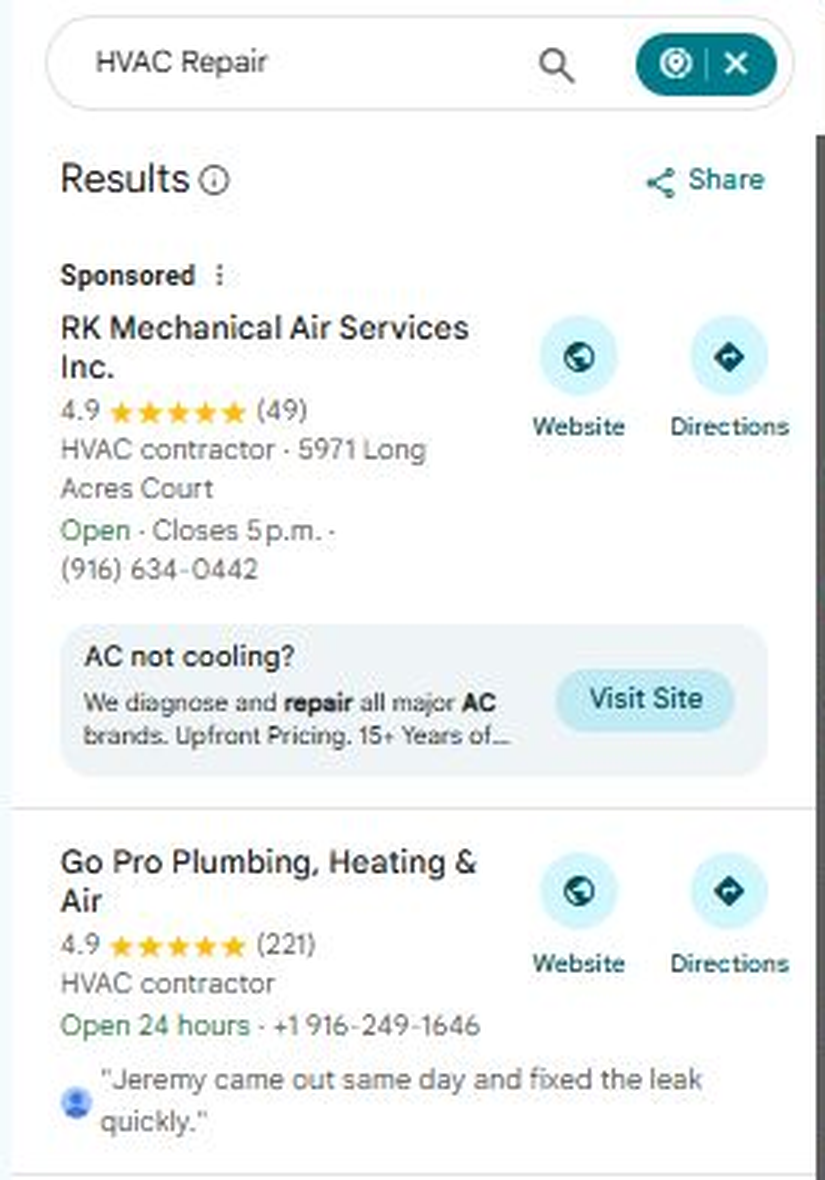
Go Pro Plumbing, Heating & Air in Sacramento already had a strong reputation and a 4.9-star rating. They were second on Google Maps for "HVAC Contractor" and third for "HVAC Repair", which in a Sacramento summer means the phone rings somewhere else. They reached first for both, with only a paid ad above them.
They're in good company. Just a few of the other businesses we've moved up the map: Southwest Kitchen and Bath in Tucson, at #1 on Google Maps for five searches; Colour Crafters Painting in Daytona Beach, in the top three for five; Candace and Basil's Mississauga store, from #10 to #1. Industry by industry, our pages for plumbers, HVAC companies, roofers, movers and dentists show how the same work plays out in each trade. More results are on our case studies page.
Doing it yourself, or getting help

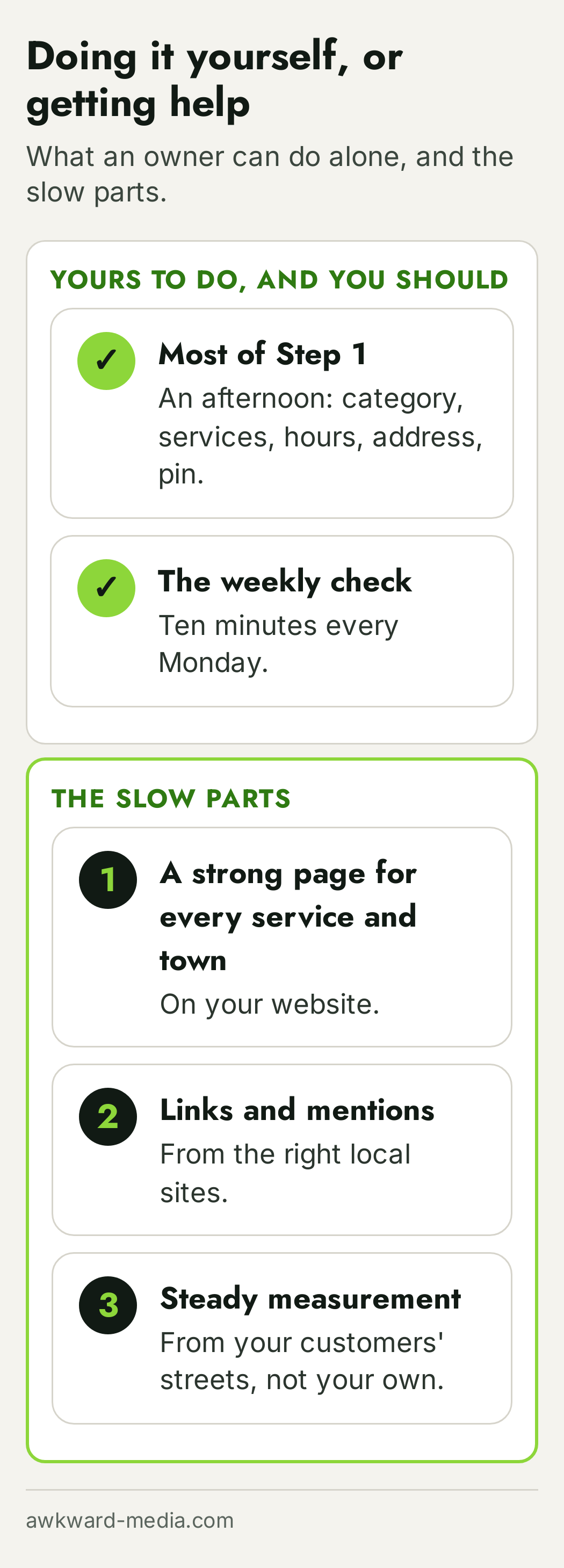
An owner with an afternoon can do most of Step 1 and the weekly check alone, and should. The profile is yours, and nobody knows your services and hours better. The slow parts, a website with a strong page for every service and town, links and mentions from the right local sites, and steady measurement from your customers' streets rather than your own, are where most businesses either hire help or stall.
That's what we do. Awkward Media is a full-service SEO agency: organic and national SEO, ecommerce SEO, local SEO and AI search. Google Maps from $1,497 a month. Google rankings from $2,697 a month. Full pricing is on our SEO pricing page. It's built for businesses already doing $20,000 a month or more in revenue, with enough work coming in to handle more calls. If you want to know where you stand first, the free Google visibility check shows it, or book a free strategy call and we'll walk through your map from your customers' side of town. Owners in a city we cover, such as Denver, Toronto or Chicago, will find what we know about their market on our locations page.
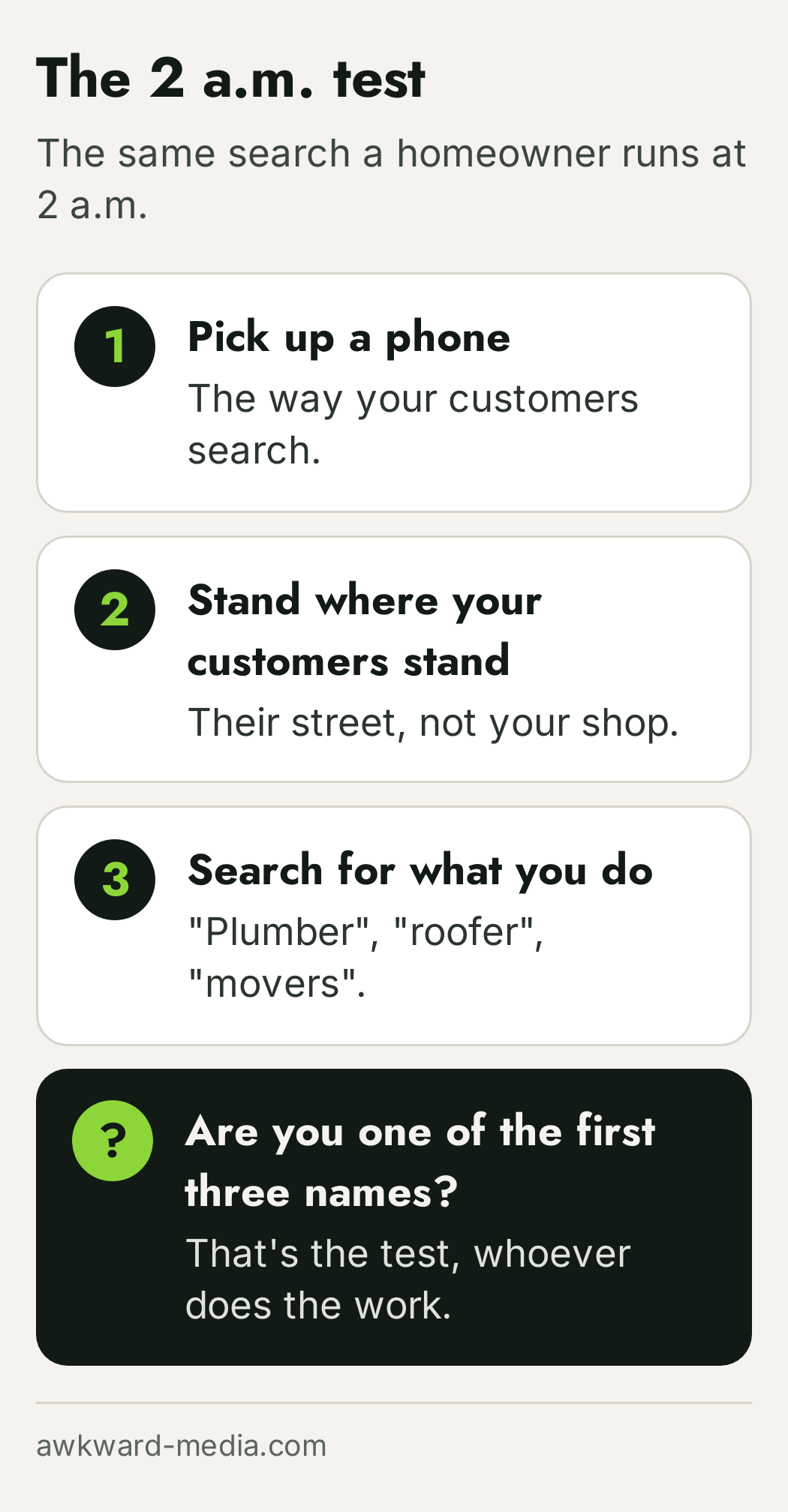
Whoever does the work, the test is the same one the homeowner in the basement runs at 2 a.m. Pick up a phone, stand where your customers stand, and search for what you do. Are you one of the first three names?
Every fact in this story is linked to its source. Spot something out of date? Tell the editor and we will correct it.
Questions readers ask
Frequently asked questions
How can I increase my Google Maps ranking?
Work on the three things Google says it ranks on. Make your Google Business Profile match what people search (the right main category, every service listed, true hours), back it with a website that has a page for each service and town, and build prominence through links and mentions from local websites and a steady flow of genuine reviews. Distance from the searcher is the one factor you can't change.
How do I get my business to appear on Google Maps?
Create or claim a Google Business Profile at google.com/business and verify it. Google says only verified businesses can show their information on Maps and Search. Verification reviews take up to 5 business days.
How long does it take for my business to show up on Google Maps?
Google says verification takes up to 5 business days, edits can take up to 3 days to appear in search results, and rankings for a new business can take up to a month to appear.
Why is my business not showing up on Google Maps?
Usually one of five reasons: the profile isn't verified, it's suspended, there's a duplicate profile, a recent edit is still under review, or the business is new. If you show up for your name but not for your trade, it's a relevance problem: the wrong main category, an empty services list or no website page for that service.
Why is my business not publicly visible on Google?
Most often because the profile hasn't finished verification or has been suspended or disabled for breaking Google's guidelines. Google sends a notice to the account that manages the profile, and a suspended profile won't show until the issue is resolved through Google's appeal tool.
Why don't all businesses show up on Google Maps?
Only verified businesses show their information, and Google shows the businesses it judges most relevant, closest and best known for each search from each location. A business can exist on Maps and still not appear for a given search from a given street.
Why does my Google Maps ranking change depending on where I search?
Because distance from the searcher is one of Google's three local ranking factors. When we searched "plumber" from two points in Denver about five miles apart on October 20, 2026, no business appeared in the top 20 from both.
Can I pay Google to rank higher on Google Maps?
No. Google states: "There's no way to request or pay for a better local ranking on Google." Paid ads can appear above the map results, labelled Sponsored, but they don't change where your profile ranks.
Do Google reviews help you rank higher on Google Maps?
They help, as one part of prominence. Google lists links from other websites and the number of reviews as examples of what makes a business prominent. In the 2026 Whitespark survey, star rating and review count ranked 6th and 9th among Maps factors, behind category, distance, business name, address and hours. Ask for genuine reviews steadily and never offer anything in exchange.
Should I put keywords in my Google Business Profile name?
No. Experts rank keywords in the name highly for rankings, but Google's guidelines say adding unnecessary information to your business name "isn't permitted, and could result in the suspension of your Business Profile." Use the name on your sign.
Does a bigger service area help me rank in more towns?
Nothing in Google's help pages says so. Service areas tell customers where you travel. Google allows up to 20 and asks that the area stay within about 2 hours of driving time from your base. Reaching more towns comes from prominence and from website pages about those towns.
How far from my address can I rank on Google Maps?
As far as your prominence carries you against businesses closer to each searcher. In a dense city it can be a few miles; in a spread-out market it can be much farther. One of our clients, Mae Fence Company, went from not showing up to first on Google Maps for "cedar fencing company", searched 20 miles from their Fulton location.
Do Google Business Profile posts help rankings?
Not much, in the experts' view. In Whitespark's 2026 survey, how often a business posts ranked 148th of 187 factors for the map. Posts can still show customers you're active. Category, services, hours, your website and prominence matter more for ranking.
What is Ask Maps?
Ask Maps is a chat built into Google Maps, powered by Google's Gemini AI and launched on March 12, 2026 in the US and India. People can ask detailed questions about places and get answers that name businesses. A complete profile, descriptive reviews and a clear website give it more to work with.
Can a beginner do this without an agency?
Yes, for the basics. Any owner can verify the profile, fix the name, category, hours, pin and services, reply to reviews and run a weekly check. Building service and town pages, earning links from local websites and measuring rank from customers' locations take longer and are where most businesses get help.
About the author