Local SEO and Google Maps
The bad Google review you can't remove, and what to do instead
Most bad Google reviews can't be removed. What Google takes down, why courts rarely help, the 2024 fake-review ban, and what actually protects your rating.
· Updated · 6 min read

In this story
In 2008, a man named John Palmer ordered a few Christmas presents from a website called KlearGear. They never came. His wife, Jen, could not reach anyone at the company, so she did what millions of unhappy customers do every day. She wrote about it online.
Four years later, KlearGear wrote back. Her review, the company said, broke a "non-disparagement" clause in its terms of sale, and the penalty was $3,500. She had 72 hours to take the review down or pay. When the Palmers refused, KlearGear reported the $3,500 to the credit bureaus as an unpaid debt. A car loan stalled. A mortgage refinance stalled. The Palmers spent the better part of two years fighting a bill for a sentence they had written about a parcel that never arrived.

They won. A federal judge in Utah ruled in 2014 that they had never owed KlearGear a cent and awarded them $306,750, according to Public Citizen, the advocacy group that brought the case. Jen Palmer took her story to the United States Senate. And in December 2016, President Obama signed the Consumer Review Fairness Act, which makes clauses like KlearGear's void across the country.
Most business owners are not KlearGear. But nearly every one of them has felt what KlearGear felt: the heat in the face when a stranger's one-star verdict lands on the most public page they own. On Google, that page is the Google Business Profile, the free listing that shows a business's hours, photos and reviews in search results and on Google Maps. It is often the first thing a new customer sees, and the review at the top of it can feel like a sign hung on the front door by someone else.
So owners ask, and they ask in numbers. Around 8,100 times a month in the United States, someone types some version of "how to remove Google reviews" into Google, according to Google's own advertising estimates. The honest answer is the one almost nobody wants: usually, you can't. And the owners who do best on Google are the ones who stop trying.
What Google will actually take down
Google does remove reviews. It removes a great many of them. But it removes them for breaking its rules, not for being unkind, unfair or wrong about your Tuesday.
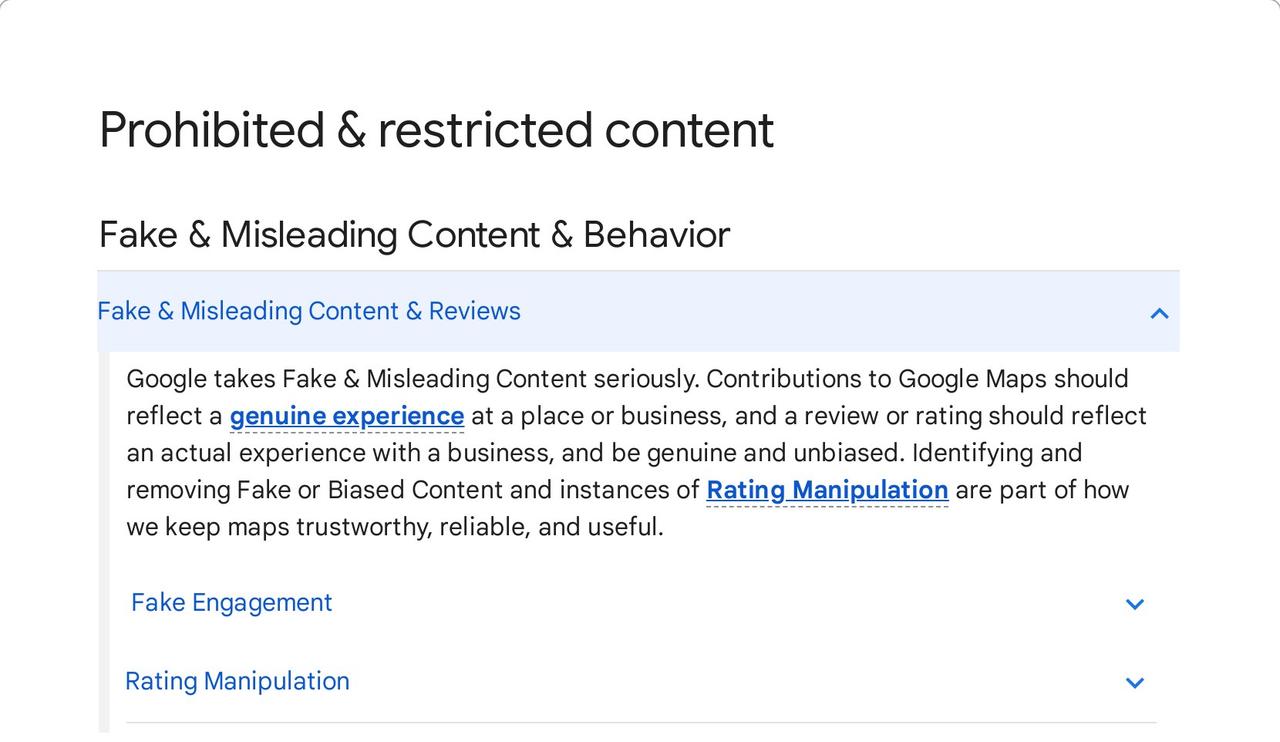
Google's content policy for Maps lists what is not allowed. A review must "reflect an actual experience with a business," so a rant from someone who never set foot in the place can go. So can reviews that were paid for, reviews posted from several accounts by one person, and reviews from a "conflict of interest," which Google defines to include current or former employees and competitors. Harassment, threats, hate speech, personal information, profanity and "unsubstantiated allegations of unethical behavior or criminal wrongdoing" are all out. So is anything off topic, which Google describes as "general, political, or social commentary or personal rants."
What is protected, in Google's own words, is a negative experience told "in a respectful manner."
| Google will consider removing | Google will leave up |
|---|---|
| A review from someone with no real experience of the business | A real customer's bad experience, told politely |
| A review from a competitor, or a current or former employee | A review you believe is unfair or exaggerated |
| Paid reviews, or several reviews from one person's accounts | A one-star rating with no written comment |
| Threats, harassment, hate speech or someone's private information | Criticism of your prices, your staff's manner or your wait times |
| Accusations of crimes with nothing to back them up | A review of an old visit that no longer reflects how you work |
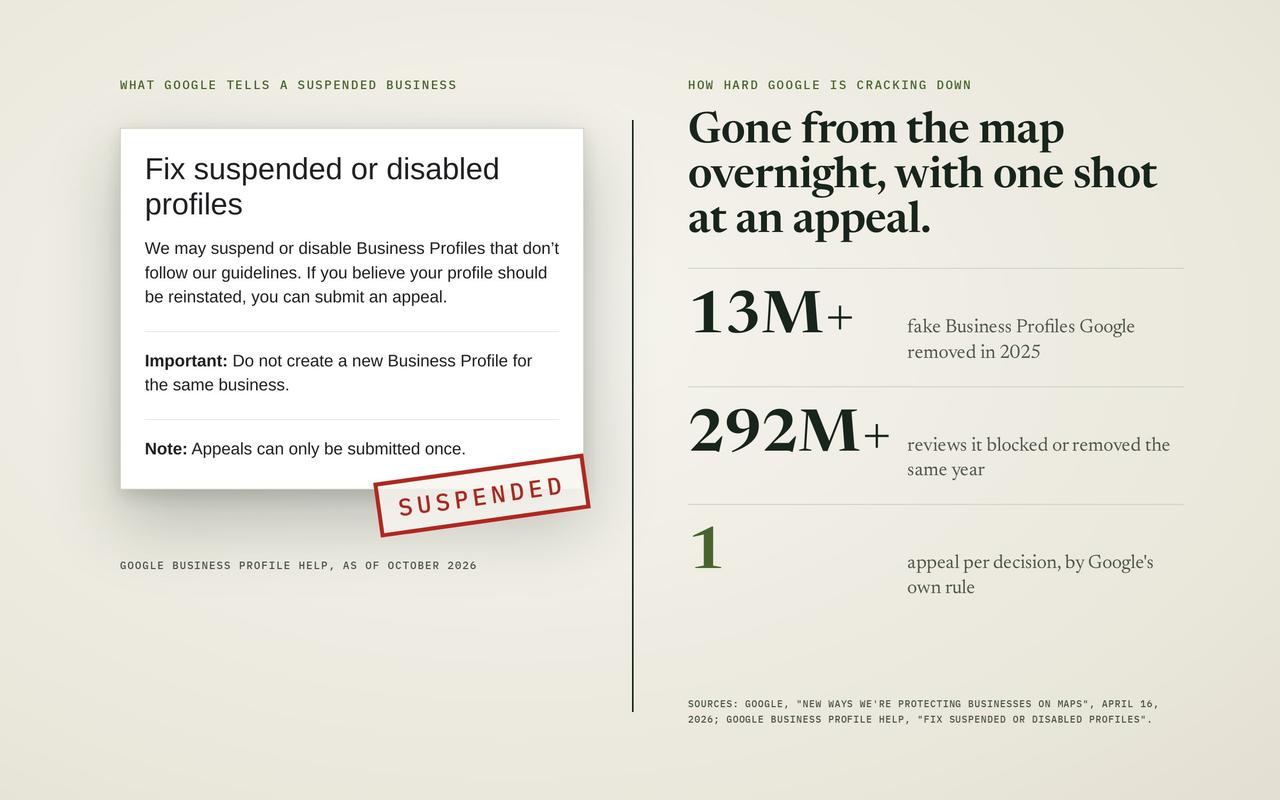
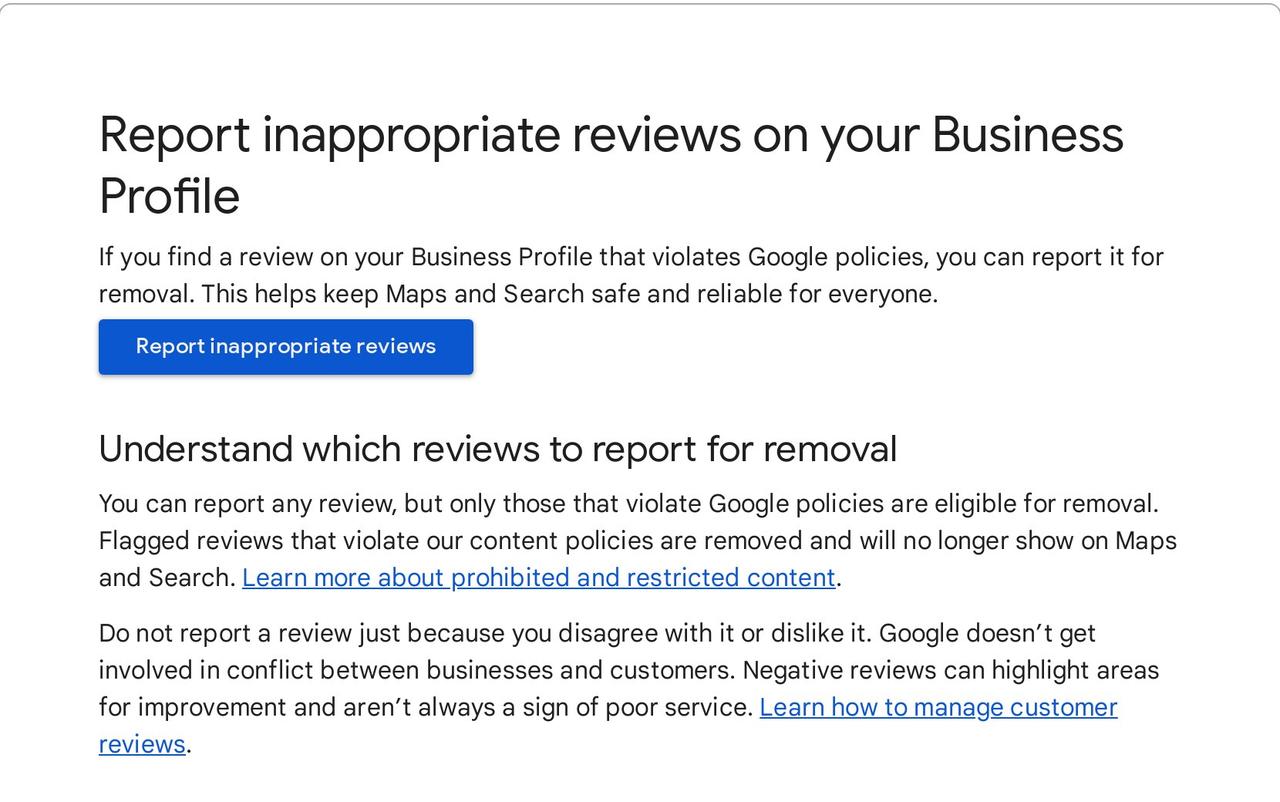
The process is simple and slow. From the Business Profile, an owner opens the reviews, flags the one in question, picks a reason and sends the report. Google says its evaluation "typically takes several days," and the result can be followed in its Reviews Management Tool. If Google decides the review breaks no rule, the owner gets one appeal, covering up to ten reviews at a time. After that, the matter is closed.
Google's help page is unusually blunt about the rest.
"Google doesn't get involved in conflict between businesses and customers."
Google Business Profile Help
The same page tells owners: "Do not report a review just because you disagree with it or dislike it." In other words, the report button is for spam and abuse. It is not a complaints desk.
Why a lawsuit rarely gets you further
Some owners, at this point, call a lawyer. Dawn Hassell did. Hassell, a San Francisco attorney, believed a former client named Ava Bird had posted false and damaging reviews of her firm on Yelp. She sued Bird for defamation, the legal term for a false statement that harms someone's reputation, and won by default when Bird did not respond. A trial court then went a step further and ordered Yelp, which had never been part of the case, to delete the reviews.

Yelp fought the order all the way to the California Supreme Court, and in July 2018 a divided court sided with Yelp. The reason was Section 230 of the federal Communications Decency Act, the 1996 law that says a website is generally not treated as the publisher of what its users post. Hassell had won her case against the reviewer. She could not use it to force the platform's hand.
The ruling bound only California courts, and Canadian law works differently, so any owner weighing a lawsuit, whether in Toronto, Vancouver or Tampa, needs a lawyer where they work. But the pattern holds across both countries. A lawsuit costs months and real money, and every filing gives the original complaint a fresh audience. KlearGear's demand for $3,500 is why most of us have heard of the Palmers at all.
The law now points the other way
For most of the last decade, the risk in online reviews ran mostly toward the customer. That has turned around.
In August 2024, the Federal Trade Commission voted 5 to 0 to ban fake reviews and testimonials outright. The rule, which took effect that October, forbids writing, buying or knowingly spreading fake reviews, including ones written by AI. It bans paying customers for reviews on the condition that they are positive. It bans insiders from reviewing their own company without saying so. And, in a clause aimed squarely at the instinct behind KlearGear, it bans using "baseless legal threats" or intimidation to get negative reviews removed. When the rule was announced, the commission could seek civil penalties of up to $51,744 for each violation, a figure that rises with inflation.
"Fake reviews not only waste people's time and money, but also pollute the marketplace," said Lina Khan, then the commission's chair.
Canada had already drawn its own line. In November 2014, Bell Canada launched two new mobile apps that quickly collected glowing four-star reviews. Scott Stratten, a marketer in Oakville, Ontario, looked up the reviewers on LinkedIn and found that several worked for Bell, some in senior jobs. The following October, Canada's Competition Bureau fined Bell $1.25 million, the first penalty of its kind in the country. The bureau found that the reviews gave the false impression they came from independent customers.
Google is counting, too
The platforms have stopped waiting for regulators. Google says it blocked or removed more than 240 million policy-violating reviews in 2024, most of them before anyone saw them. That was more than 40 percent more than the year before, and in its next annual report the figure grew again.
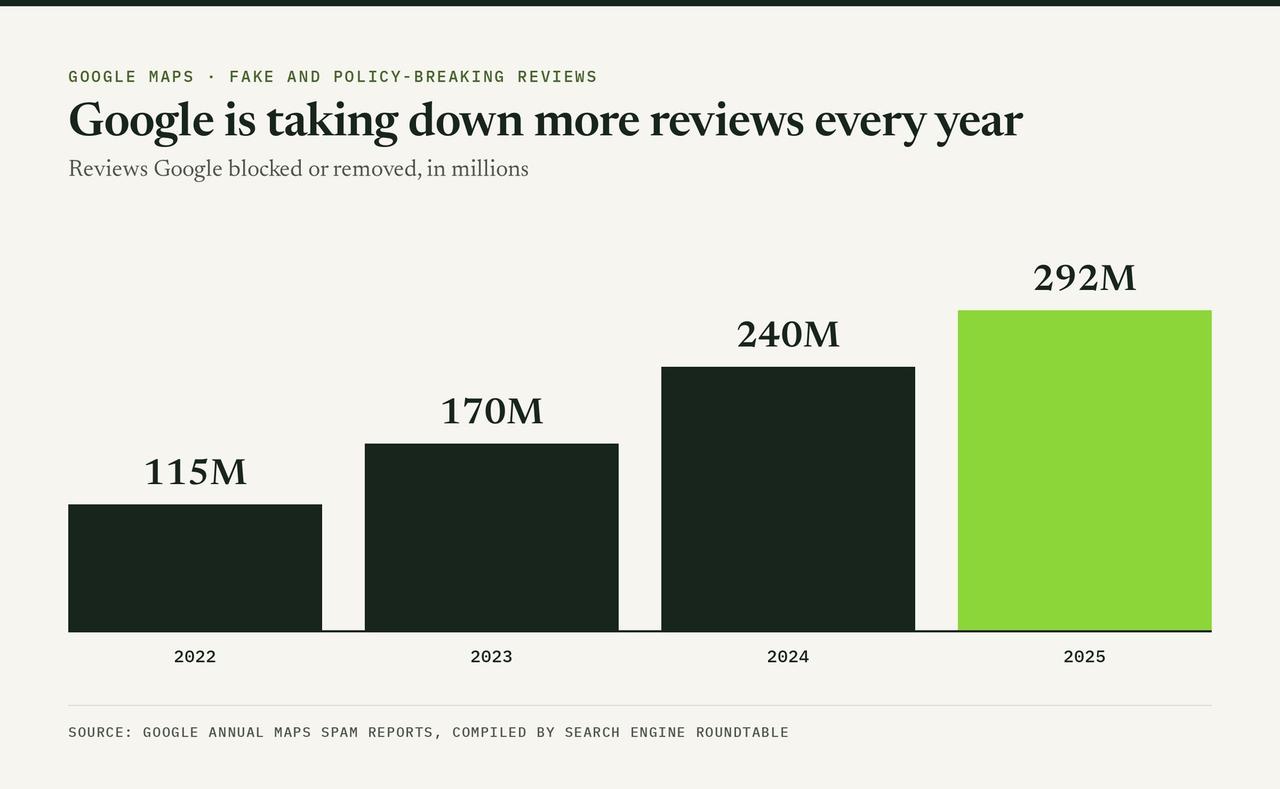
Sources: Google's annual reports, as compiled by Search Engine Roundtable.
Google now also posts a warning on some Business Profiles in the United States, Britain and India when it has recently removed suspicious five-star reviews, and it said in April 2025 that the warnings would spread worldwide. A business that buys praise no longer just risks losing it. It risks a notice on its own listing telling every customer that suspicious praise was taken down.
The fine print matters as much as the fines. Google's policy forbids a business to "discourage or prohibit negative reviews, or selectively solicit positive reviews from customers." That outlaws a once-common trick called review gating, in which a business asks customers privately whether they were happy and sends only the happy ones to Google. The FTC rule takes aim at the website version of the same trick: a business may not suggest the reviews it shows are the whole story when it has quietly filtered out the bad ones.
What one bad review is really worth
None of this would matter if reviews did not move money. They do, and the best evidence is more interesting than the marketing slogans built on it.
In a well-known Harvard Business School study, the economist Michael Luca matched Yelp ratings for restaurants in Seattle with their sales records from Washington State's revenue department. Yelp rounds each restaurant's average to the nearest half star, so two restaurants with almost identical true scores can show different ratings. Comparing them, Luca found that a one-star increase led to a 5 to 9 percent rise in revenue. The effect was concentrated in independent restaurants. For chains, whose names already tell customers what to expect, ratings barely registered. (Brands with many branches win on Google another way, through multi-location SEO.)
That is the first lesson for an independent business: the stars matter most to the people who don't already know you. That is why reviews sit near the centre of any serious SEO plan for a small business.
The second lesson is stranger. Researchers at Northwestern University's Spiegel Research Center, working with the review company PowerReviews, found that across more than 40 product categories, the likelihood of a purchase peaked at an average rating between 4.2 and 4.5 stars and then fell as ratings approached a perfect 5. Shoppers, it turns out, distrust perfection. A few honest complaints make the praise believable.
The third lesson explains why the fraud happens at all. In a second study, Luca and Georgios Zervas of Boston University found that Yelp's filter flagged roughly 16 percent of restaurant reviews as suspicious, and that a restaurant was more likely to commit review fraud when its reputation was weak: when it had few reviews, or had just received bad ones. The businesses most tempted to cheat are the ones for whom a single review weighs the most.
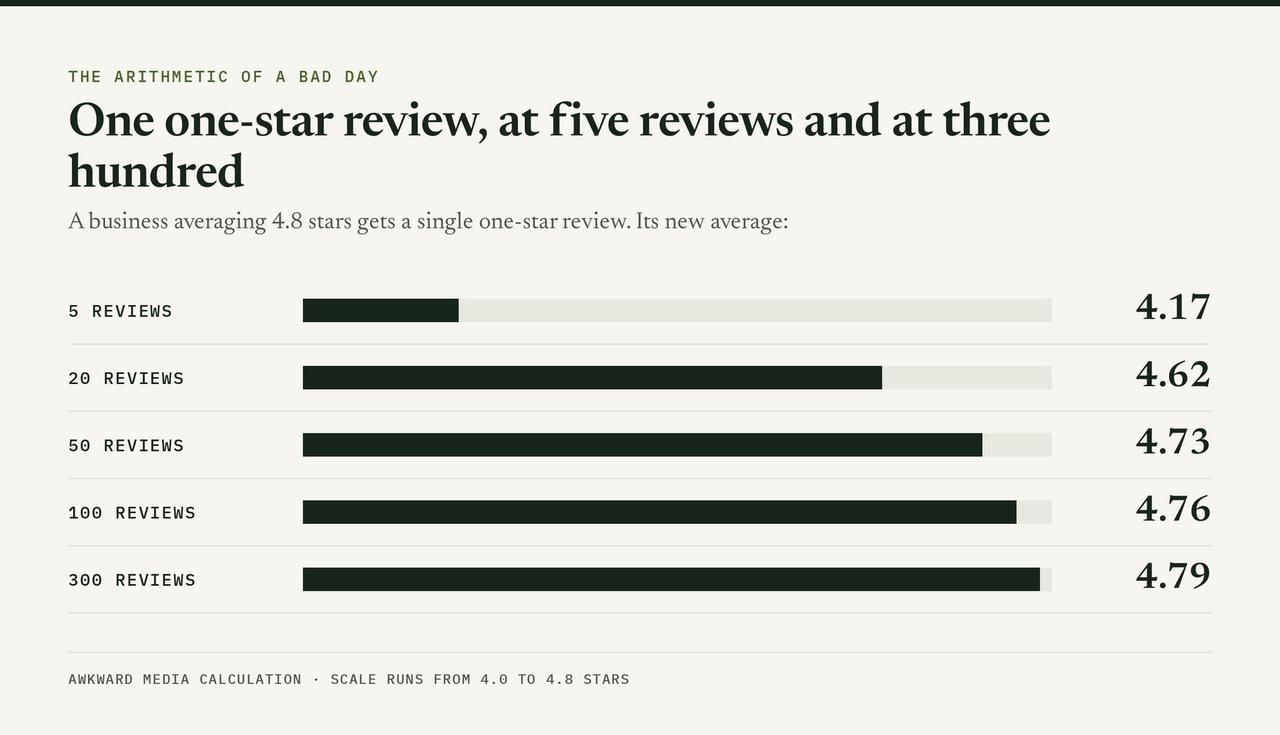
Put the three findings together and a plain truth emerges. One bad review among five is a crisis. One bad review among three hundred is texture. The defence against a bad review is not deletion. It is volume.
The reply is the real review now
Reviews also feed directly into where a business appears. Google says it ranks local results mainly on three things: relevance, or how well a listing matches the search, which is shaped by what the profile and the business's own website say (the work called on-page SEO); distance from the person searching; and what it calls prominence, or how well known a business is. Google says prominence draws on "how many websites link to your business," which is why link building and the rest of the work done away from your own website matter for a local shop as much as for a national brand. On its own help page about local ranking, Google says prominence depends in part on "how many reviews you have," and that "more reviews and positive ratings can help your business's local ranking." It adds a line every owner should read twice: "There's no way to request or pay for a better local ranking on Google." The only route into the top three on the map, the small box of businesses Google shows above the regular results, is to earn it. That earning is what local SEO means, and reviews are a large part of it.
Google also tells owners that replying to reviews "shows that you value their feedback," and that "positive reviews and helpful replies can help your business stand out." That second phrase is the quiet point of this whole story. A bad review is read by the next hundred customers, not by the one who wrote it. They are not deciding whether the reviewer was right. They are deciding what kind of business you are when things go wrong.
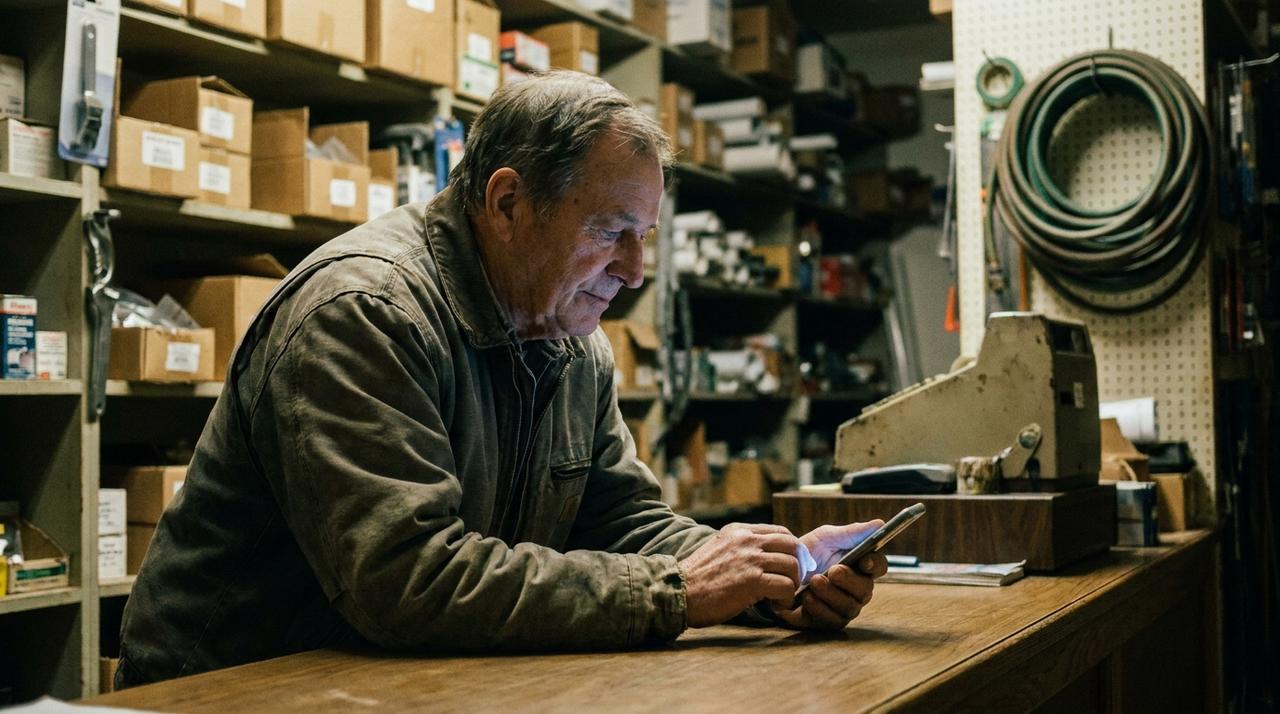
A good reply is short, calm and specific. It thanks the customer, says what happened without arguing, says what has changed, and offers a direct line to fix it. It never names the customer's private details, never accuses, and never threatens, which after October 2024 is a legal risk in the United States as well as a bad look. Picture a dentist who answers a complaint about a long wait with a plain apology and a note about new booking times. That dentist has not lost an argument. That dentist has written an advertisement the next anxious patient will believe, because it sits right under the complaint. It is the kind of trust practices like Burloak Centre Dentistry are built on, and we hold ourselves to it too: you can read what our own clients say on our reviews page.
What to do this week
- Read the review against Google's rules, not your feelings. If it is fake, from a competitor or former employee, abusive, or off topic, report it from your Business Profile and choose the reason that matches the policy.
- Use the one appeal wisely. If Google says no and you are sure the review breaks a rule, appeal through the Reviews Management Tool. You get one appeal, for up to ten reviews.
- Reply to every review, good and bad. Keep replies to a few sentences. Write them for the next customer, not the last one.
- Ask every customer for a review, not just the happy ones. Send the same request to everyone, at the same moment in the job, with a direct link. No discounts, gifts or contests in return, and no screening first.
- Check your paperwork. If your contracts or website terms contain a clause that penalizes customers for bad reviews, remove it. In the US it is void, and the FTC tells businesses to delete such clauses even if they have never used them.
- Walk away from anyone selling reviews. If an agency offers to "manage" your rating with reviews it writes or buys, that is the conduct the FTC banned and Google now flags on your profile. Our guide to choosing an SEO agency lists the other warning signs, our guarantees page shows what an honest agency puts in writing, and our free SEO Second Opinion will tell you whether what you are being sold holds up.
- Get an honest read on your profile. A proper SEO audit looks at your reviews alongside everything else Google weighs. For a quick start, our free Google Visibility Check shows where you stand today.
For the businesses we work with, reviews are one part of a larger piece of work: making a business the obvious choice on the map across every town it serves. It is the work behind a storm shutter company in Wilmington, North Carolina that ranks first on Google Maps when searched from 52 miles away, and a Louisville cleanup firm that went from 37th to first for "blood cleanup services." And it matters most in trades where trust is the whole sale, from dentists to law firms, roofers and plumbers.
KlearGear tried to make a bad review disappear, and it turned one unhappy customer into a federal law. Most owners will never face anything that dramatic. But the lesson scales all the way down. The review you hate will probably stay. What you control is everything that stands next to it.
Every fact in this story is linked to its source. Spot something out of date? Tell the editor and we will correct it.
Questions readers ask
Frequently asked questions
Can I get a negative Google review removed?
Only if it breaks Google's rules. Google removes fake reviews, paid reviews, reviews from competitors or current and former employees, and reviews with harassment, hate speech, private information or off-topic rants. A real customer's honest bad experience stays up, even if you think it is unfair.
How do I report a Google review?
Open your Google Business Profile, go to your reviews, click the report icon beside the review, choose the reason that matches Google's policy and send the report. You can also use Google's Reviews Management Tool, where you can follow the decision.
How long does Google take to remove a review?
Google says its evaluation typically takes several days. If it decides the review breaks no rule, you can make one appeal, covering up to ten reviews, through the Reviews Management Tool.
Can I pay someone to remove bad Google reviews?
No one can legitimately remove a review that follows Google's rules. Services that promise to, or that offer to post reviews for you, put you at risk: buying fake reviews is banned under the FTC's 2024 rule in the US, and Google can warn customers on your profile when it removes suspicious reviews. Our guide to choosing an SEO agency covers the other red flags.
Should I reply to a bad review?
Yes. Google says replying shows you value feedback and that helpful replies can help a business stand out. Keep it short and calm, say what has changed, offer a direct way to fix the problem, and never share the customer's private details or threaten them.
Do reviews affect where my business shows on Google Maps?
Yes. Google says the number of reviews you have and your ratings are part of how well known it judges your business to be, and that more reviews and positive ratings can help your local ranking. Reviews are one part of local SEO; the rest is how you win the Map Pack across every town you serve.
About the author