Guides
Home service SEO in 2026: what a homeowner sees on Google before your website, trade by trade
We ran 24 live Google phone searches for eight home service trades in Phoenix, Charlotte and Columbus. Here is what a homeowner sees before your website, and what it takes to get into each spot.
· Updated · 6 min read
In this story
On the morning of November 3, 2026, we searched Google the way a homeowner does when something breaks, as a phone in each city sees it. "Plumber Phoenix." "Roofer Charlotte." "Pest control Columbus." Eight trades, three cities, twenty-four searches.
We weren't looking for who ranked first. We were counting what a homeowner has to scroll past before they reach a plumber's or a roofer's own website: the map, the sponsored strips, Google's AI answer, Yelp, Angi, Reddit threads and Facebook groups. That stack is what home service SEO is really about in 2026, and almost nobody who sells it shows it to you.
Here is what we found, trade by trade, and what it takes to get into each spot.
What is home service SEO, in plain words?
SEO stands for search engine optimization. For a home service business (plumbing, heating and cooling, roofing, electrical, pest control, cleaning, landscaping, moving) it means one thing: when someone nearby searches for what you do, your business is one of the names they see and call.
Ten years ago that mostly meant your website's spot in the list of blue links. It still means that. It now also means your spot on the Google map (what most people call local SEO), whether Google's AI answer names you, and whether you show up on the "best plumbers in town" lists and forum threads that Google puts on the same page. The website work hasn't stopped mattering. It now pays off in more places at once.
How we ran the searches
We used a search research tool that shows Google's live results page as a phone in a given city sees it. On November 3, 2026, we ran "[trade] [city]" for eight trades in Phoenix, Arizona; Charlotte, North Carolina; and Columbus, Ohio. Three cities in three different regions, chosen so one city's quirks wouldn't decide the result. (We used the city name rather than "near me", because "near me" only works properly from a real phone standing in a real place.) For each search we wrote down, in order: what sat at the top, how many businesses the map showed and how many Google reviews each had, whether an AI answer appeared and whom it named, and what kind of page held each of the first ten website results.
For demand, we used Google's own advertising planner estimates for the "near me" version of each search across the United States, read the same day. Those figures are estimates Google gives advertisers, not exact counts.
What sits above your website: the tally
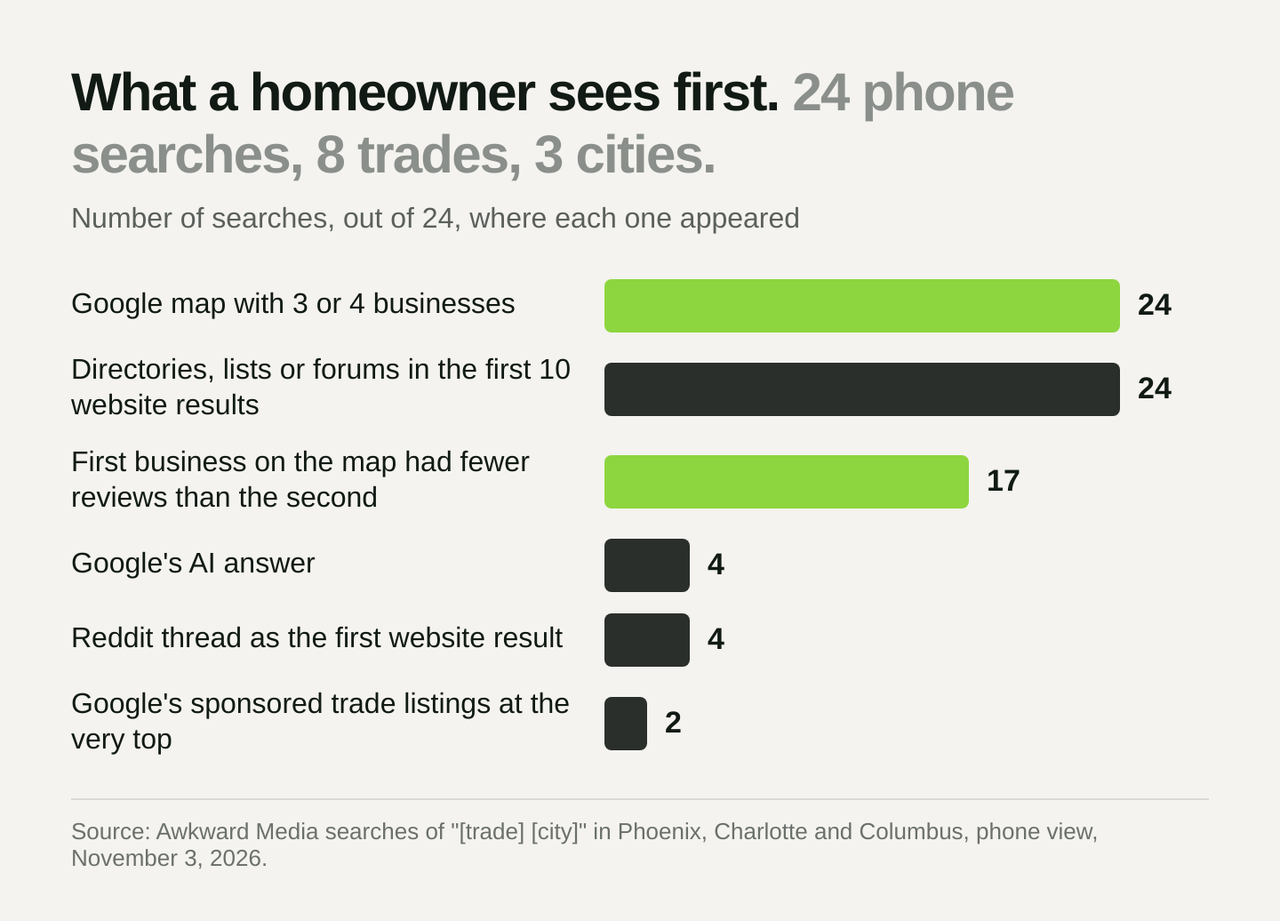
| What was on the page | Phoenix | Charlotte | Columbus | Total |
|---|---|---|---|---|
| Google map with 3 or 4 businesses | 8 of 8 | 8 of 8 | 8 of 8 | 24 of 24 |
| Google's sponsored trade listings (Local Services Ads) at the very top | 1 (electrician) | 1 (movers) | 0 | 2 of 24 |
| Google's AI answer | 2 (pest control, movers) | 1 (house cleaning) | 1 (pest control) | 4 of 24 |
| First business on the map had fewer reviews than the second | 6 of 8 | 5 of 8 | 6 of 8 | 17 of 24 |
| Reddit thread as the first website result | 0 | 2 (roofer, house cleaning) | 2 (electrician, landscaping) | 4 of 24 |
| Directories, "best of" lists and forums among the first 10 website results | about 4 to 6 | about 3 to 7 | about 4 to 8 | in every search |
Source: our own searches, phone view, November 3, 2026. Review counts as Google showed them, which rounds large numbers (1,300, 6,400). "Directories" means Yelp, Angi, Thumbtack, the Better Business Bureau and similar sites; "lists" means "10 best" articles; "forums" means Reddit, Facebook groups and question threads.
Four things stand out.
The map was on every single search
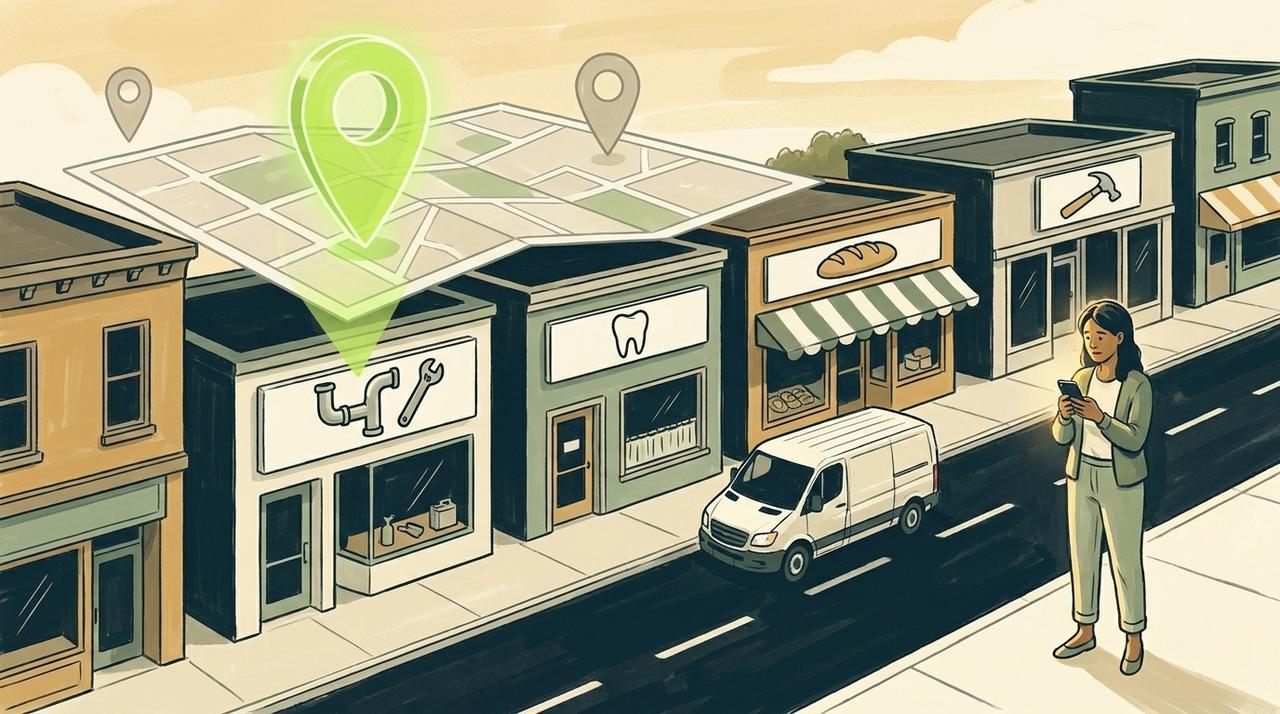
All twenty-four searches showed the Google map with three or four businesses on it, near the top of the page. On a phone, those three names are among the first things a homeowner sees, before any business's own website. The map is fed by each business's free Google listing, called a Google Business Profile; getting it right is what our Google Business Profile service does. That is why the map is the first thing we look at for any home service client, and why our map ranking service exists.
Google's AI answer named the map businesses, and only them
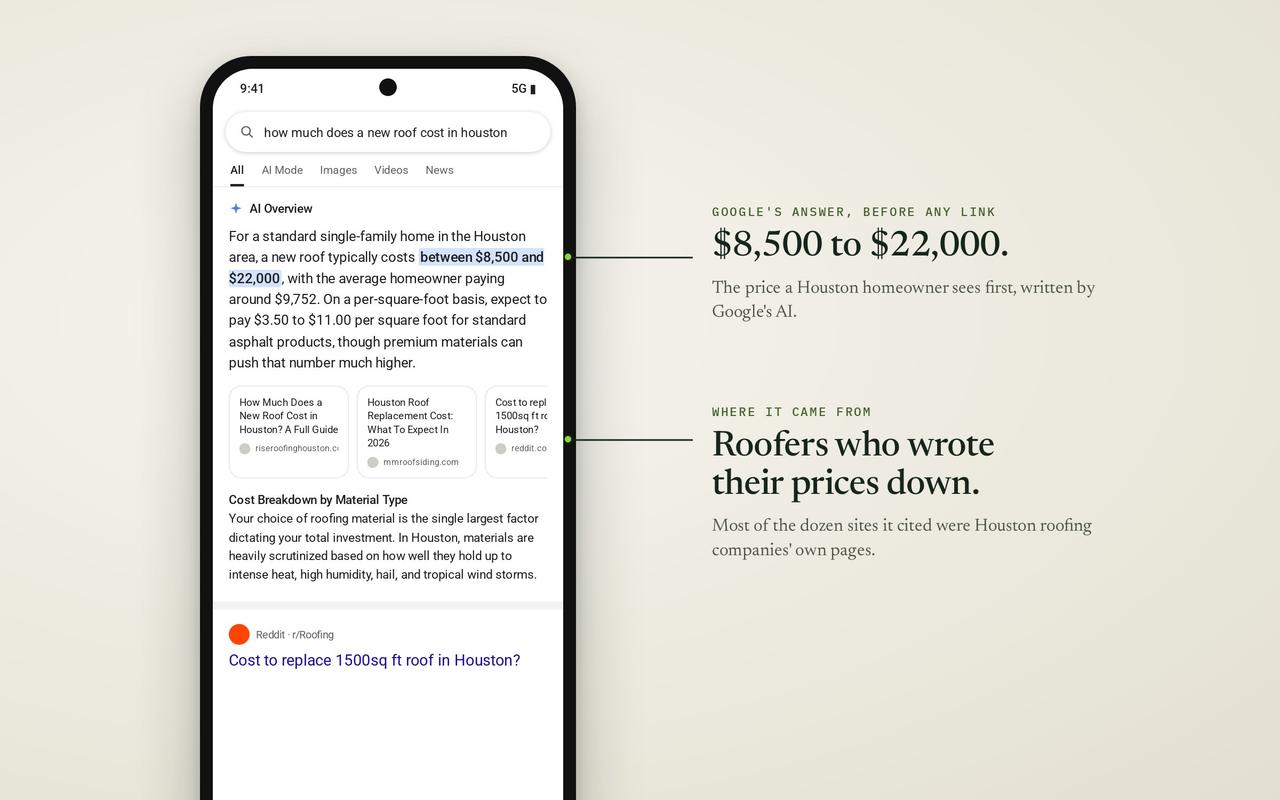
The AI answer, the paragraph Google writes itself at the top of some searches, showed up four times: pest control and movers in Phoenix, house cleaning in Charlotte, pest control in Columbus. Each time it described the same three businesses the map showed, and no others. In Columbus it simply listed the three map businesses with their star ratings. In Charlotte it cited Reddit and two of the cleaning companies' own websites as its sources.
Four out of twenty-four is a small sample, so read it as a pattern worth watching, not a law. But the pattern is plain: on these searches, getting onto the map and getting named by Google's AI were the same job.
Directories and forums took about half of the website results
Below the map, the ten website results were never just plumbers' and roofers' own sites. In every search, somewhere between three and eight of the ten were Yelp, Angi, Thumbtack, "10 best" lists, the Better Business Bureau, marketplaces, Reddit or Facebook. A Reddit thread was the first website result four times: for "roofer Charlotte", "house cleaning Charlotte", "electrician Columbus" and "landscaping Columbus". Two Facebook groups sat in the top ten for "electrician Charlotte", and Facebook group threads asking for recommendations showed up for cleaners and movers in Columbus.
That matters for two reasons. First, there are fewer website spots left for actual businesses, so the ones that are left are worth more. Second, a homeowner who clicks a list or a thread still picks a business from it, so being named on those pages counts too.
Google's own sponsored listings were rarer than you'd think
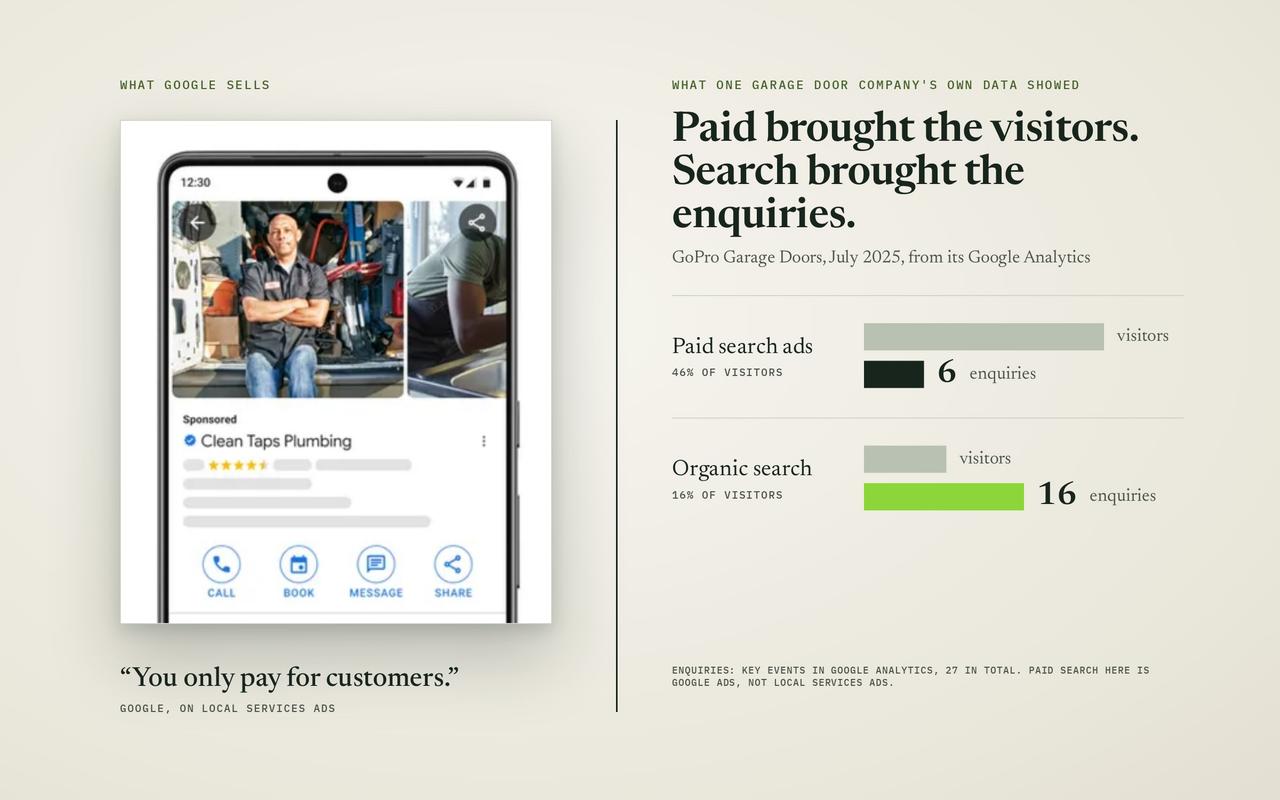
Google sells a separate kind of ad to local trades, called Local Services Ads, which sits above everything else. On our twenty-four searches it appeared only twice: electricians in Phoenix and movers in Charlotte. We compared those ads with SEO in our guide to Local Services Ads. Ordinary text ads appeared lower down on some searches; for "pest control Columbus", two national brands' ads sat in the middle of the page. On most of the pages we saw, the first thing a homeowner met was the map, not an ad.
Why the business with fewer reviews can still be first
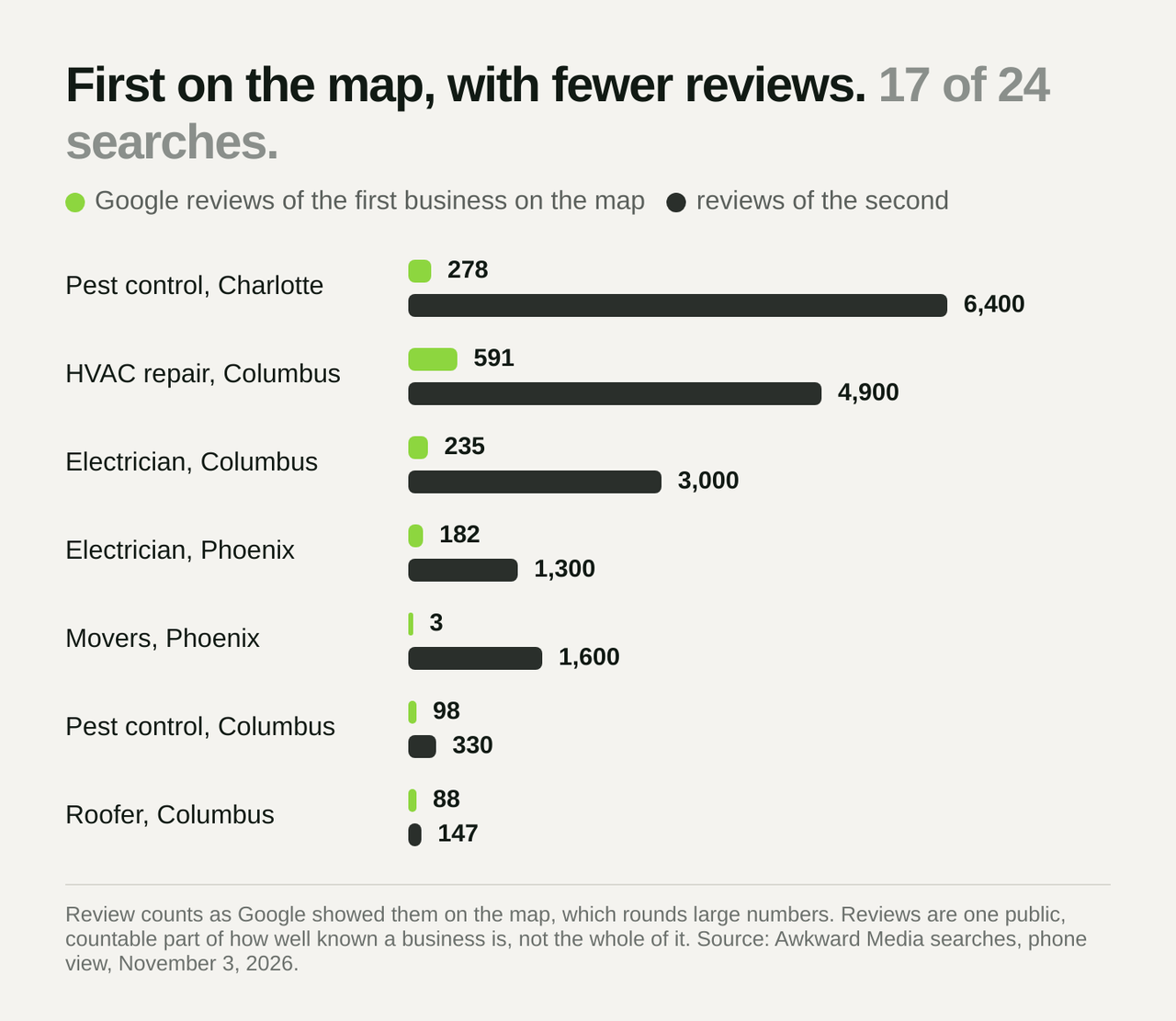
You've probably looked at the map and decided you can't win it, because a rival has a thousand more reviews. Our searches say otherwise. In 17 of our 24 searches, the first business on the map had fewer Google reviews than the second.
- "Electrician Phoenix": the first business on the map had 182 Google reviews. The second had 1,300.
- "Pest control Charlotte": the first had 278 reviews. The second had 6,400.
- "HVAC repair Columbus": the first had 591. The second had 4,900.
- "Electrician Columbus": the first had 235 reviews and no website on its listing. The second had 3,000.
- "Movers Phoenix": the first business on the map had 3 reviews. Its name matched the search almost word for word. The second had 1,600.
- "Landscaping Columbus": all three map businesses had fewer than 100 reviews. The first had 10.
Google's own help page on local ranking names three things: relevance ("how well a Business Profile matches what someone is searching for"), distance ("how far each business is from the customer who's searching") and prominence ("how well-known a business is"). For prominence, Google mentions "how many websites link to your business and how many reviews you have", and in practice it is built from many signals: links, mentions of the business across the web, what its own website says, and reviews. We use review counts in this article because they are public and anyone can count them. They are one visible piece of prominence, not the whole of it.
So the lesson is not "stop collecting reviews". Keep asking happy customers for them. The lesson is that a business which is clearly about the exact service, close to the searcher, and well described across its website and the web, can sit above a rival with five times the reviews. Our guide on how to rank higher on Google Maps walks through each of those signals step by step.
Trade by trade: what a homeowner sees
Each trade below has the search, how many times a month Americans run its "near me" version, what Google's ad planner estimates a click costs an advertiser, and what we saw in Phoenix, Charlotte and Columbus. Demand and cost figures: Google Ads planner estimates, United States, read November 3, 2026.
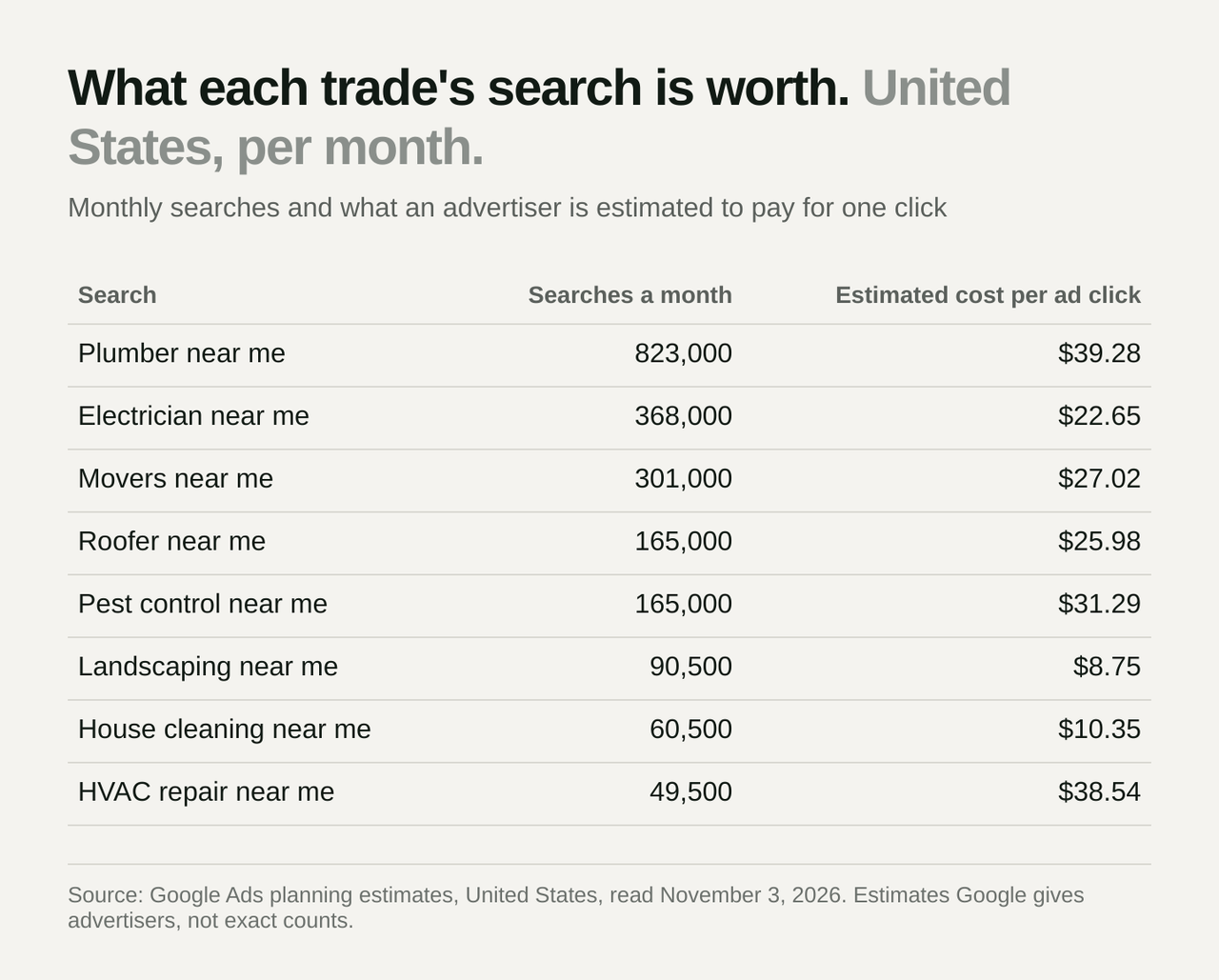
"Plumber near me": 823,000 searches a month, about $39 a click
The biggest search in home services by a distance, and the second most expensive click on this list. In Phoenix the map showed four plumbers with 465 to 1,400 reviews each, and the website results mixed plumbing companies with a "10 best plumbers" list, Yelp and a Facebook answers page. In Columbus the first plumber on the map had 411 reviews, fewer than either of the other two, and the first website result was a "10 best plumbers" list. In Charlotte the map also showed four, and one of them was a heating and cooling company with 3,400 reviews: Google decided it was relevant enough to a plumbing search to put it there. About seven of Charlotte's top ten website results were directories, lists or forum questions. More on what we do for plumbers on our plumbing page.
"HVAC repair near me": 49,500 searches a month, about $39 a click
Fewer searches than plumbing, but the most expensive click here: Google estimates $38.54. In Phoenix the three map businesses had 2,000, 9,900 and 33,900 reviews, the biggest numbers we saw anywhere. In Charlotte, Google added a "Discussions and forums" block of Reddit-style threads to the page, and the first map business had fewer reviews than the second. In Columbus, a Facebook recommendations page was the fourth website result. See our heating and cooling page.
"Roofer near me": 165,000 searches a month, about $26 a click
In Phoenix, Yelp was the first website result, and the manufacturer GAF's contractor finder, Thumbtack and Angi were all in the top ten. In Charlotte, the first website result was a Reddit thread from r/Charlotte, and none of the three roofers on the map had more than 640 reviews. In Columbus none had more than 147, and about eight of the first ten website results were Yelp, Thumbtack-style directories or "best roofers" lists. A roof is a big, rare purchase, and homeowners go looking for other people's opinions first. That's why mentions on lists and threads carry weight here. Our roofing page covers the rest.
"Electrician near me": 368,000 searches a month, about $23 a click
The only trade where Phoenix showed Local Services Ads at the very top. Below them, the first business on the map had 182 reviews and the second had 1,300. The Better Business Bureau was the first website result. In Charlotte, two Facebook groups and two forum recommendations sat in the top ten. In Columbus, a Reddit thread titled "Electrician recommendation?" was the first website result. See our page for electricians.
"Pest control near me": 165,000 searches a month, about $31 a click
Google's AI answer showed up in Phoenix and named the three businesses on the map. It cited one of those companies' own websites twice. In Charlotte, the first map business, with 278 reviews, sat above one with 6,400, and Angi, Yelp and Thumbtack all took website spots. In Columbus the AI answer appeared again and listed the three map businesses with their ratings; a Reddit thread was the fourth website result. Our pest control page has more.
"House cleaning near me": 60,500 searches a month, about $10 a click
The trade where forums mattered most. Reddit was the second website result in Phoenix and the first in Charlotte, and Columbus added a "Discussions and forums" block and a Facebook group thread. Charlotte also showed an AI answer, which named the three map businesses and cited Reddit and two of the cleaners' own websites. Marketplaces quoting hourly prices (from $20.62 an hour in Charlotte, $22.02 in Phoenix) and a discount-deals site also took spots. See our cleaning company page.
"Landscaping near me": 90,500 searches a month, about $9 a click
The cheapest click on the list, and the most open map. Six of the nine map spots across the three cities went to businesses with fewer than 100 reviews, and the first landscaper on the Columbus map had 10. In Phoenix the first website result was Thumbtack; in Charlotte a City of Charlotte page made the top five; in Columbus a Reddit thread came first. For a landscaper starting out, this is the trade where the map is most within reach. More on our landscaping page.
"Movers near me": 301,000 searches a month, about $27 a click
Phoenix showed an AI answer naming the three map businesses, and the first of those had three reviews and a name that matched the search. Charlotte showed Local Services Ads at the top and four businesses on the map, then Yelp, a forum question, two marketplaces and a local news "best movers" list in the website results. In Columbus the second business on the map had 35 reviews, and a Facebook group asking for "reputable moving companies" made the top ten. See our moving company page.
What it takes to get into each spot
Every spot on the page has its own way in. None of them replaces the others: the same work tends to lift several at once.
The map
Google weighs relevance, distance and prominence. Its own help page, read on November 3, 2026, lists what a business can do on its Google Business Profile (the free listing that powers the map): verify the business, keep its information complete and accurate (the kind of business it is, its hours, its address if customers visit), respond to reviews, and add photos and videos. Choose the category that matches the job people search for, not a broad one. Use photos of real jobs. It also means a website with a page for each main service and each town you work in, so Google can see the match. Distance you can't change, but how far out you show up can grow as prominence grows. Our map ranking service is built around that radius.
Google's AI answer
On our searches the AI answer named the map businesses and cited their websites and Reddit. So the way in is the map work above, plus a website that says clearly, in plain sentences, what you do, where, and for whom, so it can be quoted. Our AI search service covers this, with dedicated work for Google's AI answers and ChatGPT. Our explainer on Google's AI Overviews shows how the answer box works.
The directories and "best of" lists
Yelp, Angi, Thumbtack and the Better Business Bureau rank on their own. You can't move them, but you can be on them, with the same name, address and phone number everywhere, and the same services listed. For the "10 best" lists, look at who writes the ones that rank in your city and ask to be considered.
Reddit and Facebook threads
You can't buy your way into a Reddit thread, and you shouldn't try. Homeowners recommend businesses that did good work and answered the phone. What you can do is make sure that when someone names you, the name they type finds you: a consistent business name and a website that comes up for it.
Your own website's spot in the results
This is the classic SEO work and it still pays: a fast site that works on a phone, one page per service and per town, plain headings that match what people search, and links from other local websites (our technical SEO, on-page SEO and link building work). With half the website spots taken by directories, the few left go to the businesses that have done this well. That is what our SEO service does for home service businesses, alongside the map and AI work.
How do I check what homeowners see for my own trade and town?
You don't need a tool or an agency to repeat what we did. You need your phone, a notepad and about 20 minutes. Here's the same test, step by step, so you can see your own first screen the way a customer sees it.
Step 1: Search from where your customers are, not from your shop
Google's map is built partly on distance, so the results change from street to street. Searching from your own shop tells you what your neighbours see, not what a customer across town sees. Pick three spots you'd happily drive to for a job: one close, one in the middle of your area, one near the edge. Do the search from each, or have a friend who lives there do it for you.
Step 2: Use a private window and type the search the way a homeowner would
Open a private window in your phone's browser (Chrome calls it Incognito, Safari calls it Private), so your own past searches don't nudge the results. Then type what a homeowner with a problem would type: "plumber near me", "roofer [your town]", "ac repair [your town]". Not your business name. Customers who already know your name will find you anyway. This test is about the ones who don't.
Step 3: Write down everything above your own website
Scroll slowly and make a list in order: any sponsored listings, the map and the businesses in it, any Google AI answer, then each website result until you reach yours. Mark each one as a business, a directory (Yelp, Angi, Thumbtack, the Better Business Bureau), a "best of" list, or a forum (Reddit, Facebook). In our 24 searches, that list usually had a directory or a forum in about half of the first ten spots. Yours may look different, and that's the point of writing it down.
Step 4: Look at the three businesses on the map, not just the first one
Tap each of the three. Note how far each is from where you searched, how complete their listing is (hours, photos, the services they name), how many reviews they have and how recent the last few are. Do the same for your own listing. Remember what we found: in 17 of 24 searches, the first business had fewer reviews than the second. Review counts are useful here because you can count them, but they are one signal among many. If a business with half your reviews sits above you, look at what else it has: a closer location, a fuller listing, a stronger website, more sites mentioning it.
Step 5: Open the directories that came up and check your own entry
For every directory or list that appeared above you, open it and search for your business. Three things matter: are you on it at all, is your name, address and phone number written exactly the way it is on your Google listing, and does the entry describe the work you actually want? A homeowner who clicks "10 Best Roofers" and doesn't see you won't go looking for you.
Step 6: Read the Reddit and Facebook threads in full
If a forum thread came up, read every reply. You'll see which local businesses neighbours recommend by name, and the reasons they give: showed up on time, explained the price, fixed it the first time. That's free research on what your customers care about, and it tells you whether your name is part of the conversation in your town.
Step 7: Ask the question the way people ask an AI
Google's AI answer showed up on only 4 of our 24 searches, all typed as short trade-and-town searches. Homeowners also type full questions, so try one: "who is the best plumber in [your town] for a water heater?" Note which businesses it names and which websites it points to. When it named businesses in our test, they were the ones already on the map.
Step 8: Repeat it in a month
Keep the notepad. The same 20 minutes a month later tells you whether anything moved, which is a better guide than any single day's search.
What should I hand to whoever runs my website?
If someone else looks after your site, a nephew, a freelancer or an agency, you don't need to learn their job. You need to hand them a clear list. Copy this, fill in the blanks, and send it:
- One page per service. "Please make sure we have a separate page for each main job we want: [water heaters, drain cleaning, repiping]. Each one should say what we do, where, and roughly what it costs or how pricing works."
- One page per main area. "Please add a page for each town we want work from: [list], with real details about the jobs we do there."
- Match the Google listing. "Please check that our business name, address and phone number on every page match our Google listing exactly."
- Speed on a phone. "Please check how fast our site loads on a phone and fix what slows it down."
- Proof on the page. "Please add photos of our real jobs and a few customer reviews in their own words to the service pages."
- Link the listing. "Please make sure our Google listing links to the right page on our site, not just the home page, if a service page fits better."
- Tell me what changed. "Please send me a short note each month saying what was done and where we now show up for [our three main searches]."
If nobody looks after your site, that list is also the plain version of what local SEO work covers, and what you should expect any agency to show you it is doing.
What it looks like when it works
A few of the home and property businesses we work with, as their own results pages showed them:
- A landscape design company in Seattle (Angkorscape): the top unpaid result on Google for "luxury landscape design" and "landscape construction Sammamish". For "luxury landscape designers", Google's AI answer names them among the top Seattle firms, and their website is the first result right below it.
- A painting company in Daytona Beach, Florida (Colour Crafters Painting): 5 searches in the top three of the Google map.
- A kitchen and bath remodeler in Tucson, Arizona (Southwest Kitchen and Bath): 5 searches at #1 on the Google map.
The Seattle case is the pattern from our searches in one picture: the website ranks, the AI answer names the business, and each helps the other. More results are on our case studies page.
How much does home service SEO cost?
Ongoing SEO for an established local business commonly runs from about $1,500 to $5,000 a month, depending on how many services and towns are involved and how crowded the market is. Our guide to what an SEO consultant costs breaks down the surveys behind those numbers, and our own plans are on the pricing page.
The useful comparison is with ads. Google estimates an advertiser pays about $39 for one click on "plumber near me" and about $39 for "HVAC repair near me". Ads stop the day you stop paying; a map or website ranking keeps working. Our article on SEO versus Google Ads goes through when each one makes sense.
Is SEO dead in 2026?
No. It is busier. Our twenty-four searches show that a homeowner's results page now holds a map, sometimes an AI answer, sometimes sponsored listings, then a mix of directories, forums and business websites. Every one of those spots is earned by the same kind of work: a clear, well-built website, a complete Google Business Profile and a business that is talked about across the web. The work hasn't changed its purpose. It now pays off in more places.
How long does it take to show up?
It depends on the trade, the town and where you start. Our article on how long SEO takes sets out realistic timelines. For our own clients we put a promise on it: Page one in 60 days, or we work free. The details of what counts are on our guarantees page.
If you run a small shop and want the basics first, start with our local SEO guide for small businesses. If you've had a website rebuilt recently and your calls dropped, read our piece on redesigns and SEO first. That's a different problem with a different fix.
Every fact in this story is linked to its source. Spot something out of date? Tell the editor and we will correct it.
Questions readers ask
Frequently asked questions
What is home service SEO?
It's the work that makes a plumbing, heating, roofing, electrical, pest control, cleaning, landscaping or moving business show up when someone nearby searches for that service: on the Google map, in Google's AI answer, on the lists and directories Google shows, and in the website results.
What shows up first when a homeowner searches for a trade on Google?
On all 24 phone searches we ran in Phoenix, Charlotte and Columbus on November 3, 2026, the Google map with three or four businesses was near the top. Google's own sponsored trade listings sat above it on 2 of the 24, and an AI answer appeared on 4.
Do I need more reviews than my competitors to get on the map?
Not always. On 17 of our 24 searches the first business on the map had fewer reviews than the second, for example 278 against 6,400 for pest control in Charlotte. Google ranks the map on relevance, distance and prominence, and reviews are one part of prominence among many.
Why are Yelp, Angi and Reddit above my website?
Google shows them because homeowners click them to compare businesses. In our searches they took about three to eight of the first ten website results. Being listed accurately on them, and being recommended in them, is part of the job.
How do I get named in Google's AI answer?
On our searches, the AI answer named the same businesses the map showed and cited their websites and Reddit. Rank on the map, and have a website that says plainly what you do and where.
How much does a click cost for home service ads?
Google's planner estimates, US, November 3, 2026: about $39 for "plumber near me" and "HVAC repair near me", $31 for pest control, $27 for movers, $26 for roofers, $23 for electricians, $10 for house cleaning and $9 for landscaping.
About the author