Local SEO and Google Maps
Google Local Services Ads vs SEO: what you pay for, and what you keep
Google sells its top boxed listings with one line: you only pay for customers. What counts as a customer, what a lead really costs, and why the places under the ad matter more.
· Updated · 6 min read
In this story
On October 1, 2026, a phone call that nobody answered became something Google could send a bill for. The change arrived in an email to advertisers, reported by Search Engine Roundtable: "Missed calls during business hours will now be charged as valid leads if a user stays on the line for more than 20 seconds." For a plumber under a sink, a roofer on a ladder or a garage door technician with both hands on a torsion spring, that is a lot of calls.
The ads in question are Google's Local Services Ads, the boxed listings marked "Sponsored" that sit above everything else when someone searches for a trade in their city. Google sells them with one memorable line: you only pay for customers. For the owner of a small service business, that sounds like the end of paying for clicks that go nowhere. It is also the start of a different question. If Google decides what a customer is, who is really in charge of the bill?
This is a guide to that question, written for owners deciding where the next dollar goes. It sets Google's own rules beside the independent data and beside one garage door company's real analytics, and it ends with the case for using both channels, in the right order.
What a Local Services Ad actually is
A Local Services Ad is a listing a business pays for, shown at the very top of Google for searches like "plumber near me" or "electrician in Houston." Google describes them as "pay-per-lead listings for verified local service providers, which appear at the top of the page." A lead, in plain words, is a customer getting in touch: a call, a message or a booking request. With ordinary Google Ads you pay each time someone clicks. Here you pay each time someone contacts you.
SEO, short for search engine optimization, is the other route onto that same page. It is the work of making a business show up in the results Google does not sell: the map with three businesses on it, which most people call the map pack, and the ordinary list of websites underneath. Nobody pays Google for those places. They are earned by having the most complete profile, the best reviews and the most useful website for the search, which is what our local SEO service is built around.
The two sit inches apart on a phone screen. They work on entirely different terms.
What you are paying for
Google's help page on how leads work lists what counts as a charged lead. Answering a call counts, and so does calling the customer back. A text or an email from the customer counts. A voicemail counts. In the United States and Canada, a booking request counts. And a missed call during business hours counts, provided the caller stayed on the line for more than 20 seconds.
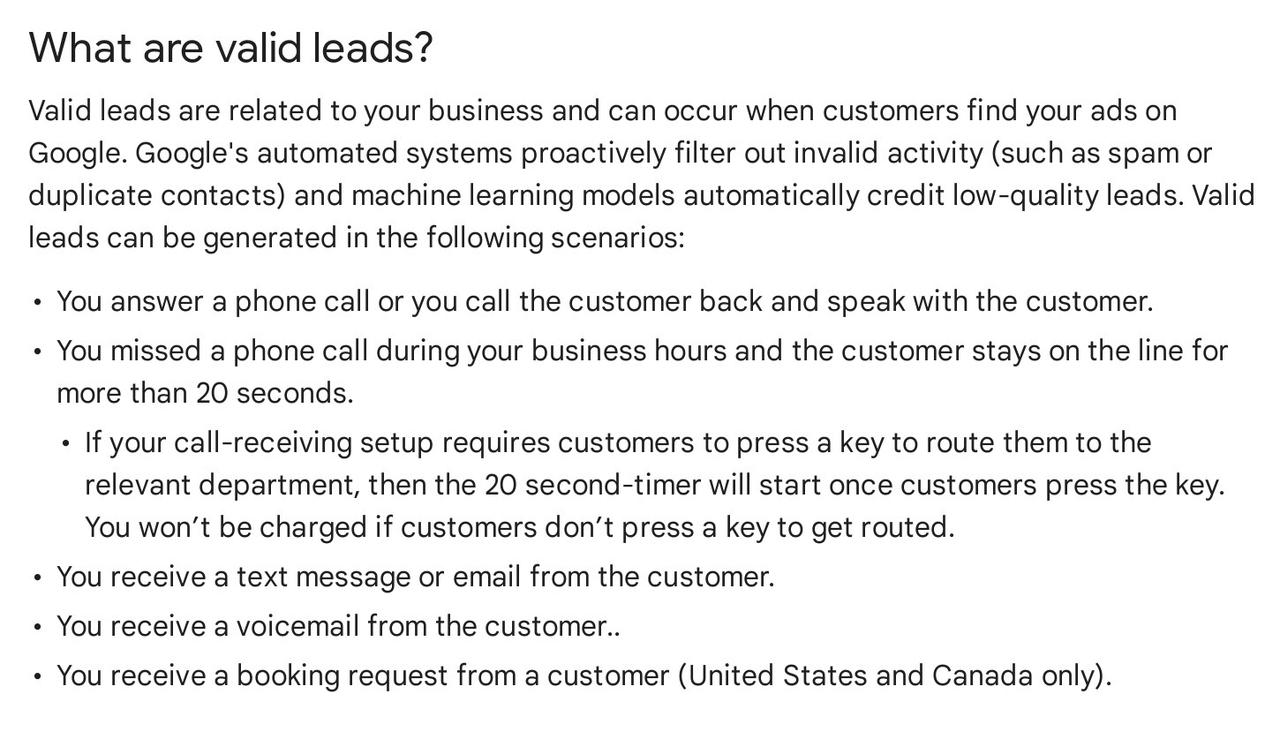
The price of each lead is not fixed. Google says lead prices "may vary depending on your location, the job type, the type of lead, or your bidding mode." For message leads, one factor is "whether the customer has contacted other Local Services advertisers." In other words, a homeowner who messages four companies at once can cost each of them something.
Bad leads are meant to be refunded, but no longer on request. Since July 2024, Google's models decide. "Charged leads get reassessed by our models over time," the help page says, and Google no longer gives credits for leads marked "job type not serviced" or "geo not serviced." A call about a job you do not do, from a town you do not cover, can now simply be a cost of doing business.
Owners have noticed. Complaints about lead quality grew loud enough in early 2025 that Google answered them in public. Ginny Marvin, Google's Ads liaison, said Google "actually credit[s] more leads overall now than we did when advertisers had to manually dispute leads." That can be true in total while a particular account still pays for calls it would never have chosen.
The badge that changed its name
For years the selling point was a green tick and two words: Google Guaranteed. It told homeowners Google had screened the business and stood behind the work with a money back guarantee. That promise has gone. On August 20, 2025, Google announced: "Starting in October, we'll be unifying all Local Services Ads (LSA) badges." Google Verified would replace "Google Guaranteed, Google Screened, License Verified by Google and the Money Back Guarantee."
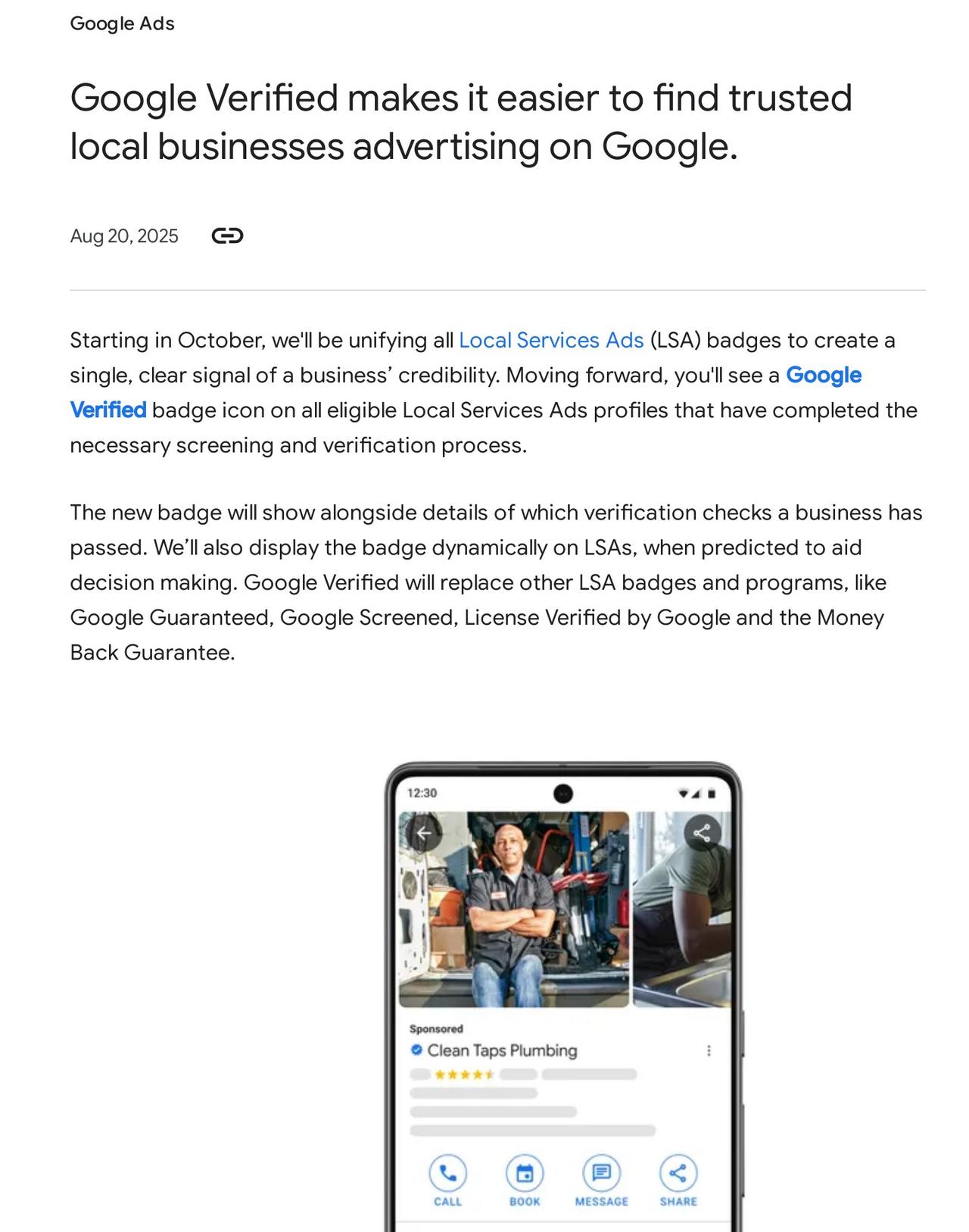
Google's help page on the new badge is plain about the money: the guarantee is being discontinued, and claims are only possible for services booked through the ads before December 7, 2025. The screening is still real. Businesses in the United States must pass background checks and show a state or provincial business licence and general liability insurance, and Google says the process takes three to four weeks on average. But the thing many homeowners still search for has quietly become a verification mark, not a promise to pay.
People have not caught up. Google's own "People also ask" box for these searches includes "Is Google Guaranteed still a thing?" and "Are local service ads going away?" The answer to the first is no. The answer to the second is not yet, but the product is being folded into Google Ads as a special kind of Performance Max campaign, Google's automated campaign type, from August 2026 in the United States and in 2027 elsewhere, according to Google's migration notice.
Where the ads sit, and what sits under them
The strongest argument for Local Services Ads is their position. Google sells them as listings "which appear at the top of the page," and when they show, nothing sits above them. But they do not show on every search, and they never fill the screen. Directly beneath them sits the map with three businesses, and beneath that the ordinary results.
That is the part most owners miss. The ad is rented by the day. The first place on the map is there for free on every search where Google shows the map, whether or not anyone bought an ad that morning. Getting a business into those three places is the whole job of our map pack expansion work.
It also matters how Google ranks the ads themselves. According to Google's page on ad ranking, the order is an auction on "bid and overall profile quality," and profile quality means "your rating, number of reviews, average response time, use of high-quality images." Missed calls, Google adds, "may negatively affect your responsiveness." Reviews, photos and speed of reply are exactly what decides the free map listings too. Paying Google does not excuse a business from earning them, which is why what happens to your reviews matters on both sides of the page.
What a lead costs
Google publishes no average prices. The best independent figures come from SearchLight Digital, which sells call tracking software and studied 888 contractor accounts in February 2026: $6.72 million of spending and 126,650 leads, measured before any credits. The blended cost was $53 a lead. Electricians paid $39, HVAC companies $51, plumbers $57 and drain and sewer firms $59.
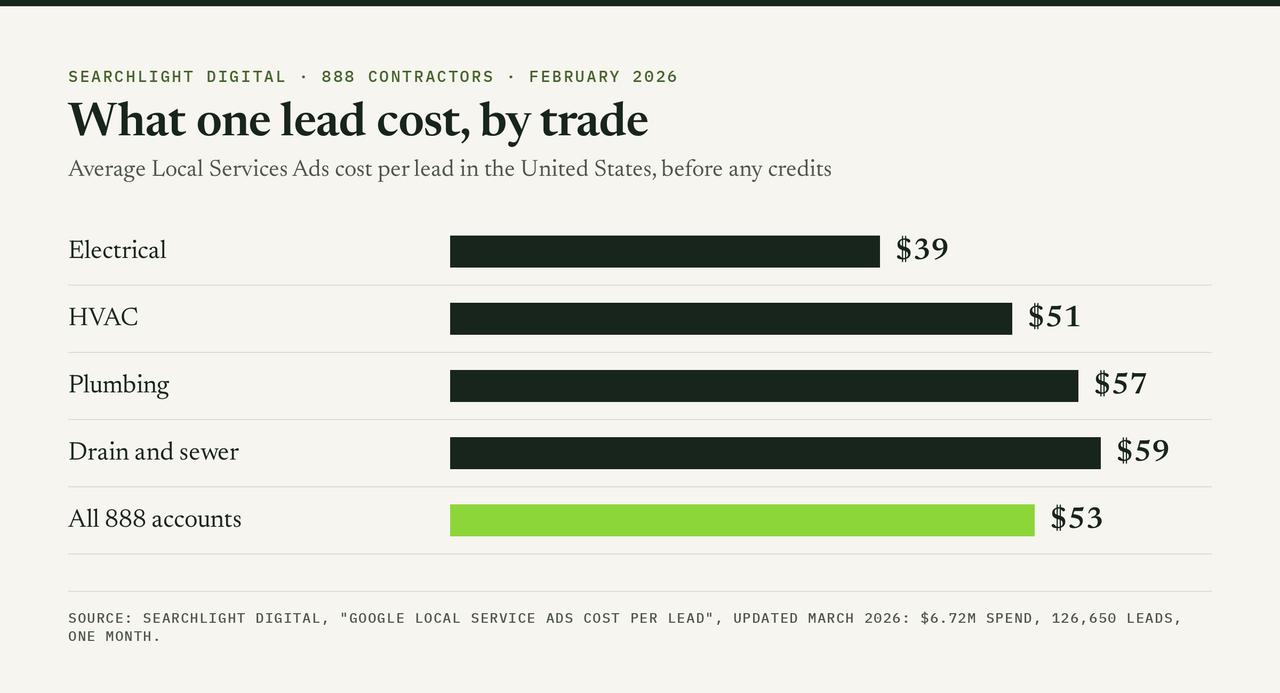
A lead is not a job. If one call in three turns into paid work, a $57 plumbing lead is really a $171 customer, and that is before the calls that were wrong numbers, sales pitches or someone shopping four quotes. For a plumbing company or an HVAC contractor in a busy month, the ads can be worth every cent. The point is that the meter never stops. Turn the spending off and the calls stop the same afternoon. Compare that with what an owner pays for search work in our SEO pricing guide, where the result is a position that keeps producing calls after the invoice is paid.
What one company's own numbers showed
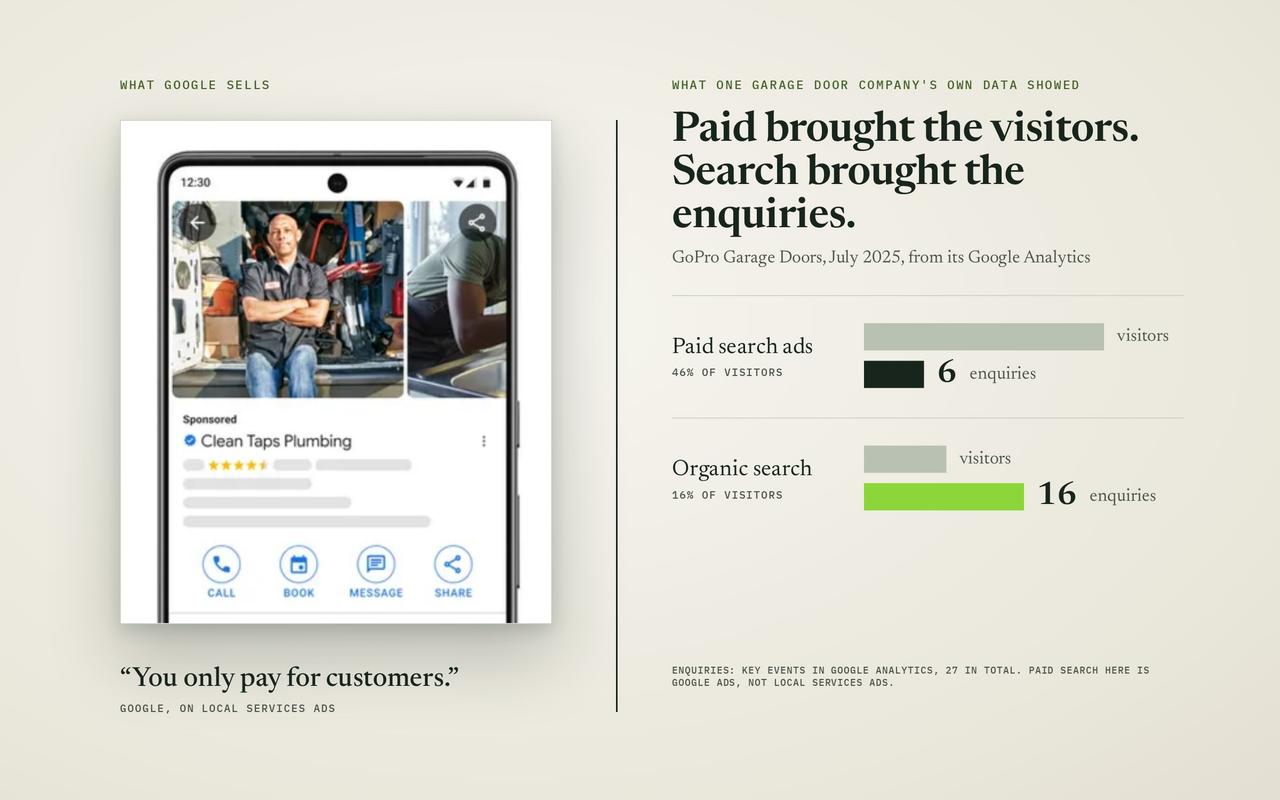
Industry averages only go so far. Here is a single business, a garage door repair company and one of our clients, looking at its own Google Analytics for July 2025. Paid search brought 606 visitors to the website that month, 46 percent of the total. Organic search, meaning the unpaid results, brought 206, under 16 percent. Then the report counts key events, the actions the company had marked as enquiries. Paid search produced 6 of them. Organic search produced 16, almost 60 percent of all 27.
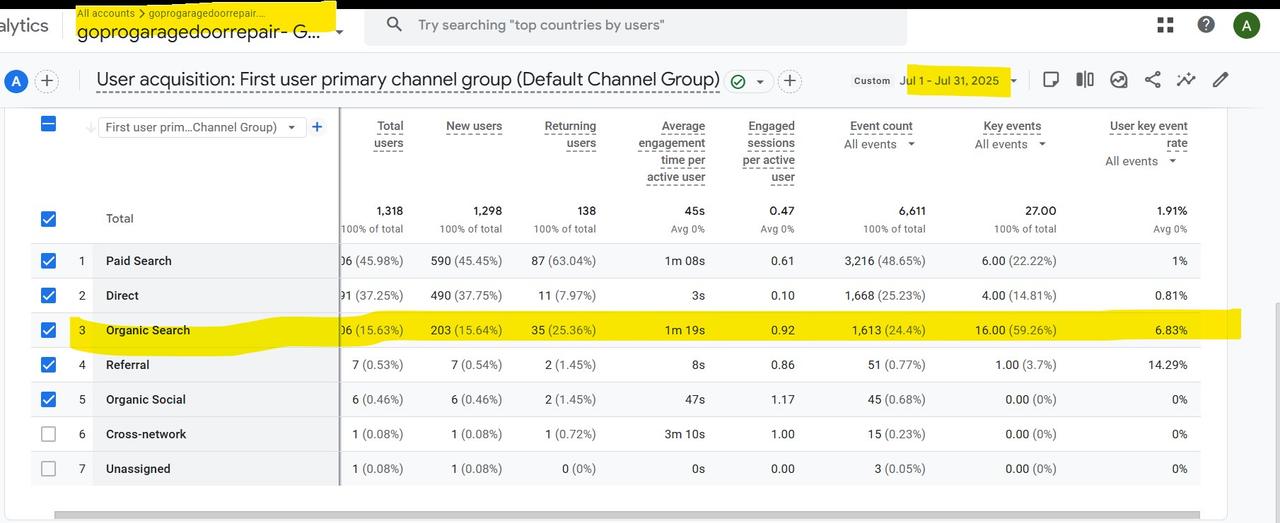
Put another way, a visitor who found the company in the unpaid results was nearly seven times as likely to get in touch, 6.83 percent against 1 percent. This was ordinary Google Ads, not Local Services Ads, and one month at one company proves nothing on its own. But it shows the pattern owners describe all the time. Paid placement buys attention. A page that answers the question is what turns attention into a call.

When there is no ad to buy
Local Services Ads are not open to every business. In Canada, Google's eligible list covers 16 trades: appliance repair, carpet cleaning, cleaning, electricians, HVAC, junk removal, lawn care, locksmiths, movers, pest control, plumbers, roofers, tree services, water damage, window cleaning and window repair. A Canadian dentist, lawyer or accountant cannot buy one at all.
For those businesses the earned results are the whole page. Pathways Dental Clinic in Calgary is a good example. A search for "Same Day Emergency Dentist in NE Calgary" shows the map, and then, as the first ordinary result, the clinic's own page written for exactly that search. No Local Services Ad sits above it, because in Canada Google has none to sell a dentist. That is the work of a dental SEO plan, and of a Calgary SEO campaign built around the searches patients make in pain.
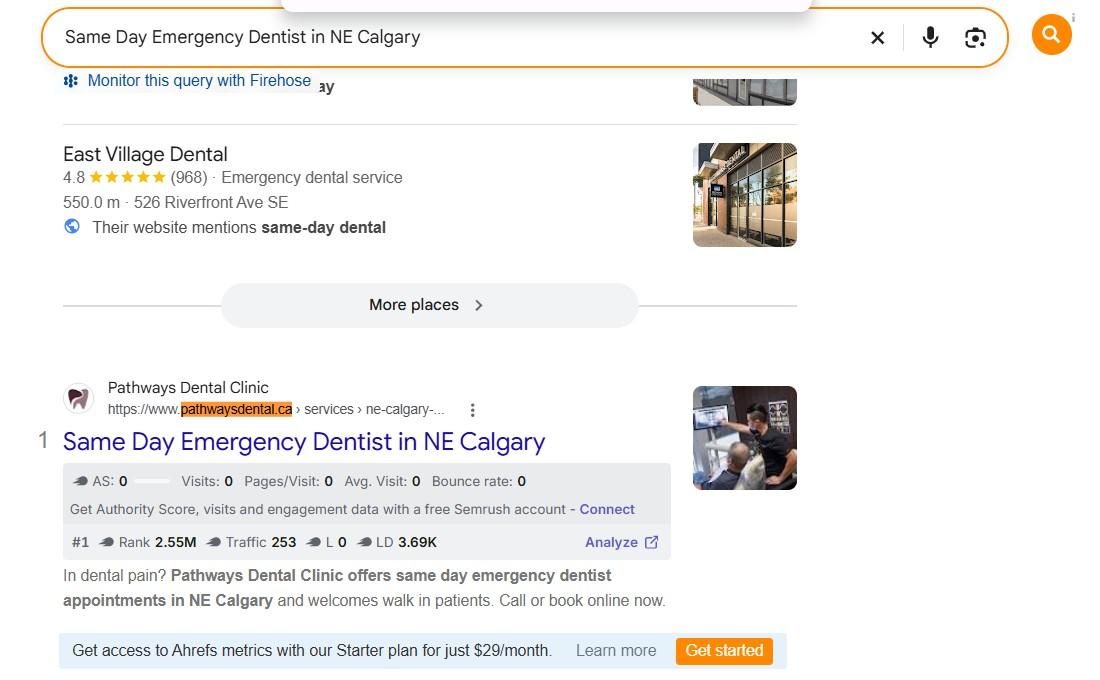
Even in the trades that can buy ads, the page that wins the click is usually a page written for the search. That is why we treat content written for each service and town as part of local search, not an extra.
The case for doing both, in the right order
None of this means Local Services Ads are a bad buy. For an eligible trade with strong reviews and someone always on the phone, they can be the fastest way to fill a quiet week. The honest comparison is about what you own at the end. A Local Services Ad is rented. The day the budget stops, so does the listing. A first place on the map, or at the top of the ordinary results, keeps working at no cost per call.
The best place to stand is directly under the ad. Go Pro Plumbing, Heating and Air in Sacramento was second and third on Google Maps for its two most valuable searches. Today, as the case study shows, one paid ad sits above it on both searches, and no other business does. In Williamsburg, Virginia, R.A. Woodall Roofing is in the map box and the first ordinary result right under it for "roofing contractor Williamsburg VA", as its case study sets out. A homeowner who scrolls past the ad lands on the same company twice. For roofing companies, where each job is large and rare, that double place on the first screen is worth more than any single lead.
There is a newer reason to care about the earned results too. Google's AI answers now sit on many of these pages, and they draw on websites and profiles, not on ads. We looked at what that means for local businesses in our piece on Google's AI Overviews.
What to do this month
Start by finding out who is already taking the calls. Our free check on who is taking your Google leads shows which businesses sit above yours on the searches that matter. If you run Local Services Ads, look at your lead list for the last 30 days and count the calls you would never have chosen, then read the billing change again: from October 1, every missed call longer than 20 seconds is on the meter. If someone cannot always pick up, that is the first thing to fix.
Then look at the free part of the page. Are you in the map pack for your main service in your own town? Is there a page on your website written for that exact search? If not, the ad is doing work your listing should be doing for nothing. That is the gap our SEO service exists to close. Pay for the top slot if it pays you back. Earn the places under it either way, because those are the ones you keep.
Every fact in this story is linked to its source. Spot something out of date? Tell the editor and we will correct it.
Questions readers ask
Frequently asked questions
What is the difference between Local Services Ads and SEO?
Local Services Ads are paid listings at the very top of Google, charged each time a customer contacts you. SEO is the work of ranking in the free results under them: the map with three businesses and the ordinary list of websites. Ads stop when you stop paying. Free rankings keep working.
How much do Google Local Services Ads cost per lead?
Google sets prices by location, job type, lead type and bidding mode, and publishes no averages. SearchLight Digital's study of 888 US contractors in February 2026 found an average of $53 a lead before credits: $39 for electrical, $51 for HVAC, $57 for plumbing and $59 for drain and sewer.
Is Google Guaranteed still a thing?
No. In October 2025 Google replaced Google Guaranteed, Google Screened and License Verified by Google with a single Google Verified badge. The money back guarantee was discontinued, and claims only cover services booked through the ads before December 7, 2025.
Do I pay for missed calls on Local Services Ads?
Yes, from October 1, 2026. Google charges a missed call during business hours as a valid lead if the caller stays on the line for more than 20 seconds.
Are Local Services Ads going away?
No, but they are moving into Google Ads as a special kind of Performance Max campaign. Google says US accounts move from August 2026 and accounts outside the US in 2027, and that you still pay only for valid leads.
Can my business use Local Services Ads in Canada?
Only in 16 eligible trades, including plumbers, electricians, HVAC, roofers, movers, locksmiths and pest control. Dentists, lawyers and most other professions in Canada cannot buy them, so the free map and website results are the whole page for them.
About the author