Guides
Is SEO worth it?
How an established business can tell before it spends.
· Updated · 6 min read

In this story
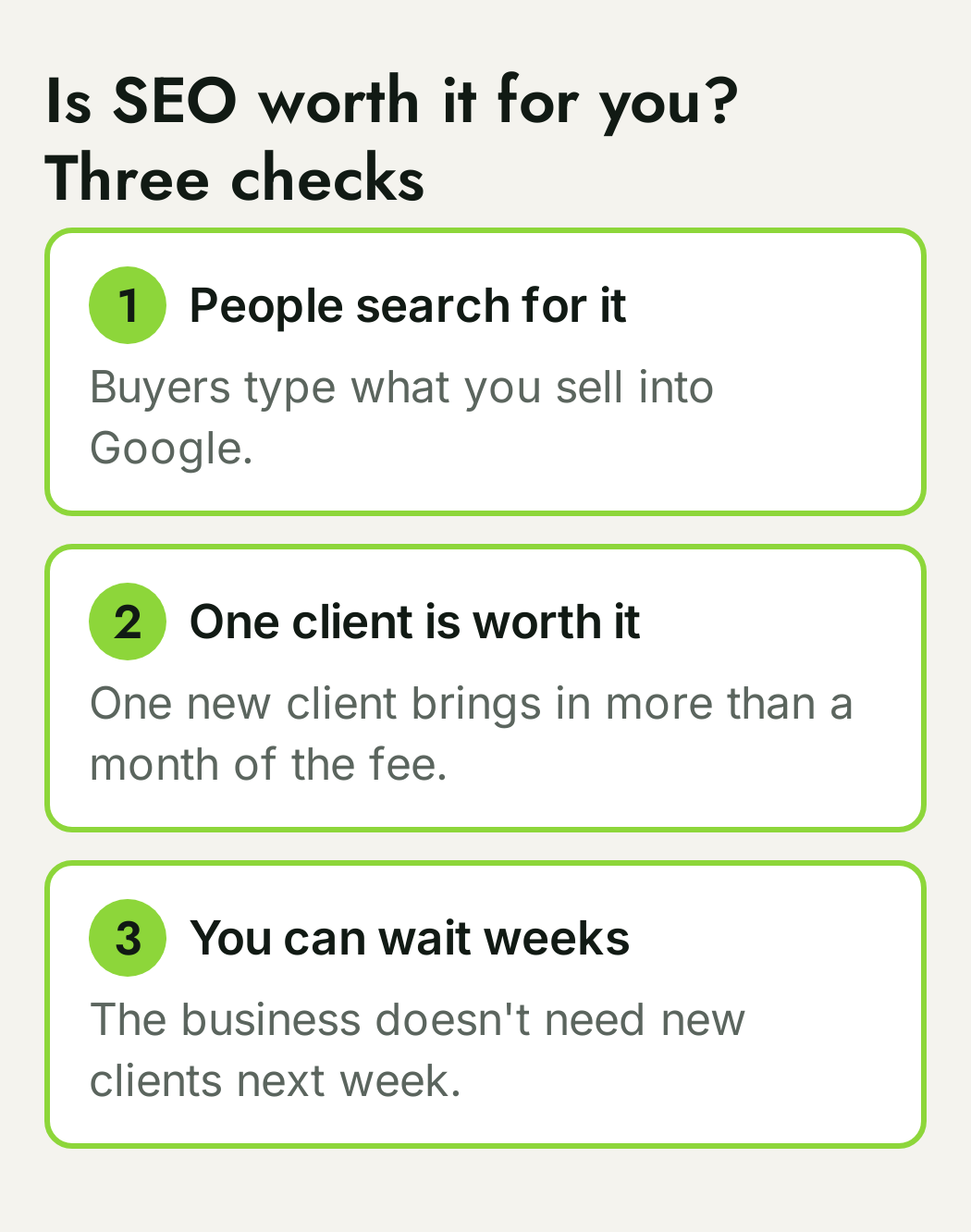
SEO is worth it when three things are true: people search Google for what you sell, one new client is worth more to you than a month of the fee, and your business can wait weeks, not days, for the work to show. If any one of them is false, put the money somewhere else for now. The rest of this guide shows how to check each one yourself, with your own numbers, before you spend anything.
The question gets asked a lot, and the answers online are thin. On November 24, 2026, the top results on Google in the US for "is seo worth it" were two Quora threads, a Facebook post, a Reddit thread and articles dated 2024. An owner deciding whether to spend a few thousand dollars a month deserves a way to work it out.
Even Google hedges. Its own page for site owners, "Do you need an SEO?", read on November 25, 2026, calls hiring one "a big decision that can potentially improve your site's visibility and save you time, but you can also risk damage to your site and reputation." That's a fair summary: it can pay, and it can go wrong. This guide is about telling which one you're looking at.
What does "worth it" mean for an established business?
SEO (search engine optimization) is the work of getting your website shown in Google's free results, the ones below the ads, when people search for what you sell. Nobody pays Google for those spots. Google says so plainly on the same page: "Google never accepts money to include or rank sites in our search results, and it costs nothing to appear in our organic search results."
So the cost of SEO is the work, not the placement: your own time, or a fee to someone who does it for you. "Worth it" then has a simple meaning. Over the months you pay for the work, do the new clients who find you through Google bring in more than the work costs?
Nobody can promise you the answer to that in advance, and you should be wary of anyone who does. What you can do is check the three conditions it depends on. Each takes about ten minutes.
Do people search Google for what you sell?
This is the first check because nothing else matters without it. SEO only works on searches people already make. If buyers don't type what you sell into Google, ranking for it brings nobody.
For the high‑ticket businesses we work with, the demand shows up even in the national numbers. Here is how many times a month people in the US search a few of them, from Google's own advertising tool, read on November 24, 2026:
| Search (US) | Searches a month |
|---|---|
| dental implants | 165,000 |
| med spa | 165,000 |
| breast augmentation | 74,000 |
| plastic surgeon | 49,500 |
| custom home builder | 40,500 |
| all on 4 dental implants | 18,100 |
Source: Google Ads estimates through our SEO research tool, whole of the US, read November 24, 2026. Google gives no figure for some legal and health searches, such as "personal injury lawyer".
Those are national numbers. Your market is your town or your region, so your share will be a small slice of them, and that's normal. A practice in one city doesn't need 165,000 searches. It needs the searches from the people within reach of it, and enough of those to matter.
To read your own: type the three or four things your best clients would type, the way they'd type them, with your town if they'd add it. If Google fills in your search as you type, people are making it. If it shows ads at the top, businesses are paying for those clicks, which tells you buyers are behind them. If you want the numbers, any agency worth talking to will show them to you before you pay.
If you sell something nobody searches for (a new kind of product, or a service people only hear about through a referral), SEO can't create the search. That's the clearest case where it isn't worth it yet.
What is one new client worth to you?
This is the number many owners skip, and it decides everything else. It isn't the price of one job. It's what one new client brings in, after the cost of serving them, over the time they stay with you.
Work it out with your own figures:
- The average sale. What a new client pays you on the first job or case.
- What's left after costs. Take off materials, lab fees, staff time and anything else the job costs you. What remains is the margin on that sale.
- What they come back for. Repeat visits, follow-up work, referrals you can trace to them. Count only what you see happen today, not what you hope for.
Add the margin on the first sale to the margin on what typically follows. That's the value of one new client to your business.
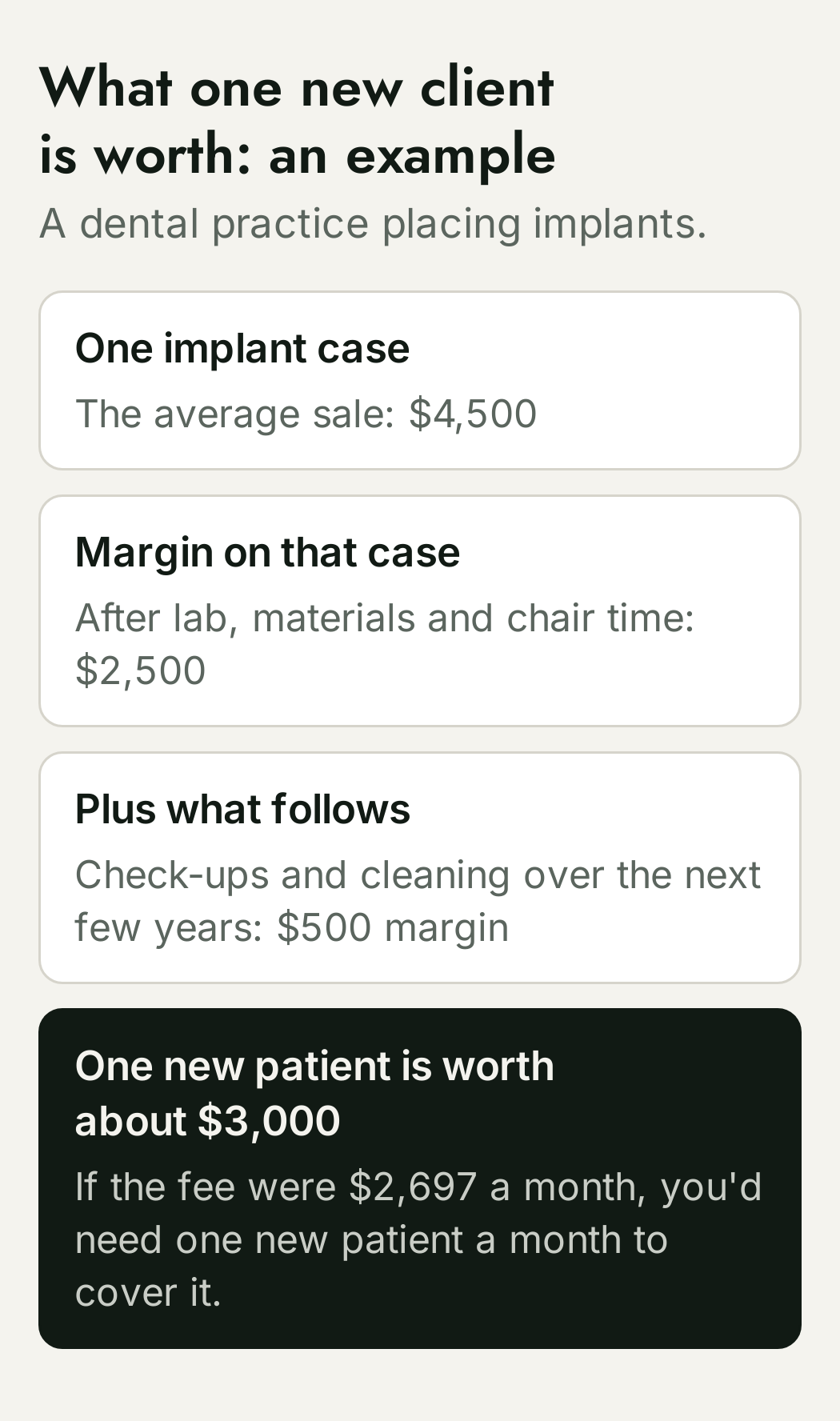
An example, with made-up figures so you can see the sum. Say a dental practice places implants. One case is $4,500, and after the lab, materials and chair time, $2,500 of it is margin. Patients who come in for implants usually stay for check-ups and cleaning, worth about $500 in margin over the next few years. So one new implant patient is worth about $3,000 to that practice. Your own numbers will be different: use them, not ours.
How many new clients would it take to cover the fee?
Now put the value of one client next to the monthly fee. Our own prices, as published on our SEO pricing page: Google Maps starts at $1,497 a month. Google rankings start at $2,697 a month. Both go up for multiple locations, multiple websites and complexity.
Divide the monthly fee by the value of one new client. The answer is how many new clients a month it would take to cover the fee.
With the example practice above, where one new implant patient is worth about $3,000: if the fee were $2,697 a month, you'd need one new patient a month to cover it. If one new client were worth $800 to you, you'd need four. If one were worth $300, you'd need nine, and that's a much harder sum to make work.
This isn't a forecast of what SEO will bring. Nobody can tell you that honestly before the work starts, and the number of new clients depends on your market, your competitors and how well your business answers the phone. What the sum tells you is the bar. When covering the fee takes one or two clients a month, SEO has a lot of room to be worth it. When it takes a dozen, it has very little.
That's why the businesses that get the most from SEO tend to be ones where a single client is worth thousands: implant dentists, plastic surgeons, med spas, personal injury and family law firms, luxury builders. It's also why we only take on established businesses: their numbers usually pass this test before we've done a thing.
What would the same clicks cost you in Google Ads?
The other way to show up on Google is to pay for every click. Google's advertising tool estimates what advertisers pay, and for high‑ticket searches it's a lot. Average cost of one click in the US, read on November 24, 2026:
| Search (US) | Average cost of one click |
|---|---|
| dental implants | $28.46 |
| all on 4 dental implants | $26.78 |
| breast augmentation | $13.11 |
| plastic surgeon | $12.42 |
| custom home builder | $8.95 |
| med spa | $7.27 |
Source: Google Ads estimates through our SEO research tool, whole of the US, read November 24, 2026. Real prices in your town can be higher or lower.
That's per click, not per client. A visitor who clicks an ad and leaves still costs the full price. Here's a quick sum to do with your own search: divide your monthly marketing budget by the cost of one click in your area. That's how many visits the same money buys in ads, every month, for as long as you keep paying.
The free results work differently. Once your page ranks, each visit from it costs nothing extra, and the clicks don't stop the day a payment does. That's the core case for SEO next to ads. It isn't one or the other: ads are fast, and SEO builds something you keep. We compared them in full in SEO vs Google Ads.
When is SEO not worth it?
An honest answer has to include the cases where the money is better spent elsewhere. SEO isn't the right buy, or isn't the right buy yet, when:
- Nobody searches for what you sell. No search, no visitors, however well you rank. Build awareness first.
- You need clients next week. SEO takes weeks to show and months to build. If this month's numbers are the emergency, ads are the faster tool. Our guide on how long SEO takes has the timeline.
- You can't take on more work. If you're booked out and can't grow the team, more people finding you only means more people you turn away.
- One client is worth too little. If covering the fee takes dozens of new clients a month, the sum above won't work at agency prices. Doing the basics yourself is the better start, and Google says so too (below).
Our SEO services page puts the short version of this in one line: if nobody searches for what you sell, or you have no room for more work, wait.
Is SEO worth it for a small business?
It depends less on the size of the business than on the sum above. A two‑person clinic doing complex, expensive work can pass the test easily: a single new client covers the month. A larger business selling low‑priced, one‑off jobs can fail it.
For a small business on a tight budget, Google's own advice is to start yourself. Its free SEO starter guide and a free Google Business Profile cover the basics, and you can do a lot of it yourself.
Where hiring a team starts to make sense is when the searches you want are competitive (others are already working hard to rank for them), when your time is worth more spent on clients, and when the value of one client makes the fee a small bar to clear.
If you're weighing a freelancer against a team, our guide to what SEO consultants cost sets out the prices side by side.
How do you know whether it's working?
You shouldn't have to take anyone's word for it, ours included. Before you sign with anyone, ask what you'll be able to see, and when. Google itself suggests asking any SEO: "What kind of results do you expect to see, and in what timeframe?" and "How do you measure your success?"
These are the things worth looking at, in this order:
- Where you rank for your list of searches. Before any work starts, you should have a written list of the searches that matter to your business. Look at where you stand for each, on the day work starts and every month after.
- Visits from Google. Google's free Search Console shows how often your site appeared in search, how often people clicked, and for which searches. Ask for access to your own; it's yours.
- Enquiries you can trace. Ask new clients how they found you, and note it. Over a few months, you'll see whether Google is one of the answers.
Plenty of agencies ask you to wait six to twelve months before judging them. We put our dates in writing instead: Page one in 60 days, or we work free.
So, is SEO worth it?
For a business that sells something people search for, where one new client is worth more than a small part of a month's fee, and that can wait weeks for the work to show: usually, yes, and more so every month it holds, because a ranking keeps working without a charge for each click. For a business that fails any of those three checks, not yet, and nobody should sell it to you as if it were.
Do the three checks with your own numbers. If they pass, the next question is who does the work. Our SEO checklist for business owners sets out what good work looks like, in 30 checks in plain words.
If you'd like us to look at your searches and your market with you, the strategy call is free and takes 30 minutes. Our work is for established businesses already doing $20,000 a month or more.
Every fact in this story is linked to its source. Spot something out of date? Tell the editor and we will correct it.
Questions readers ask
Frequently asked questions
Is SEO worth it in 2026, with AI answers at the top of Google?
Yes, for a business that passes the three checks in this guide. The same work now pays off in more places: Google's map, its normal results, and the AI answers at the top of the results. Our guide to Google's AI Overviews explains how they pick their sources.
What is SEO ROI, and how do I work it out?
ROI (return on investment) compares what the work brings in with what it costs. For SEO, work out what one new client is worth to you after costs, divide the monthly fee by that figure, and you have how many new clients a month it takes to cover the fee. Then track where new clients came from, month by month, against that bar.
How long before I know if SEO is worth it?
You can do the three checks in this guide before you spend anything. After work starts, look at where you rank for your list of searches each month. Our guide on how long SEO takes sets out what to expect, and when.
Is SEO dead?
No. People still search Google for what they want to buy, and the free results still take the clicks below the ads. What changed is that there are now more places to show up, including the AI answers at the top of the results.
How much does SEO cost?
Ours: Google Maps starts at $1,497 a month. Google rankings start at $2,697 a month. Both go up for multiple locations, multiple websites and complexity. Our SEO pricing page compares them with what other agencies charge.
Do I really need SEO for my website?
Not every website does. If your clients come only through referrals and nobody searches for what you sell, a website can do its job without it. If people search Google for your service in your area, someone will show up for those searches, and SEO is how that becomes you.
About the author