Local SEO and Google Maps
Local SEO for small business: a step-by-step guide for 2026
How a small business gets found on Google, Maps and AI answers in 2026: how Google picks who shows up, and the steps that put you there.
· Updated · 6 min read
In this story
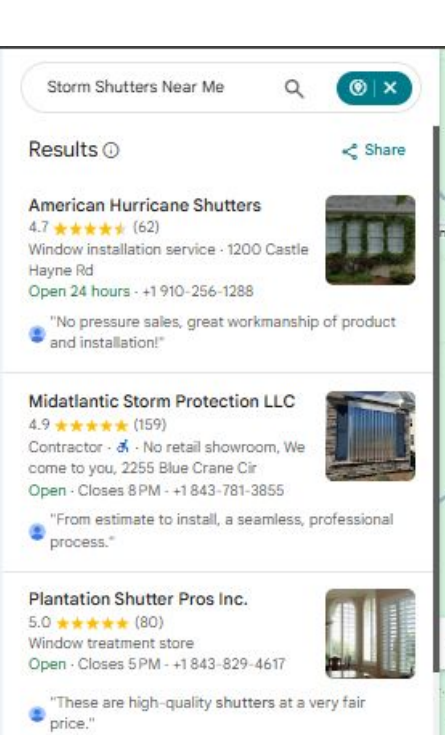
In January 2026, we searched Google Maps for "storm shutters near me" from Ocean Isle Beach, a beach town on the North Carolina coast. The first business on the list was American Hurricane Shutters. Its shop is in Wilmington, 52 miles up the road.
The two businesses listed below it had 159 and 80 reviews. American Hurricane Shutters had 62. On paper, a shop that far away, with fewer reviews than the businesses under it, should not have been first.
That search is a small lesson in how Google decides which local businesses a customer sees. The closest business does not automatically win. Neither does the one with the most reviews. What wins is a set of things a small business can work on, most of them free and most of them within reach of an owner with a phone and an afternoon. The name for that work is local SEO, and this guide walks through it step by step, as it stands in October 2026.
What local SEO means, in plain words
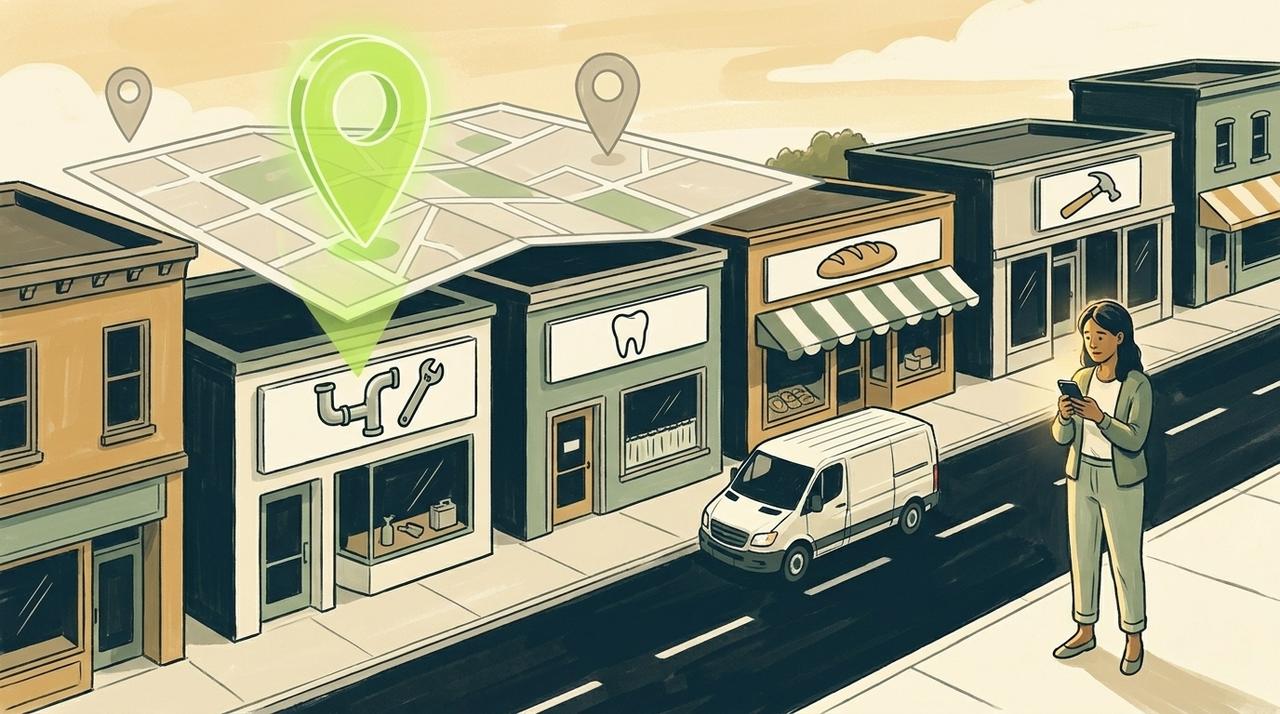
SEO stands for search engine optimization: the work of getting a business shown when people search on Google. Local SEO is the part of it that deals with searches where the customer wants someone nearby, like "plumber near me", "dentist in Oakville" or "emergency roof repair".
For those searches, Google shows your business in up to three places on the same screen:
- The map box. A small map with three businesses under it, usually near the top of the page. Tap "more" and it opens Google Maps with the full list.
- The regular results. The list of websites under the map, the part most people picture when they think of Google.
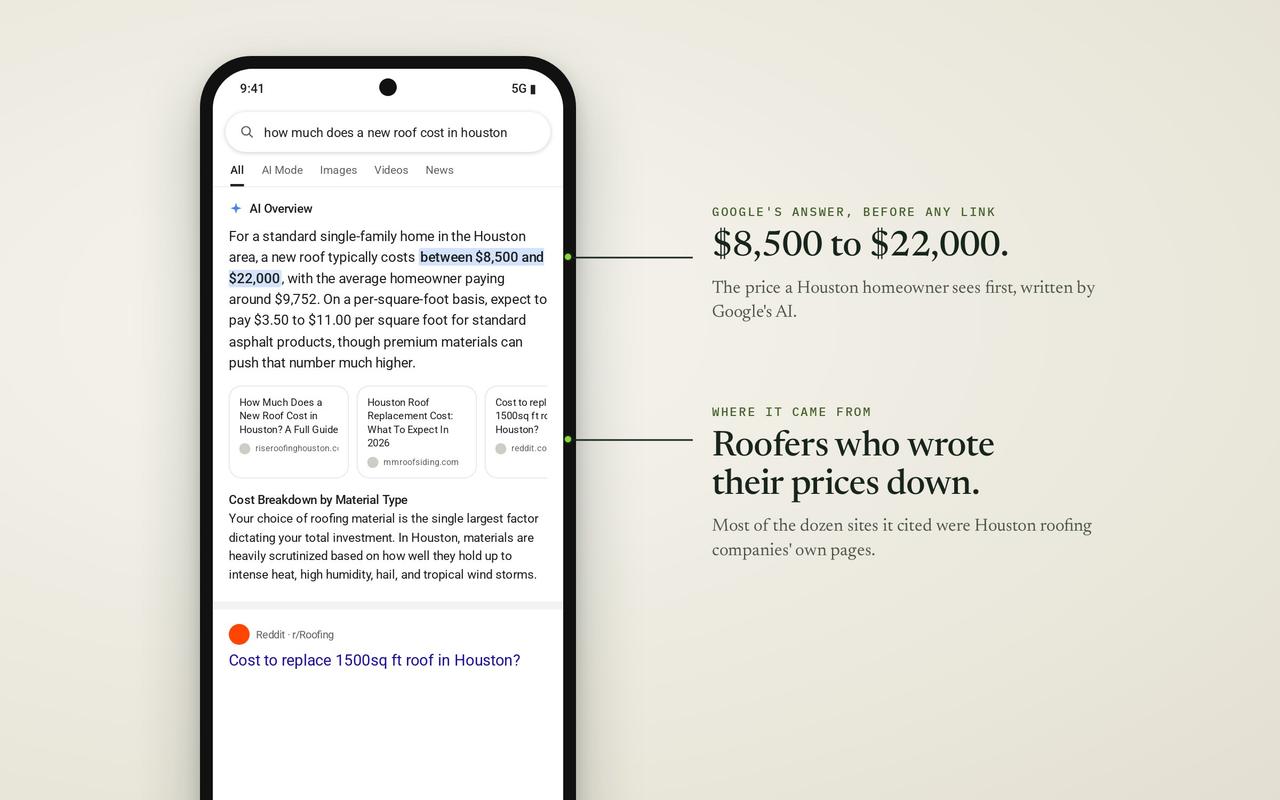
- The AI answer. Google now often writes a short answer at the very top of the page, called an AI Overview, and sometimes names businesses in it. Assistants like ChatGPT do the same when someone asks them for a recommendation.
Customers move between all three. In a July 2026 BrightLocal survey of 1,227 Americans who had recently looked for a local business, 52% started on Google Search and another 9% on Google Maps. Only 8% chose an AI tool first. But 75% used more than one channel before choosing, and 73% started on a phone.
That matters for one practical reason. The things that put a business in the map box are, to a large degree, the same things the AI answers read. A small business does not need three separate plans. It needs one done well.
How Google picks the three businesses on the map
Google is unusually open about this. Its help page on local ranking says that "local results are mainly based on relevance, distance, and popularity," and then explains the three under the headings relevance, distance and prominence.
- Relevance "is how well a Business Profile matches what someone is searching for." A bakery will not show up for "wedding cake" if nothing on its profile or website mentions wedding cakes.
- Distance "refers to how far each business is from the customer who's searching." You cannot move your shop, so this is the one factor you cannot change directly.
- Prominence "means how well-known a business is." Google adds that this is "based on info like how many websites link to your business and how many reviews you have."
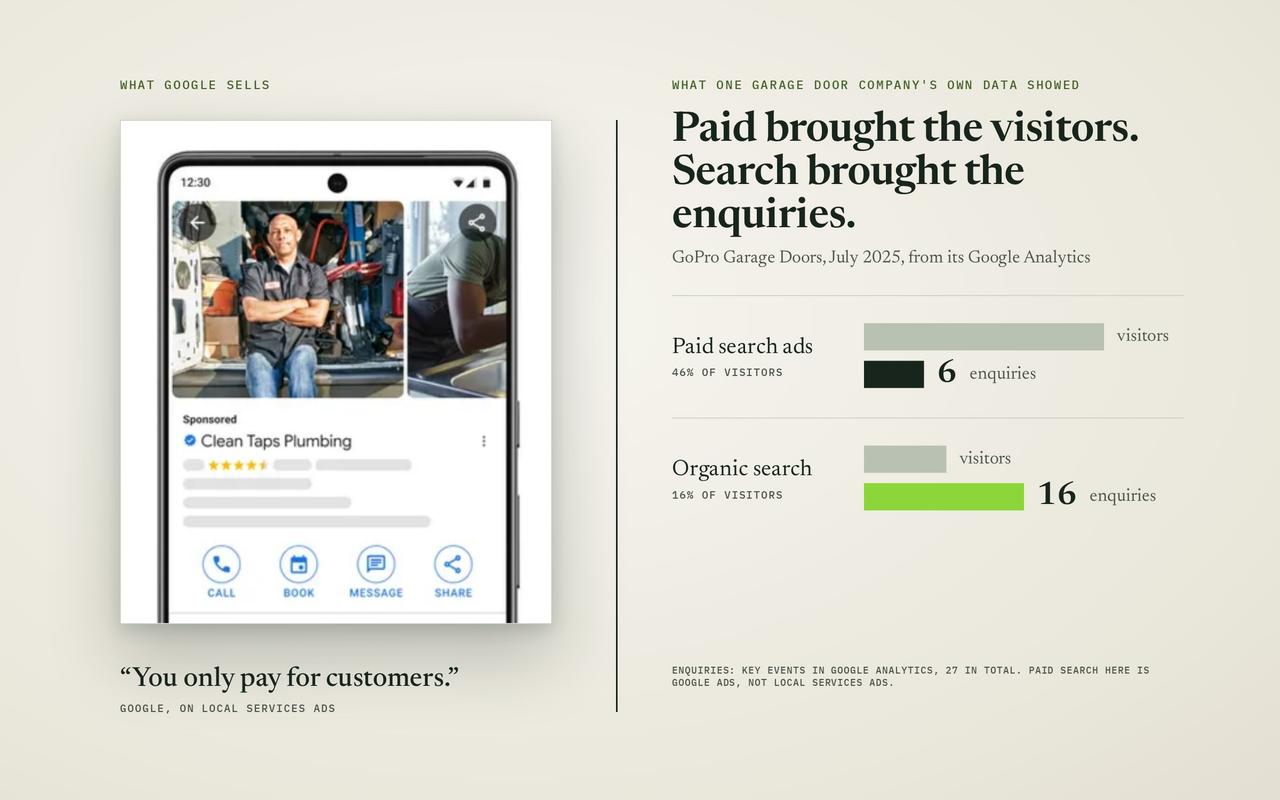
The same page closes the door on shortcuts: "There's no way to request or pay for a better local ranking on Google." Ads can buy a spot above the map, as we explained in our piece on Google's Local Services Ads, but the map itself cannot be bought.
Google does not publish the full recipe, so the industry surveys the people who do this work for a living. The best known is the Local Search Ranking Factors survey, run by Darren Shaw of the Canadian firm Whitespark. The 2026 edition, published in November 2025, asked 47 local search specialists to weigh 187 factors. Their top ten for the map box, in order:
- The main category chosen on the Google Business Profile
- How close the business is to the person searching
- Words in the business name that match the search
- Having a real address in the city being searched
- Being open at the time of the search
- A high star rating
- Showing an address on the profile, rather than hiding it
- Extra categories on the profile
- The number of Google reviews with written comments
- The map pin sitting in the right place
Two of those ten are about reviews. Most of the rest are about how the business is set up on Google: its category, its hours, its address, its pin. That is the first thing to understand about local SEO. Reviews are the part everyone can see and count, so they get the attention. They are one input among many.
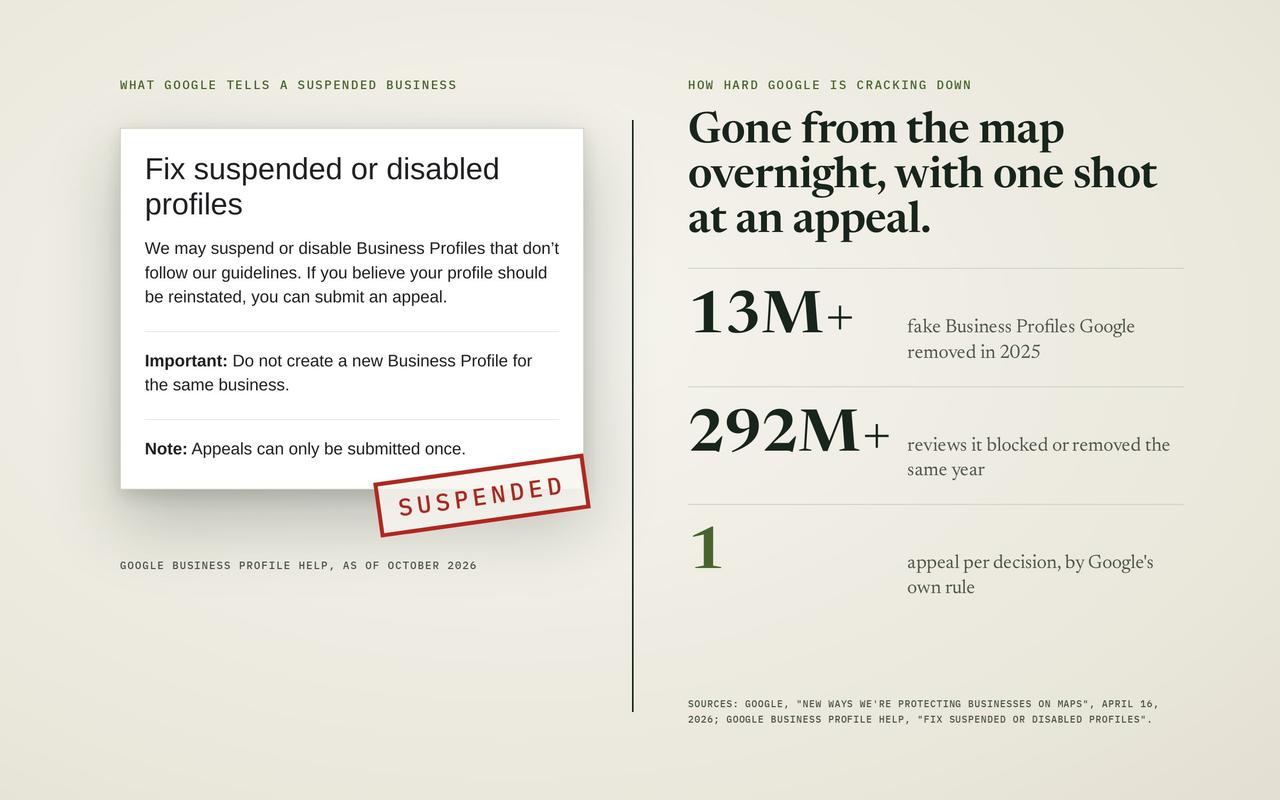
The list also hides a trap. "Words in the business name" ranks third, which tempts owners to rename themselves "Smith Plumbing Best Plumber Austin" on Google. Don't. Google's rules for business profiles say "your name should reflect your business's real-world name" and that adding unnecessary information to it isn't permitted. Breaking that rule is one of the common reasons a profile gets suspended. If your real name already says what you do, you have an edge. If it doesn't, the rest of this guide is how you make up for it.
Step 1: Set up your Google Business Profile properly
Your Google Business Profile is the free listing that appears on Maps and in the map box: your name, hours, phone number, photos and reviews. If you have never claimed yours, search your business name on Google, find the listing and look for the option to claim it. Google will ask you to verify that you own the business, and its own ranking tips list "Verify your business" first.
The basics are covered in the small business SEO section of our site, including choosing the right main category and listing every service. Here is what goes beyond them.
Choose your main category for the calls you want most. It is the top factor in the Whitespark survey for a reason. A business that does both heating and plumbing but wants more furnace work should lead with the heating category and add plumbing as an extra category, not the other way round.
Keep your hours exact, including holidays. Being open at the time of the search ranks fifth in the survey. A business that is listed as closed on a Saturday morning will not appear to someone searching on Saturday morning, even if the owner is answering the phone.
Hide your address only if you have to. Google says that if you are a service-area business, one that goes to customers rather than having them come to you, "you should hide your business address from customers." A plumber working from home should follow that rule. But a business with a real shop or office that customers visit should show it, because a visible address in the city being searched counts for a lot. Never invent an address to look local. It breaks Google's rules.
Write a description that says what you do and where. Google allows up to 750 characters. Use them to say, in plain words, what you do, for whom, and in which towns.
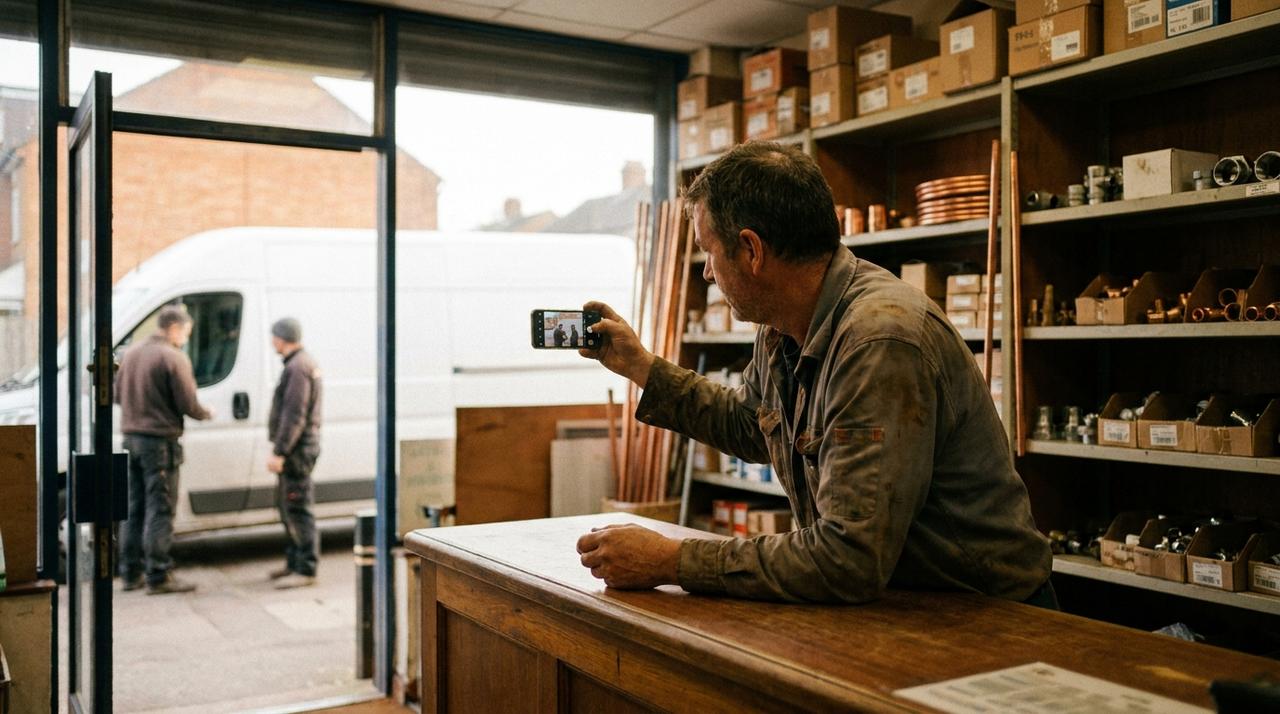
Add photos of your real work, and keep adding them. "Add photos & videos" is one of Google's own ranking tips. Phone photos of finished jobs, your team and your van are worth more than stock images, because they show customers who will turn up.
Post updates. Google still lets owners publish updates, offers and events on their profile. Google archives posts after six months unless they have a date range, so a post every few weeks keeps the profile looking alive.
Turn on messaging if it's offered to you. Google's older chat feature closed in 2024. Today, in some regions, Google lets verified businesses add a WhatsApp or text message option to their profile, under the contact settings. Google says it "might not be available" for every profile, so check yours.
Know where the questions went. For years, profiles had a public question-and-answer section. In December 2025, Google confirmed to Search Engine Roundtable that it was essentially removing it from Google Maps, in favour of an "Ask" button that answers customers' questions with AI, drawing on what it knows about your business. In August 2026 the same publication reported Google testing a revamped version. Either way, the practical answer is the same: put the answers to your customers' common questions where Google can read them, on your profile and on your website.
Step 2: Give every service and every town a page on your website
A profile tells Google who you are. Your website tells it what you do, in detail, and that is where relevance is won or lost.
The most useful single change most small businesses can make is to give each main service its own page. Whitespark's 2026 survey added a new list this year: the factors that matter most for being named in AI answers. "Dedicated Page for Each Service" came second. A roofer with one page that says "we do roofing" gives Google nothing to match against "flat roof repair" or "gutter replacement". A roofer with a page for each gives it something to match against every one of them.
If someone else manages your website, you can send them this:
Please make sure each of our main services has its own page. On each one, include: what the service is, who it's for, what it typically involves, the towns we serve for it, three or four common customer questions with short answers, and a few photos of real jobs. Put the service name and our main town in the page title. Add our business name, address and phone number to the footer of every page, written exactly as they appear on our Google listing.
Those customer questions matter more than they used to. With the question section on Google profiles largely gone, the AI answers have to get their facts from somewhere. Google's own guidance for its AI features says there are "no additional requirements to appear in AI Overviews or AI Mode," and lists keeping "your Merchant Center and Business Profile information" up to date among its recommended practices. In other words, the same well-built pages that help you rank in the regular results are what AI answers read. We explain how those answers choose businesses in our report on Google's AI Overviews.
If you serve several towns, each one that brings real work deserves a page that says what you do there, with local detail a competitor could not copy. That is how one business reaches the next town over, and it's the core of what our SEO content writing and on-page SEO teams do. A slow or broken website undoes all of it, which is why technical SEO sits underneath.
Step 3: Get your business named on the sites AI reads
Here is where 2026 differs most from the advice in older guides. Google's map box is still where most local customers start. But a growing share also ask AI tools, and those tools build their answers from what other sites say about you.
BrightLocal, a British company that makes local search software, ran about 200,000 local searches through Google Maps, Google's AI Overviews, Google's AI Mode and ChatGPT, and published the results in September 2026. Google Maps named one of the businesses it was tracking in 66% of searches. The AI tools did so far less often.
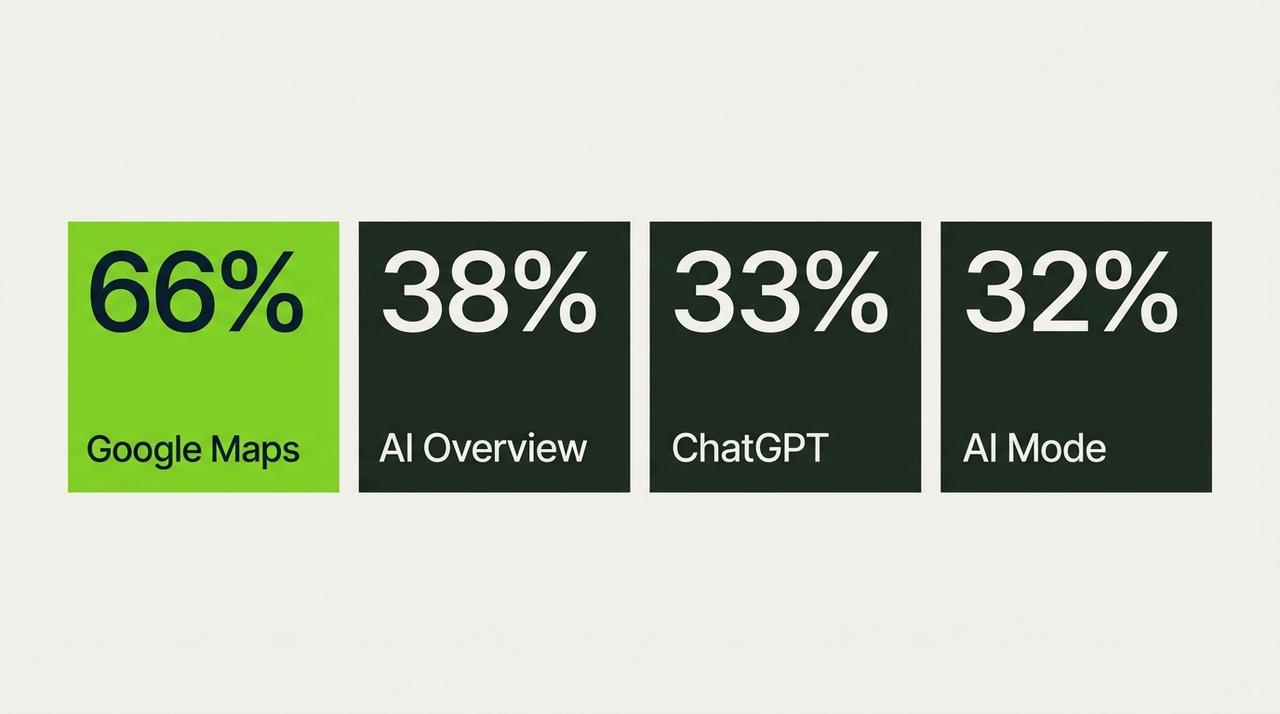
The AI answers were also unstable. When BrightLocal ran the same search again, the businesses named overlapped by only 23% on ChatGPT, 21% on AI Mode and 33% on AI Overviews. A business can be recommended in the morning and missing by lunch.
So where do the AI tools get their names? BrightLocal's study found that 93% of the different websites the AI tools used as sources were business websites. A separate BrightLocal analysis of 1.9 million citations, published in August 2026, found that Google Business Profiles alone accounted for about 29% of all the sources the AI tools pointed to, and Yelp for about 9.5%. Yext, a company that manages business listings, found in 2025 that first-party websites produced 44% of the citations in its sample and listings 42%.
Put plainly: your own website and your listings are most of what AI tools read about you. Whitespark's survey puts it in one line: "In AI SEO, mentions (citations) are the new link." The factor its experts ranked first for AI visibility was being on "expert curated best of and similar lists."
The steps that follow from that are not glamorous:
- Make sure your name, address and phone number are identical everywhere. Your website, Google, Apple Maps, Bing, Yelp, Facebook and the directories for your trade. Differences make it harder for Google and the AI tools to be sure they are all you.
- Get listed where your customers look. Every trade has its own directories and associations. A dentist's list is not a roofer's.
- Get onto the local "best of" lists. Local newspapers, city guides and trade publications publish them. Being named on one is now worth more than it was.
- Earn links from local sites. Google names links as part of prominence. A sponsorship of the local youth team, a supplier who lists you as an installer, a chamber of commerce membership: each is a local site that points to yours. Our link building work does this at scale.
None of this replaces the work in steps one and two. It adds to it. A strong profile and a well-built website now pay off on the map, in the regular results and in the AI answers at once, which is why our local SEO services include AI search in every plan. For businesses that want to go further with AI tools specifically, we cover ChatGPT and Google AI Overviews as services of their own.
Step 4: Treat reviews as one part of prominence
Reviews deserve their own step because customers read them, not because they decide the ranking on their own. BrightLocal's 2026 consumer review survey, by Rosie Murphy, asked 1,002 American adults how they choose. The answers explain why reviews matter even after you have been found:
- 97% read reviews for local businesses.
- 68% will only use a business with four stars or more, up from 55% in 2025.
- 74% look for reviews written in the last three months.
- 89% expect owners to respond to reviews.
The same survey found that 45% of consumers now use AI to get business recommendations, up from 6% a year earlier. Reviews are part of what those tools read too.
The American Hurricane Shutters search at the top of this article shows the limit. It ranked first with fewer reviews than the two businesses below it. In Louisville, Kentucky, our client 360 Hazardous Cleanup reached second place on Google Maps for "biohazard cleaners" with a single review, 20 days after starting from 67th. Neither got there by out-reviewing its rivals.
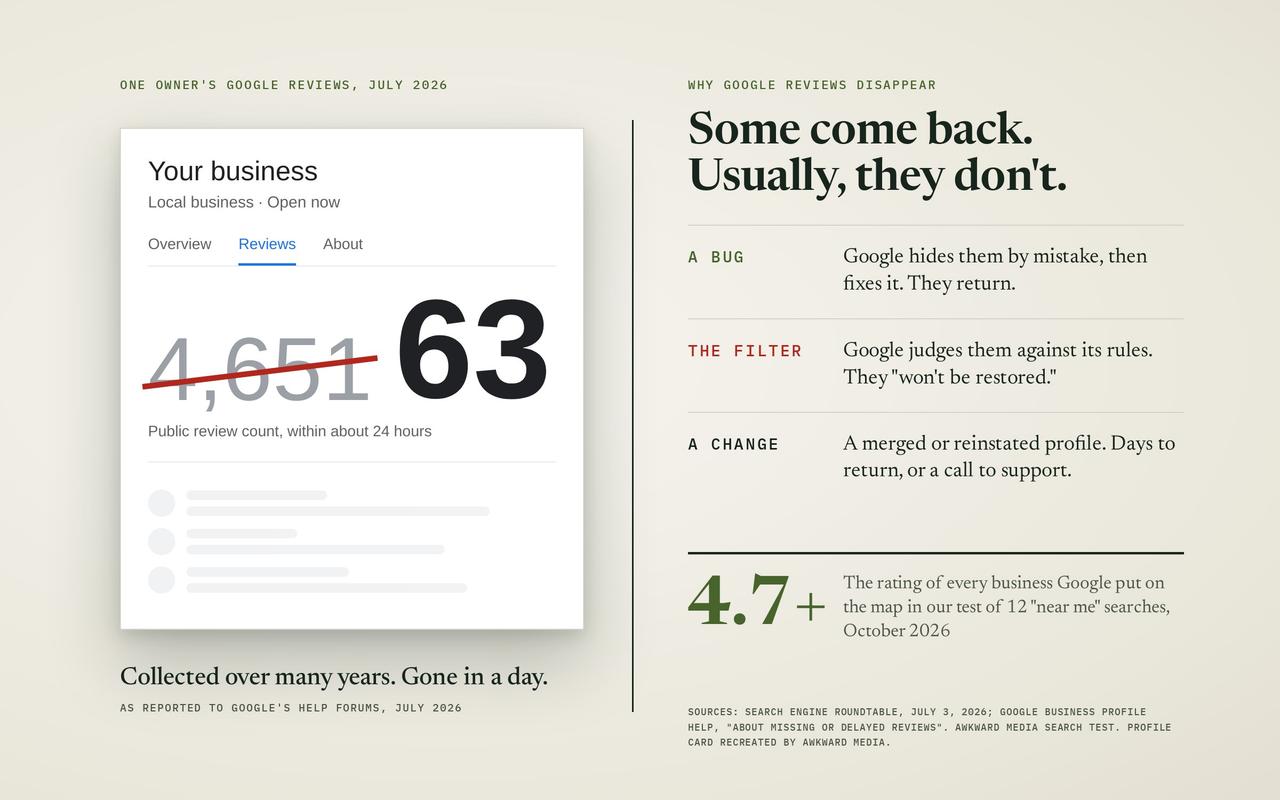
So ask every customer, the same way, after every job, and reply to what they write. Don't buy reviews, don't offer rewards for them, and don't ask staff to hit review targets: Google bans all three, and we explained the rules in detail in why Google reviews disappear. If a bad review lands, our guide to the review you can't remove covers what to do instead.
Step 5: Reach past your own street
Distance is the one factor you cannot change. You can change how far your business is trusted.
Because distance counts, the map box favours businesses close to the person searching, and a shop's reach usually thins out the further a customer is from its door. The work of pushing that circle outwards is the work in steps one to four, done town by town: a page for each town that brings in jobs, mentions and links from sites in those towns, reviews from customers who live there. It is slow, and it compounds.
It is also the kind of work behind American Hurricane Shutters coming first 52 miles from its shop. Reaching that far is what our Map Pack expansion service is built for, and our free guide to reaching the top three on Google Maps walks through it. Businesses with several branches face the same problem in reverse, with each branch competing for its own patch, which is the job of multi-location SEO.
Step 6: Know whether it's working
You do not need to learn an analytics tool to tell whether local SEO is working. Three habits are enough.
Ask every new caller how they found you, and write it down. "Google", "the map", "ChatGPT", "my neighbour". After a month you will know more than most marketing reports tell you.
Search for yourself the way customers do. Once a month, on your phone, search for your three most valuable services the way a customer would, from a few places across your area. Note where you appear on the map and in the regular results. Ask an AI assistant who it recommends for the same job in your town.
Ask whoever runs your website for one monthly number. Google gives website owners a free tool called Search Console that shows which searches brought people to the site. Send this: "Each month, please send me the top 20 searches people used to find our website on Google, and how many clicks each one brought, compared with the month before."
How long it takes
Honestly, it depends on how far behind you start and how crowded your trade is in your town. Some movement can be quick. 360 Hazardous Cleanup went from an average Google Maps position of about 50th to about 2nd across eight searches in 20 days. Go Pro Plumbing, Heating & Air in Sacramento moved from second and third to first on Google Maps for "HVAC contractor" and "HVAC repair". Shoreside Therapies went from second and third to first for its two main Maps searches.
Other markets take longer, and anyone who promises a date for a specific position on the map without seeing your market is guessing. Our own promise is about the first page of Google, and it's written down on our guarantees page.
Doing it yourself, or handing it over
Everything in this guide can be done by an owner. Steps one and four cost nothing but time. Step two needs whoever manages your website. Steps three and five are where most owners run out of hours, because they are slow, repetitive and never finished.
If you would rather hand it over, our guide to choosing an SEO partner lists the questions worth asking anyone you consider, us included. What we charge is on our SEO pricing page. Our own local work is for businesses already doing $20,000 a month or more, in trades like plumbing, heating and cooling, roofing, electrical, landscaping, dentistry, therapy and law, across the cities we work in.
If you are not sure where you stand, our free Google Visibility Check shows how your business appears on Google today. Our AI Search Guide goes deeper on the AI answers. Or talk to us directly.
The shutter business in Wilmington did not move its shop closer to Ocean Isle Beach, and it did not out-review its rivals. It made itself the most obvious answer Google could find for that search, from 52 miles away. That is local SEO. It is available to any small business willing to do the work, one step at a time.
Every fact in this story is linked to its source. Spot something out of date? Tell the editor and we will correct it.
Questions readers ask
Frequently asked questions
What is the difference between local SEO and SEO?
SEO is the work of getting a business shown in Google's results. Local SEO is the part that deals with searches where the customer wants someone nearby. It adds work that ordinary SEO doesn't need, like the Google Business Profile, the map box and distance, but it rests on the same foundations: a good website that answers what customers search for.
How much should a small business spend on local SEO?
It depends on how many services and towns you want to rank for and how crowded your trade is locally. Much of the groundwork in this guide is free if you do it yourself. If you hire help, our current prices are on our SEO pricing page.
Can I do local SEO myself?
Yes. Setting up your Google Business Profile, keeping hours and details exact, adding photos and asking every customer for a review cost nothing but time. Building service and town pages, getting listed and earning links take longer, and that is where most owners bring in help.
How long does local SEO take?
It varies by market. Some clients have moved into the top three on Google Maps within weeks: 360 Hazardous Cleanup reached the top three for eight searches in 20 days. Crowded markets take longer.
Do I need a website if I have a Google Business Profile?
You can appear on the map without one, but a website is what tells Google, and the AI tools, what you do in detail. Studies of AI answers in 2025 and 2026 found business websites among the most used sources, so a business without one gives up a large share of where it could be found.
Does AI change local SEO?
It adds to it. The AI answers from Google and ChatGPT draw mainly on business websites and listings, the same things local SEO already builds. The new part is that mentions on other sites, like local best-of lists and trade directories, now count for more.
About the author