01
Our clients come from referrals. Why do we need SEO?
+
Keep the referrals. But a referral still ends in a search: the person who was given your name looks you up before they reach out, and if what they find is thin, they keep looking. And the person with no referral picks from whoever shows up first.
02
Can each therapist in our group practice have their own Google listing?
+
Often, yes. Google’s rules let a public-facing practitioner have their own listing when clients can reach them at the verified location during stated hours. The practice keeps its own listing too, and each therapist’s listing carries only their name. A practice with one therapist uses one shared listing, named practice name, colon, therapist’s name. We set them up to Google’s current rules.
03
Can we just advertise on Google instead?
+
You can, with limits. Google treats mental health ads as sensitive, so you can’t aim them at your own client list, at lists of people who visited your website, or at lookalikes of either. The free map listings and results underneath the ads have no such limits, and they keep working between invoices.
04
Do couples therapy, anxiety and trauma really need their own pages?
+
Yes, if you want more clients for each. Each is a different search with different practices at the top, and someone choosing a therapist wants a page that speaks to their situation: who it’s for, what the first session is like, fees, online or in person. One line on a services page can’t do that.
05
Our clients value their privacy. Do we have to ask them for reviews?
+
No. Whether and how you ask is your call under your own professional rules. Reviews are one input Google weighs among many, so your plan doesn’t rest on them: how well your listing and pages match the search, how close you are to the person searching, and how well known your practice is across the web all count, and we work on all of it.
06
Will you need access to client records or our practice software?
+
No. We don’t need any client information to do this work. Everything we change is public: your website, your Google listing and the other sites that mention your practice.
07
Do you write the content, or do we?
+
We do. We write your specialty pages, area pages and answers, and you check each one for clinical accuracy and your professional rules before it goes live. Your own words about how you work make the pages better, so we ask for them.
08
Do you need access to our website?
+
Access lets us make the changes ourselves, which is faster. If someone else runs your site, we hand them a clear list in plain words, page by page.
09
Do you work with therapy practices on any website builder?
+
Yes. WordPress, Squarespace, Wix, a custom site or a site that came with your practice software: the work is the same, only who presses the buttons changes.
10
We rent a room by the hour in a shared office. Can we still show up on Google Maps?
+
It depends on whether clients can reach you there during the hours you state, which is how Google’s rules for practitioners are written. We check your setup against Google’s current rules before we touch your listing, so it’s set up in a way that lasts.
11
We have two offices. Do we need two Google listings?
+
If clients are seen at both during set hours, yes: each office gets its own listing and its own page on your site. Our multi-location SEO page explains how we set that up without the two competing.
12
We’re moving offices or changing our practice name. Will we lose our rankings?
+
Not if it’s handled carefully. Your Google listing, your website and the directories that list you all need the new details at the same time, and old pages need to point to new ones. We plan the change before it happens.
13
Should each therapist in our practice have their own page on the website?
+
Yes, in a group practice. People often choose the person before the practice: their training, their approach, who they see and when. A page per therapist answers that, and gives Google a page to show when someone searches that therapist’s name.
14
Does a blog help a therapy practice rank?
+
Only when each post answers a question your future clients actually search, in plain words, and links to the specialty page it belongs to. Posts written to fill a calendar rarely rank for anything.
15
We’re a new practice with no reviews yet. Is it too early for SEO?
+
No. The listing, the specialty pages and the area pages are built the same way for a new practice, and starting early means they’re ready as your name gets known. Broad searches in a big city take longer to win than one specialty in one town.
16
Do you work with practices that take insurance as well as private pay?
+
Both. We write the pages for how you actually work: the insurers you take, private-pay fees, sliding scale if you offer it. People search for those details, so stating them plainly helps.
17
How do I know the work is paying off?
+
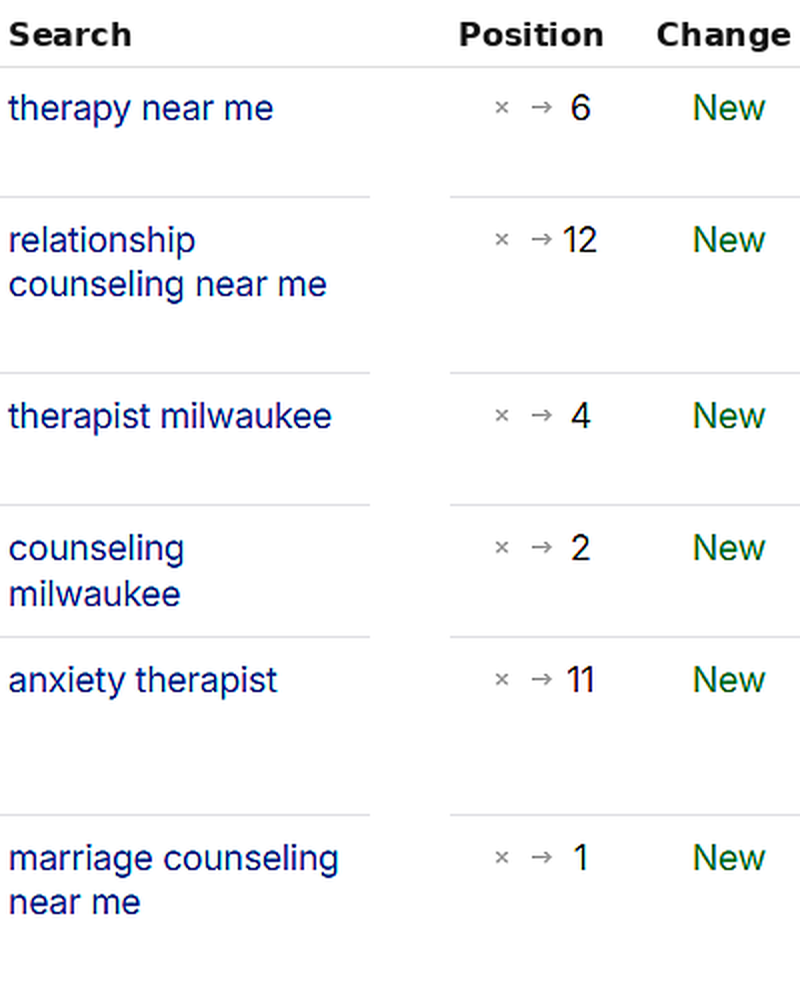
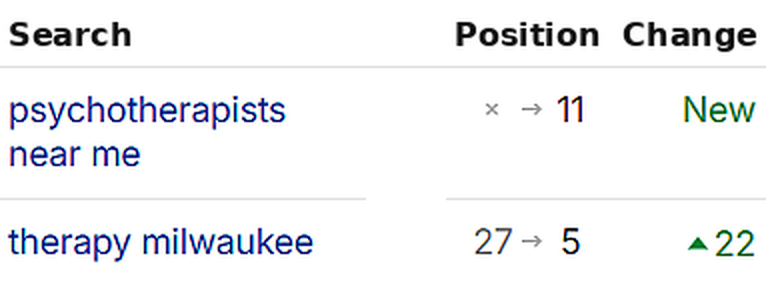
You can see where each target search ranks, on Google and on the map, and every ranking is one you can search on Google yourself. Ask your account manager about any of it and get a fast, straight answer.
18
Is therapist SEO a one-time project?
+
No. Other practices keep working on their listings, Google keeps changing what it shows, and your specialties and areas change. The first months build the listing and pages that should win. After that the work is new specialties, new areas, mentions on trusted sites and keeping what you’ve won.
19
Can we choose which kinds of clients the work brings in?
+
You choose which specialties and areas we aim at, and we weight the work to them. If you want more couples work and less general counselling, the couples pages and searches come first.
20
Do you guarantee a #1 ranking?
+
No one honest can promise #1. We give two promises in writing, with dates on them, and both are set out in full in the “Our SEO guarantees” section on this page.
21
Can you take on our practice this month?
+
The work is for therapy and counselling practices, solo or group, doing $20,000 a month or more, in Canada or the USA. Very limited spots left for the month of October. We put a cap on clients we can take in to keep our promises.