Guides
SEO vs Google Ads: What a Click Really Costs in Your Trade (2026)
Google's own prices for 14 local searches, from $6 to $163 a click, set against what SEO costs and how fast each one works. Trade by trade.
· Updated · 6 min read

In this story
Google's own advertising tool has a price for the moment your phone rings. On October 30, 2026, it estimated that one click on an ad for "emergency plumber" in Dallas costs $81.71. Not one job. Not one phone call. One click, from one person who may hang up after the second ring, or may never call at all.
The same search in Toronto came in at $35.58. "Personal injury lawyer near me", across the United States, came in at $163.07 a click. "Med spa near me" came in at $6.00.
Those numbers sit at the heart of the oldest argument in small-business marketing: should you pay Google for ads, or work your way up the free results? Google calls the paid side PPC, short for pay-per-click, and the free side SEO, short for search engine optimization, which simply means the work that gets your business shown in Google's unpaid results and on Google Maps. Most articles on the question were written by agencies that sell one side, or by software companies that sell tools for both. Almost none of them show you what a click actually costs in your trade.
So we went and looked. This article sets Google's own estimates for 14 money searches beside the largest public study of what small businesses really pay for ads, quotes Google's help pages on how the price is set, and explains in plain words what the free side costs and how long it takes. Then it answers the question you came with: which one, for your business, and when both.
The short answer
Ads rent you a spot at the top of Google today. SEO earns you a spot in the free results and on the map that keeps working after you stop paying for each visit. Ads are fastest. SEO is the one that keeps paying off, and it now pays off in more places than it used to, because the same work that ranks you on Google also feeds Google Maps, Google's AI answers and ChatGPT.
Google itself says the choice is a false one. Its own small-business guide to the question, published in March 2023, tells owners: "it might help to reframe the thinking from "SEO vs. PPC" to "SEO and PPC," because both can help your business in different ways."
We agree, with one condition. You should know what each costs in your trade before you decide how much of each to buy. That's what the rest of this piece is for.
| Google Ads (pay-per-click) | SEO (free results and Maps) | |
|---|---|---|
| What you pay for | Each click on your ad | The work that gets you ranked, usually a monthly fee |
| How fast it shows | The same day your ads are approved | First movement in weeks, bigger gains over months |
| What happens when you stop paying | Your ads disappear | Your rankings stay while the work holds |
| Where it shows | Ad slots, labelled "Sponsored" | Free results, Google Maps, Google's AI answers, ChatGPT |
| Best for | Testing an offer, filling a gap right now, seasonal rushes | Owning the searches your customers make every day |
| Price per visit | Rises with competition in your town | Falls the more searches you rank for |
What a click costs in your trade
Google Ads has a planning tool that advertisers use before they spend a dollar. For each search it gives two things: roughly how many times a month people type it, and what advertisers pay per click to show up for it. We pulled both for 14 searches that bring in work for local businesses, across the whole United States, on October 30, 2026. They are Google's estimates, not invoices, and your real price depends on your town, your ad and your competitors. But they're the numbers Google gives its own advertisers.
| Search (United States) | Searches a month | Google's estimate per click |
|---|---|---|
| dentist near me | 1,830,000 | $14.71 |
| plumber near me | 823,000 | $39.28 |
| electrician near me | 368,000 | $22.65 |
| personal injury lawyer near me | 301,000 | $163.07 |
| pest control near me | 165,000 | $31.29 |
| garage door repair near me | 165,000 | $45.75 |
| moving company near me | 110,000 | $23.35 |
| med spa near me | 110,000 | $6.00 |
| emergency plumber | 90,500 | $74.89 |
| roofing contractor near me | 90,500 | $24.37 |
| water damage restoration | 90,500 | $55.09 |
| hvac repair near me | 49,500 | $38.54 |
| divorce lawyer near me | 40,500 | $24.85 |
| mortgage broker near me | 14,800 | $19.01 |


Two things stand out. The first is the spread: the most expensive search on the list costs 27 times the cheapest. The second is where the money concentrates. The searches that cost the most are the ones made by people with a problem right now: a burst pipe, a garage door that won't close, water on the floor, a car crash. Those people don't browse. They call the first business that looks right. Advertisers know it, and they bid accordingly.
The average click and the click that rings the phone
If you've read that Google Ads clicks cost "about five dollars", you weren't misled, exactly. LocaliQ, the advertising company that publishes the yearly benchmarks most of the industry quotes, put the average cost per click across all industries at $5.42 in its 2026 report, last updated June 1, 2026 by Stephanie Heitman. The same report found that "cost per lead decreased overall for the first time in five years."
LocaliQ's 2025 home-services study, built from 3,211 US campaigns between April 1, 2024 and March 21, 2025, gives the typical figure trade by trade. Here's how it lines up against Google's estimate for the one search that, in each trade, brings the call.
| Trade | LocaliQ: typical cost per click, whole trade | Google's estimate for the "near me" search |
|---|---|---|
| Plumbing | $10.49 | $39.28 (plumber near me) |
| Electricians | $12.18 | $22.65 (electrician near me) |
| Roofing | $10.70 (roofing and gutters) | $24.37 (roofing contractor near me) |
| Garage doors | $5.75 (garages) | $45.75 (garage door repair near me) |
| Dentists | $8.00 (2026 report) | $14.71 (dentist near me) |
| Lawyers | $9.87 (attorneys, 2026 report) | $163.07 (personal injury lawyer near me) |


The two columns measure different things, and it matters. LocaliQ's figure is what its advertisers actually paid, across every search in their campaigns, cheap ones included. Google's figure is its estimate for one search. But the gap tells the story an average hides. In every trade we checked, the search a customer makes when they're ready to hire costs more than the trade's typical click. The average is pulled down by searches like "how to fix a running toilet", which are cheap because the person typing them was never going to call.
Said differently: when someone tells you ads in your trade cost ten dollars a click, ask them which click.
Your city changes the price
Google Ads prices are set town by town. We pulled the same searches for Dallas and for Toronto on the same day. The prices are Google's estimates in US dollars.
| Search | Dallas, per click | Toronto, per click |
|---|---|---|
| plumber near me | $51.01 | $20.29 |
| emergency plumber | $81.71 | $35.58 |
| water damage restoration | $84.42 | $20.47 |
| garage door repair near me | $53.42 | $20.48 |
| hvac repair near me | $31.55 | $36.45 |
| dentist near me | $16.43 | $15.50 |

A Dallas plumber pays more than twice what a Toronto plumber pays for the same click, by Google's estimate. A Dallas restoration company pays four times as much. But the gap isn't one-way: heating and cooling repair cost more in Toronto than in Dallas on the day we looked, and dentists paid nearly the same in both cities. The only way to know your price is to look up your searches in your town. If you run a business in either city, our Dallas SEO and Toronto SEO pages show what ranking there involves.
How Google sets the price of a click
A lot of owners imagine they're paying a fixed price, like a newspaper ad. They aren't. Every time someone searches, Google runs a fresh auction among the advertisers who want to show up, and your price is set in that split second.
You pay just enough to beat the business below you
Google's help page on the subject puts it plainly: "you only pay what's minimally required to clear the Ad Rank thresholds and beat the Ad Rank of the competitor immediately below you." Ad Rank is Google's score for where your ad sits. You set a maximum you're willing to pay, and Google's help pages add that it's "the most you'll typically be charged for a click, but you'll often be charged less - sometimes much less."

A better ad and a better page can cost you less
Your bid isn't the only thing in the score. Google lists six factors behind Ad Rank, including the bid and "the quality of your ads and landing page". Its help page spells out what quality means: "expected clickthrough rate, ad relevance, and landing page experience". In plain words: does your ad match what the person typed, do people tend to click it, and does the page they land on give them what the ad promised. A business with a clear, fast, relevant page can outrank a competitor who bids more.
The top spot costs the most
Google runs "different auctions for each ad location", and it warns advertisers that "the actual CPC when you appear above search results is often higher than the actual CPC if you appear below search results." CPC means cost per click. The spot most people see, above everything else, is the one you pay most for.

What that means for your budget
Here's a simple illustration, not a forecast. At Google's US estimate of $39.28 a click for "plumber near me", a budget that buys 100 clicks a month costs $3,928. If you pause the ads, the clicks stop the same day. There's nothing wrong with that. It's how renting works. It just means the money buys this month's clicks and nothing more.
What a lead from ads costs
A click isn't a customer. LocaliQ's studies also measure how many clicks turn into a lead, meaning a call, a form or a booking, and what each lead costs. These are LocaliQ's own figures from its advertisers' campaigns.
| Trade (LocaliQ) | Clicks that became a lead | Cost per lead |
|---|---|---|
| Handyman | 13.45% | $54.05 |
| Dentists (2026) | 10.67% | $72.97 |
| Garages | 5.66% | $81.45 |
| Electricians | 9.08% | $93.69 |
| Landscaping | 6.42% | $117.92 |
| Plumbing | 7.63% | $129.02 |
| Attorneys (2026) | 5.55% | $131.63 |
| Painting | 10.80% | $138.38 |
| Roofing and gutters | 3.70% | $228.15 |
| All industries (2026) | 8.18% | $66.69 |


Roofing is the outlier: fewer than 4 in 100 clicks became a lead, so each lead cost more than $200. That's not a reason for a roofer to avoid ads. It's a reason to know the number before setting the budget, and to ask what the same money would do on the free side.
What SEO costs, and what you're paying for
Google's March 2023 guide makes a point that sounds too simple to matter: "There's no cost to appear in organic search results like Google's." Organic results are the free ones, under the ads. Nobody pays Google for those spots. What you pay for is the work that earns them.
The work behind a ranking
In everyday words, that work is: making your website fast and easy for Google to read; writing pages that answer what your customers search, town by town and service by service; getting other respected websites to mention and link to you; and building up your Google Business Profile, the listing that shows on Google Maps. Our SEO services page lays out each piece, and local SEO covers the map side.
How agencies charge for it
Most agencies charge a monthly fee. Ours starts at $1,497 a month for Google Maps rankings and $2,697 a month for rankings on Google's main results, rising for businesses with several locations, several websites or more complex work. Ranking in AI answers is included in every plan, and there's no long-term contract: it runs month to month. The full breakdown is on our pricing page, and our guide to what an SEO consultant costs compares the going rates across the market.
Why the price per visit falls over time
Ads charge you the same way for the thousandth click as for the first. SEO works the other way round. The fee covers the work, not the visits, so each new search you rank for and each new town you show up in lowers what every visit costs you. That's the whole case for it, and it's why we promise rankings rather than any sum of money: rankings are what the work produces, and they're what you can check.

How fast each one works
Speed is the honest case for ads. Once Google approves your ads, they can show the same day. SEO takes longer, and anyone who promises page one next week is guessing.
How long, then? Google gave its own answer in October 2026, when a member of its Search team showed timings for the steps behind every search. We broke those down in how long SEO takes: Google typically finds a new page within about a day, but the steps that move rankings take weeks. On our own client work, first movement usually shows within weeks, and we put our timelines in writing:
- 20-day guarantee. If you don't see visible improvement in your key metrics within the first 20 days, we refund $200 on top of returning your payment for that period. Key metrics are the leading measures we agree for your campaign before we start.
- 60-day guarantee. If your qualifying keywords aren't on the first page of Google within 60 days, we keep working for free until they are. Qualifying keywords are the searches we agree on together on your strategy call.
The fine print is on our guarantees page.

Where each one shows up on the page
A Google results page for a local search usually has three layers. At the top, ads, each marked "Sponsored". Then the map, with three businesses picked from Google Maps, which the industry calls the map pack. Then the free results. More and more searches now also carry an AI-written answer near the top, which Google calls an AI Overview.
Ads buy you the first layer. SEO is how you get into the other three. Google's own guide is blunt about the limits of the paid side: "A PPC ad solution like Google Ads doesn't have the same results as SEO and won't improve your organic search rankings." Paying for ads doesn't move you up the map or the free results.

The map deserves its own word. For most local trades, the three businesses on the map get the calls from people who never scroll. Our guide on how to rank higher on Google Maps walks through the steps, and our Map Pack expansion service pushes that ranking out to towns further from your address.
Is SEO dead now with AI?
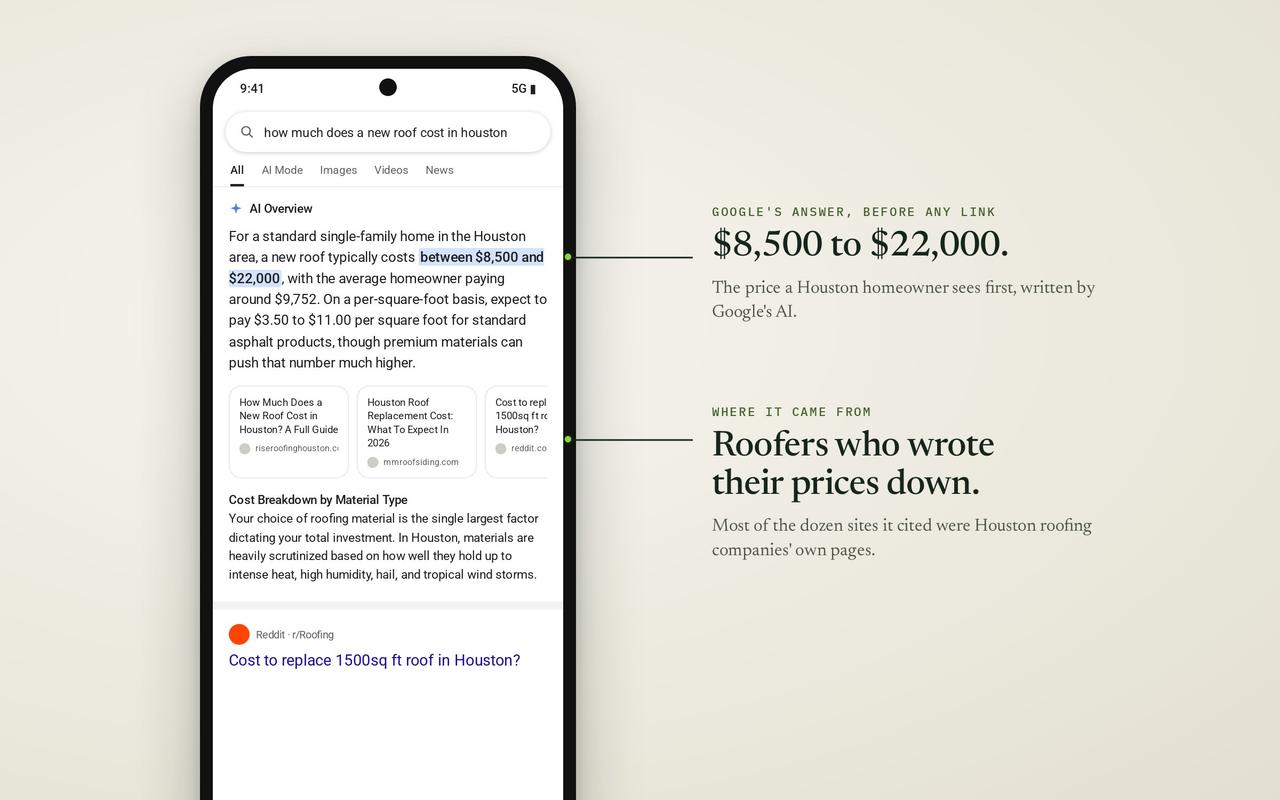
People ask Google this often enough that it shows up in the "People also ask" box for "seo vs ppc". The answer is no, and the reason is worth knowing. The AI answers on Google, and the answers ChatGPT gives, are built from websites. When we searched "seo vs ppc" on October 30, the AI answer at the top of Google pointed readers to Google's own business site, Reddit, Mailchimp, SEO.com, Semrush, Network Solutions and YouTube. Every one of those got there by being a well-built, well-cited page.
Which means the same work that ranks you in the free results now also gets you named in AI answers. That's not a replacement for ranking on Google. It's more places for the same work to pay off. Our guide to Google's AI Overviews explains how those answers pick sources, and our AI Overviews and ChatGPT SEO services cover getting named there.

Which is better for your business, SEO or Google Ads?
It depends on where your business is and what you need this quarter. Here's how we'd decide, trade by trade.
Choose ads first when
You've just opened and Google doesn't know you yet. You're testing a new service or a new town and want to see if the phone rings before you invest more. You run a seasonal business and the season starts in two weeks. Or a competitor's ranking work has a head start and you need calls while yours catches up.
Choose SEO first when
Your customers search the same things every day of the year. The clicks in your trade are expensive, so every visit you earn for free saves real money. You want to show up on Google Maps and in AI answers, which ads can't buy. Or you plan to be in business in the same towns for years.
Run both when
You can afford to. Ads cover the searches you don't rank for yet; SEO keeps adding searches you no longer need to pay for. As your free rankings climb, you can move ad money to the newer, harder searches. Google's advice to think "SEO and PPC" is right for most businesses doing real volume.

| Your situation | Start with | Why |
|---|---|---|
| Brand-new business, no reviews, new website | Ads, with SEO started at the same time | Ads bring calls this month while the free rankings build |
| Established, but clicks in your trade cost $30 or more | SEO | Every click you earn for free is one you don't buy at that price |
| Seasonal rush in the next few weeks | Ads | Ads switch on in days |
| Want to show up in towns further from your shop | SEO, Google Maps | Ads can't move you up the map |
| Testing a new service | Ads | You learn if there's demand before investing in pages |
| Doing steady volume and want to grow | Both | Ads for new searches, SEO for the ones you'll own |
Trade by trade: what the numbers say
Here's what Google's estimates say for each trade, and what we'd do with them.
Plumbers
"Plumber near me" is searched 823,000 times a month in the US at $39.28 a click by Google's estimate, and "emergency plumber" at $74.89. Those are among the priciest clicks in the home trades. For a plumber, owning the map in your service area is worth more than almost any ad budget. Our plumbing SEO page shows how that work is done.
Heating and cooling
"Hvac repair near me" came in at $38.54 a click. The searches spike with the weather, which makes ads useful for a cold snap or a heat wave and SEO useful for the other ten months. See HVAC SEO.
Roofers
"Roofing contractor near me" was estimated at $24.37 a click, but LocaliQ found fewer than 4 in 100 roofing clicks became a lead. Roofers buy a lot of clicks per job, which is the strongest argument for roofing SEO.
Electricians
"Electrician near me": 368,000 searches a month at $22.65 a click. LocaliQ found electricians turn 9 in 100 clicks into leads, one of the better rates in the home trades. Ads can work here; so can SEO for electricians.
Garage door companies
"Garage door repair near me" was estimated at $45.75 a click across the US, against $5.75 for LocaliQ's typical garage-trade click. That gap is the clearest example in our data of the urgent search costing more than the average suggests.
Water damage and restoration
"Water damage restoration" came in at $55.09 nationally and $84.42 in Dallas. These are emergency calls, often paid by insurance, and advertisers bid hard for them. Our 360 Hazardous Cleanup case study shows the free side of a similar emergency trade.
Pest control
"Pest control near me": 165,000 searches a month at $31.29 a click. Pest control is repeat business, so a customer won through the free results often comes back without another click. See pest control SEO.
Movers
"Moving company near me" was estimated at $23.35 a click. People book movers weeks out, after comparing several, which rewards the reviews and pages that SEO builds. See moving company SEO.
Dentists
"Dentist near me" is the biggest search on our list at 1,830,000 a month, at $14.71 a click. Lots of searches at a moderate price: here, both work, and the map matters most. See dental SEO and our Burloak Centre Dentistry case study.
Med spas
"Med spa near me" came in at $6.00 a click, the cheapest on our list. Cheap clicks make ads a reasonable place to start. SEO earns its keep here through the treatment searches, town by town. See med spa SEO.
Personal injury lawyers
"Personal injury lawyer near me": 301,000 searches a month at $163.07 a click, by far the most expensive search we checked. Our law firm SEO guide and law firm SEO page go deeper, and the Florida Probate Law Group case study shows a firm's results.
Family and divorce lawyers
"Divorce lawyer near me" came in at $24.85 a click, far below injury law. These clients compare firms carefully, so the firm that shows up on the map with clear pages tends to get the call.
Mortgage brokers
"Mortgage broker near me": 14,800 searches a month at $19.01 a click. A smaller search, but each client is worth a lot, and rates and trust drive the choice. See mortgage broker SEO.
Builders and contractors
LocaliQ found construction and contractors had the cheapest typical click of the home trades, at $5.31. Cheap clicks, big jobs, long decisions: a mix of both works well. See construction SEO.

What ranking looks like in practice
The trades above with the priciest clicks are where a free ranking is worth most. Here are a handful of the businesses we've ranked, each in one of those trades.
A personal injury lawyer on the map
Alex Poberesky, a personal injury lawyer, moved to #2 on Google Maps for "Personal Injury Lawyer Pikesville", searched 4 miles away, up from #13. In a trade where Google estimates a "near me" click at $163.07, that's a spot a firm doesn't pay for per visit.

A septic company in the top three
BEELER, a septic company, reached #2 on Google Maps for "Septic Cleaning Near Me", searched 4.5 miles away, up from #12.

An emergency dentist in the free results
Pathway Dental ranks as the first unpaid result on Google for "Same Day Emergency Dentist in NE Calgary", up from outside the top 100. See what ranking in Calgary involves on our Calgary SEO page.

More results, sorted by search surface, are on our case studies page.
SEO vs SEM: what's the difference?
SEM stands for search engine marketing. It's an umbrella term for any marketing on search engines, paid or free, though many people use it to mean paid ads only. So "SEO vs SEM" is usually the same question as "SEO vs Google Ads". When someone selling you marketing says SEM, ask them whether they mean ads, ranking work, or both.

| Term | What it means in plain words |
|---|---|
| SEO | Work that gets you ranked in Google's free results and on Google Maps |
| PPC | Ads where you pay for each click; Google Ads is the biggest |
| SEM | Any marketing on search engines; often used to mean ads |
| Map pack | The three businesses shown on the map near the top of a local search |
| AI Overview | The AI-written answer Google shows at the top of some searches |
| Local Services Ads | Google's pay-per-lead ads with the "Google Guaranteed" badge |
What about Local Services Ads?
For home trades, Google sells a third option: Local Services Ads, the listings at the very top with a "Google Guaranteed" or "Google Screened" badge. You pay per lead rather than per click. They're a different product with different rules, and we compared them with ranking work in a separate piece: Google Local Services Ads vs SEO.
Can a beginner do SEO?
Some of it, yes, and you should. Fill in every part of your Google Business Profile, add real photos, ask happy customers for reviews, and make sure your name, address and phone are the same everywhere online. Our guide to local SEO for small business lists the steps in order. Reviews help, as one visible sign among many that Google weighs; they aren't the whole picture, and Google also looks at how relevant you are, how close you are to the searcher, and how well known your business is across the web.

The parts that take longer to learn are the pages, the technical work on your website, and earning links from other sites. If you're about to rebuild your website, read how to redesign without losing your rankings first. And if you're weighing up who to hire, our guide on how to choose an SEO agency lists the questions to ask.
What is the best form of digital marketing?
For a local business, the best one is whichever puts you in front of people at the moment they need you. Search does that better than most, because the person has already told Google what they want. That's why both sides of this argument are worth money: ads and SEO both meet the customer at the search. The difference is whether you rent the spot or earn it.
Questions to ask before you spend on either
Five questions settle most of this. Put them to whoever runs your marketing, or answer them yourself.

What does a click cost for my top three searches, in my town?
Ask whoever manages your ads to look them up in Google's planning tool for your city, not the national figure.
How many of last month's clicks became a call or a form?
If nobody can tell you, fix that before you raise the budget on either side.
Where do I rank on Google Maps for those searches today?
Ask for it town by town, because your map ranking changes with the searcher's distance from you.
Which searches would I stop paying for if I ranked first for free?
Those are the ones where ranking work saves the most ad money.
What will I see in 20 days, and in 60?
Any agency should be able to answer this in writing. Ours is on our guarantees page.
Our work is for businesses already doing $20,000 a month or more, because ranking pays off best for a business with the trade to handle the calls it brings. If that's you, the SEO services page is the place to start.
How we reported this
Search volumes and cost-per-click figures are Google Ads' own planning estimates, pulled through a data provider on October 30, 2026, for the whole United States and separately for Dallas and Toronto. Typical costs per click, lead rates and costs per lead are LocaliQ's: its 2026 Search Advertising Benchmarks, last updated June 1, 2026, and its 2025 home-services benchmarks, built from 3,211 US campaigns. The two sources measure different things and we have not combined them into new figures. Quotes about how Google prices clicks come from Google Ads Help pages read on October 30, 2026, and from Google's March 2023 guide to SEO and PPC. Client results come from Awkward Media's own ranking reports.
Every fact in this story is linked to its source. Spot something out of date? Tell the editor and we will correct it.
Questions readers ask
Frequently asked questions
What is better, SEO or Google Ads?
Neither wins for every business. Ads are faster and stop when you stop paying. SEO takes weeks to show and keeps working once you rank. For a business with steady demand and expensive clicks, SEO usually gives more for the money over a year; for a new business or a seasonal rush, ads come first. Most businesses doing real volume run both.
What's the difference between SEO and PPC?
PPC, pay-per-click, means you pay Google each time someone clicks your ad. SEO is the work that gets your business into Google's free results and onto Google Maps, where nobody pays per click.
How much does a Google Ads click cost?
LocaliQ put the average across all industries at $5.42 in 2026. But the searches that bring calls cost more: Google's own estimates on October 30, 2026 were $39.28 for "plumber near me" and $163.07 for "personal injury lawyer near me" in the US.
How much does SEO cost?
Most agencies charge monthly. Ours starts at $1,497 a month for Google Maps rankings and $2,697 a month for Google's main results, month to month, with ranking in AI answers included. The full breakdown is on our pricing page.
How long does SEO take compared with ads?
Ads can show the same day they're approved. With SEO, first movement usually shows within weeks. Our two guarantees: if you don't see visible improvement in your key metrics within the first 20 days, we refund $200 on top of returning your payment for that period. And if your qualifying keywords aren't on the first page of Google within 60 days, we keep working for free until they are.
Do Google Ads help my free rankings?
No. Google's own guide says Google Ads "won't improve your organic search rankings." Paid and free results are run separately.
Can Google Ads get me on Google Maps?
Paying for ads doesn't move you up the free map rankings. The three businesses in the map pack are chosen by relevance, distance and how well known the business is, not by ad spend.
Is SEO dead now with AI?
No. Google's AI answers and ChatGPT build their answers from websites, so the same work that ranks you on Google also gets you named in AI answers. It's more places for the same work to pay off.
Can a beginner do SEO?
Yes, the basics: a complete Google Business Profile, real photos, steady reviews, and the same name, address and phone everywhere online. Pages, technical fixes and earning links from other websites take longer to learn.
What is the best form of digital marketing for a local business?
Search, for most local trades, because the customer has already told Google what they need. Ads and SEO both meet them at that moment; one rents the spot, the other earns it.
Why are some clicks so expensive?
Every search is an auction. Google's help pages say you pay just enough to beat the advertiser below you, so in trades where a job is worth a lot and many firms bid, like injury law or emergency plumbing, the price climbs.
Can a better website lower my ad costs?
It can. Google counts "the quality of your ads and landing page" in where your ad sits, so a clear, fast page that matches the ad can rank above a competitor who bids more.
Should I stop ads once I rank?
Not all at once. Pause ads on the searches where you rank in the top three for free, check the calls hold for a few weeks, and move that budget to searches and towns you don't rank for yet.
What is SEM?
Search engine marketing: any marketing on search engines. Many people use it to mean paid ads only, so ask whoever uses the word what they mean.
Do ad prices change by city?
Yes, a lot. On October 30, 2026, Google estimated "water damage restoration" at $84.42 a click in Dallas and $20.47 in Toronto. Check your own searches in your own town.
Are Local Services Ads the same as Google Ads?
No. Local Services Ads are Google's badge listings at the top of some home-service searches, and you pay per lead rather than per click. We compared them with SEO in a separate guide.
Is SEO cheaper than Google Ads?
Over time, usually, because the fee pays for the work, not each visit, so every new search you rank for lowers what each visit costs. In the first weeks, ads can bring more calls per dollar while rankings build.
Does SEO work for a brand-new business?
Yes, but it starts from zero, so run ads alongside it while Google gets to know the business.
What happens to my rankings if I stop SEO?
They don't vanish the next day the way ads do, but competitors keep working, so rankings can slip over the following months.
Can I run Google Ads myself?
You can. The risk is paying for searches that never bring calls, so check which searches your ads show for and cut the ones that don't fit your business.
About the author