
OrganicManitoba
Maurice and Sons
From outside the top 100 to #1 for “log home restoration manitoba”. In 21 days, seven tracked searches reached #1.
Read the case study →Website Migration SEO · Canada and the USA
A new design, a new platform or a new domain can undo years of rankings in one launch. The new site looks great, and the phone goes quiet. We plan the move before launch, so every page Google trusts today has a home on the new site and your rankings come with it.
GuaranteePage one in 60 days, or we keep working free.
30 minutes on Google Meet. For businesses doing $20k a month or more.

Illustration. A 301 is a permanent redirect: automatic forwarding from the old address to the new one.
(01) What website migration SEO is
Website migration SEO is the work that carries your Google rankings from your old website to your new one. A migration is any big change to the site: a redesign, a new platform like WordPress or Shopify, a new domain name, or new page addresses.
Google ranks pages, and it finds them by their address. Change the address and, as far as Google can tell, the old page is gone. Everything that page earned (its rankings, the links pointing at it, the trust it built up over years) stays behind at the old address unless something forwards it.
Web designers build beautiful sites. Most of them aren’t paid to protect rankings, so that part gets left to launch week, or skipped. The result is a site that looks better and gets found less.
We work beside your designer or developer, from the plan to well after launch. They build the site. We make sure Google follows you to it.
Visitors from Google, before and after launch
IllustrationAn illustration of the two patterns, not a client’s data. Google itself says rankings can move around for a few weeks or more while it re-reads a moved site.
(02) Which move are you making?
The rule: every page that brings you visitors today has a clear new home tomorrow. How hard that is depends on the move. The bars show how much is usually at stake.
Same domain, new look. Risky when page addresses, headings or the words Google ranked you for change along with the design.
Moving to WordPress, Shopify, Webflow or a custom build. Every platform writes addresses its own way, so almost every page moves.
A new name means every address changes at once. The riskiest move of all, and the one that needs the most planning.
Merging services, renaming folders, splitting one big page into several. Fine for visitors, confusing for Google without a map.
Two brands or a few regional sites folded into one. Each old site’s best pages need a clear new home.
A move to https (the padlock) or to a new server. Usually low risk, but slow pages and missed redirects still cost rankings.
Doing two at once, say a rebrand on a new platform? Common, and doable. It just means more pages to map, so start earlier.
(03) The redirect map
The redirect map is the list that pairs every old address with its new one. It’s the single most important document in a migration. Get it right and Google follows you. Get it wrong and it starts over.
/services/furnace-repair-toronto.html
→ /services/furnace-repair
One to oneThe same page at a new address. Most of the map looks like this.
/services/ac-install
/services/ac-replacement
→ /services/air-conditioning
Two into oneTwo thin pages merged. Both old addresses point at the new one.
/specials/spring-2019
→ /offers
RetiredAn old page with links pointing at it goes to its closest match, never the home page.
/old-page → /newer-page
→ /services/heat-pumps
Chain fixedOld redirects that hop twice are pointed straight at the final page.
Illustration of four rows from a redirect map. Addresses are made up.
What every row has to pass
Redirects are part of technical SEO: the work that makes sure Google can find, read and trust every page on your site.
(04) How the move runs
The safest migrations are boring on launch day, because the hard work was done weeks earlier. Bring us in a month before launch if you can. Already launched? Skip to the next section.
Plan my launch4+ weeks before launch
2 to 4 weeks before
Launch day
First 30 days
Up to a year
(05) Already launched?
The old site’s value doesn’t vanish on launch day. It sits at the old addresses, waiting for something to point it at the new pages. The sooner the missing redirects go in, the more of it comes back.
We rebuild the map from what the old site used to rank for: your Google data, saved copies of the old pages, and the links other sites still point at them. Then we fix the pages that came across thin or lost the words they used to rank for.
Start with a free SEO audit →The first week of a rescue
Find what went missing
Which pages lost their visitors, and which old addresses now show “page not found”.
Point the old addresses home
The biggest losses first, each to its closest new page.
Put back what the pages lost
Titles, headings and the copy that answered the search, on the new design.
Watch it come back
Daily checks until rankings settle, then the monthly plan takes over.
(06) What’s at stake
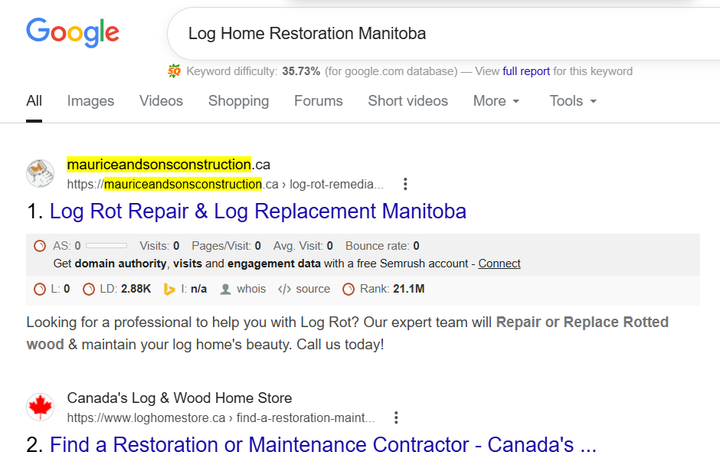
Real Google screenshots from our clients. This is what a careless launch puts at risk, and what a planned one carries across. The same team that builds rankings like these plans your move.
From outside the top 100 to #1 for “log home restoration manitoba”. In 21 days, seven tracked searches reached #1.
Read the case study →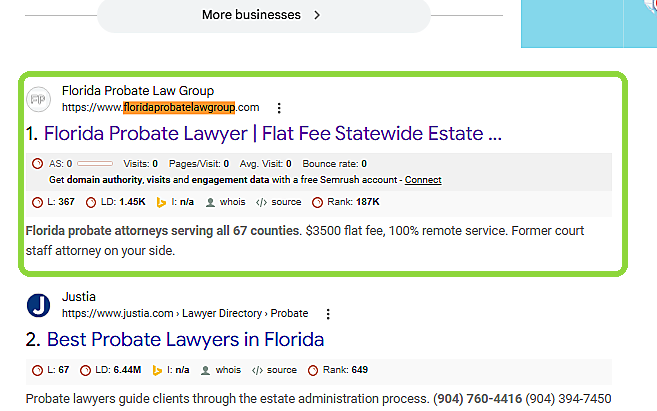
#1 statewide for “Florida probate lawyer”, above Justia. The kind of page a careless redesign quietly renames.
Read the case study →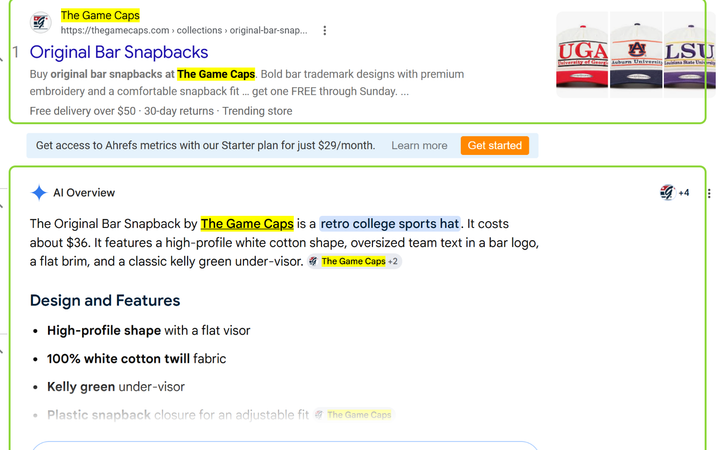
From page 5 to #1 for “original bar snapbacks”, and named in Google’s AI Overview. Product pages are the first to break on a new store platform.
Read the case study →(07) How migrations go wrong
None of these are design problems, so a good-looking site can have all eight. Every one is cheap to prevent and slow to undo.
Quick to set up, and it throws away what each page earned. Google treats most of those as missing pages.
Test sites are hidden from Google with a tag. Forget to remove it at launch and the whole new site stays invisible.
The old site had forty service pages, the new one has twelve. The other twenty-eight were bringing in calls.
Fresh copy is great, unless it drops the exact phrases buyers search. Rankings follow the words, not the design.
Some platforms default to the temporary kind. Google then keeps showing the old address and doesn’t pass along its standing.
Old redirects from the last redesign pointing at this one. Each hop is another chance for Google to give up.
Google advises moving when traffic is lower. A launch in peak season makes any dip cost far more.
Most problems only show up in the first few weeks. If no one checks daily, they get found in next quarter’s numbers.
(08) Launch-day checklist
The website migration checklist we run before any site goes live. Tap each one your team has done. Anything left unticked on launch day is a ranking at risk.
Ready to launch
0 / 12
Not sure about some of these? That’s what the free call is for.
Straight from Google
From Google Search Central’s guide to moving a site with URL changes, checked October 2026.
At least 1 year
How long Google says to keep redirects in place, so it can move every signal to the new addresses.
A few weeks or more
How long Google says a medium-sized site can take before the new addresses replace the old ones in results. Larger sites take longer.
301 or 308
The permanent redirects Google recommends. Temporary ones keep the old address showing in results.
Straight to the final page
Google can follow up to 10 hops in a redirect chain, and still advises sending visitors straight to the final page.
(09) What it costs
Your number depends on how many pages are moving and how much of your business rides on Google. The audit is free, and you get the exact price on the call.
Free
Strategy call and audit
30 minutes on Google Meet. We look at what your site ranks for today, which pages carry the most weight, and what your move puts at risk.
Book the call →Local and organic SEO
$1,497 to $5,000/mo
Google Maps, the normal Google results, or both, before the move and after it. Month to month. AI SEO included.
See SEO pricing →Several websites
$5,000+/mo
Merging brands, folding regional sites into one, or moving a large store. Same two guarantees, same month-to-month terms.
Get my exact number →Moving an online store? See ecommerce SEO: product and category pages need extra care in a move.
As seen in and rated on





(10) Before you sign
Ask every agency these. Here are our answers, no dodging.
Who builds the redirect map, and from what?
We do, from your Google data, your links and every page that makes money. Your developer puts it in place, and we test it the day it goes live.
When do you need to start?
Ideally a month before launch. Already launched? Today. The sooner missing redirects go in, the more comes back.
What do you watch after launch, and for how long?
Rankings, Google visitors and pages Google can’t find, every day for the first 30 days, then every month in your report.
What happens if it doesn’t work?
No visible improvement in 20 days: your payment back plus $200. Qualifying keywords not on page one of Google in 60 days: we keep working free until they are.
How long is the contract?
Month to month. No twelve-month lock-in, before or after the move.
New address, same promises. Two guarantees, in writing.
Guarantee 01
20days
If you don’t see visible improvement in your key metrics within the first 20 days, we refund $200 on top of returning your payment for that period.
What we measure: your traffic, what that traffic is worth, how much authority your site and its pages carry, and how many other sites link to you, against the day we start.
Guarantee 02
60days
If your qualifying keywords aren’t on the first page of Google within 60 days, we keep working for free until they are.
What counts: at least one high-value search for your business on page one of Google.
No long-term contracts. Results keep you here. Paperwork doesn't.
Your next step
On a free 30 minute call we look at what your site ranks for today, which pages carry the most weight, and what your move puts at risk. The road map is yours to keep either way.
Bring with you
We search your market live
The way your customers do, in the towns you serve.
We show who's above you, and why
On Google, on Maps and in the AI answers.
You leave with a road map
Yours to keep. If we can help, we'll invite you to work with us.
For established businesses doing at least $20,000 a month.
(11) Questions
What owners and their web teams ask us before a move.
Check my move on a free callWebsite migration SEO is the work that carries your Google rankings from your old website to your new one. It covers recording what ranks today, mapping every old page address to its new one, checking the new site before launch, testing redirects on launch day and watching rankings afterwards, so a redesign, new platform or new domain doesn't cost you the visitors you already have.
Some movement is normal. Google says rankings can shift for a few weeks or more while it re-reads a moved site. Big, lasting drops usually come from missing or wrong redirects, pages that were dropped, or pages that lost the words they ranked for. Those are what we prevent.
A 301 is a permanent redirect: automatic forwarding from an old page address to its new one. It sends visitors to the right page and tells Google the move is for good, so the new page can take over the old one's standing in search results.
A redirect map is the list that pairs every old page address with its new one. It's the most important document in a migration. We build it from your Google data and links, so every page that brings in visitors, links or sales has a clear new home.
Before the design is final, ideally a month or more before launch. That way the new page structure keeps the pages that rank, and the redirect map is ready and tested on launch day instead of being rushed.
Usually, yes. The old site's value sits at the old addresses until something points it at the new pages. We find the pages that lost visitors, put the missing redirects in, biggest losses first, and restore the titles, headings and copy that used to rank.
For a well-planned move, Google says a medium-sized site can take a few weeks or more to settle, and larger sites longer. After a botched move, recovery starts once the missing redirects and pages are fixed. That's why we fix the biggest losses first.
No. We work beside your web designer or developer. They build the site, we make sure Google follows you to it: the redirect map, the checks before launch, the testing on the day and the watching afterwards.
Yes, with planning. Every address changes at once, so every page needs a redirect to its new address, and the move is reported to Google through the Change of Address tool in Search Console, Google's free tool for site owners. Keep the old domain and its redirects for at least a year.
The platform itself rarely does. The move does, because each platform writes page addresses its own way, so almost every page gets a new address. With a full redirect map and the old titles and copy carried over, rankings come across.
No. Google treats most of those as missing pages, so what each page earned is lost. Each old page should go to the closest matching new page. Only pages with no match at all, and no visitors or links, can be left to retire.
Google says to keep redirects for as long as possible, generally at least one year, so it can move every signal to the new addresses. For visitors, keeping them for good is even better.
A staging site is the test copy of your new website, where it's built and checked before launch. It's hidden from Google with a 'keep out' tag. If that tag isn't removed at launch, Google can't read the new site at all, which is why it's on our launch checklist.
It's a great time, as long as the pages that rank today come across first. Once the move has settled, the new site can go after more searches with new pages and better copy.
Only if the website address on your Google Business Profile, the listing on Google Maps, still points to old pages. We update it on launch day so the listing sends people to the new site.
Local SEO, organic SEO, or the two together usually run between $1,497 and $5,000 a month. Several websites usually start at $5,000 a month. Your exact number depends on how many pages are moving and how much of your business rides on Google, and you get it on the strategy call. The audit is free.
We put two guarantees in writing. If you don't see visible improvement in your key metrics within the first 20 days, we refund $200 on top of returning your payment for that period. If your qualifying keywords aren't on the first page of Google within 60 days, we keep working for free until they are.
Yes. Each old site's best pages get a clear new home on the combined site, the rest are redirected to their closest match, and links pointing at both old sites are kept working, so the merged site starts with the strength of both.
They lean on the same things Google does: clear pages that answer the question, trusted sites mentioning you, and a site that's easy to read. Keeping those intact through the move keeps you in AI answers. AI SEO is included in every plan.
No. Month to month, before the move and after it.
Established businesses in Canada and the US doing $20,000 a month or more, with a website that already brings in customers from Google and a redesign, rebrand, new platform or merger coming up. We take on 15 new clients a month so every move gets done properly.