Local SEO and Google Maps
Your Google Business Profile got suspended. Now what?
Google removed more than 13 million fake Business Profiles in 2025, and real businesses get caught in the same net. What a suspension means, the one appeal you get, and how to make it count.
· Updated · 6 min read
In this story
The email reached Ryan Williams in August. Google was telling the owner of Epic Finish Painting, a painting company on Camano Island in Washington State, that his business had been suspended. "They cited the reason initially as the business is not eligible for a business profile," he told the Seattle news site MyNorthwest. "And since that time, they've given me several other reasons."
Anyone searching for a painter on Camano Island no longer found him. He uploaded document after document to prove the company was real, and for months nothing happened. "So you're really going in circles," he said. His summary of life without a listing was shorter: "It's like you don't exist." Only after the story ran, in June 2025, did Google appear ready to put him back on the map.
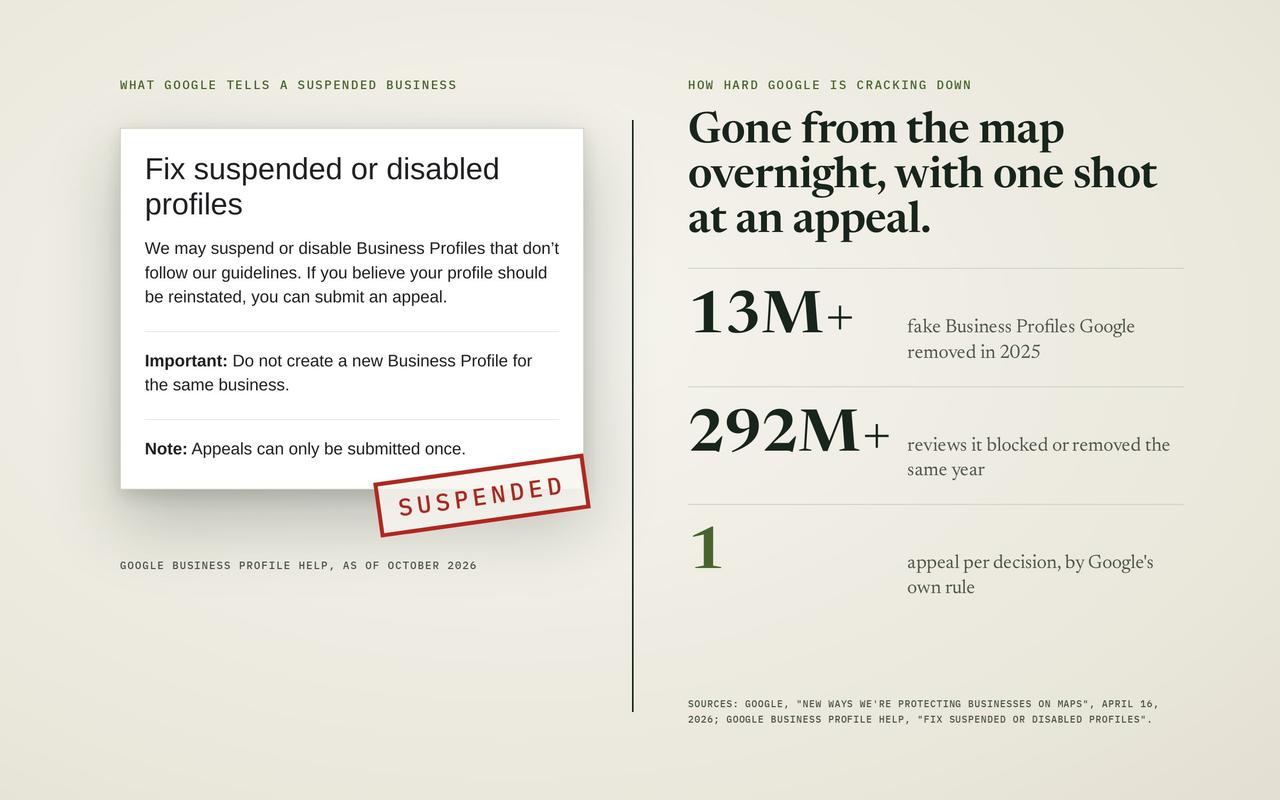
Williams was not a fraud. He was caught in a net built for frauds, and that net is getting bigger. Google says it removed more than 13 million fake Business Profiles in 2025. Somewhere inside a number that size are real companies with real trucks and real customers, and each of them gets roughly the same instructions, the most important of which fits in one line: appeals can only be submitted once.
This is a guide to that one appeal: what a suspension is, why honest businesses get caught, what to do in the first days, and how to make sure it does not happen again.
What a suspension actually means
A Google Business Profile is the listing that shows your business on Google Maps and in the map with three businesses at the top of local searches: your name, hours, phone number, photos and reviews. For most service businesses it is the single most valuable thing they own online, and it is the thing our local SEO work is built around.
Google uses two words for taking one down. Its help page on how to fix suspended or disabled profiles says: "We may suspend or disable Business Profiles that don't follow our guidelines." Google's policy pages tie the words to different triggers. A profile is disabled when Google decides "your business doesn't exist in the location you claim." A profile is suspended for breaking a rule, such as using a P.O. box as the address. When Google removes a profile, its help page says, "the public can't go to the profile."
There is a third, milder state that owners often confuse with a suspension. Google calls it a restriction, and it is aimed at reviews: Google may stop a profile receiving new reviews for a time, hide its existing reviews, and show customers a warning that fake reviews were removed. And there is a fourth, more serious one: when Google restricts the Google account that manages the profiles, "the Business Profiles you manage are suspended and you won't be able to create or claim other profiles." Knowing which of these you are facing decides everything that follows.
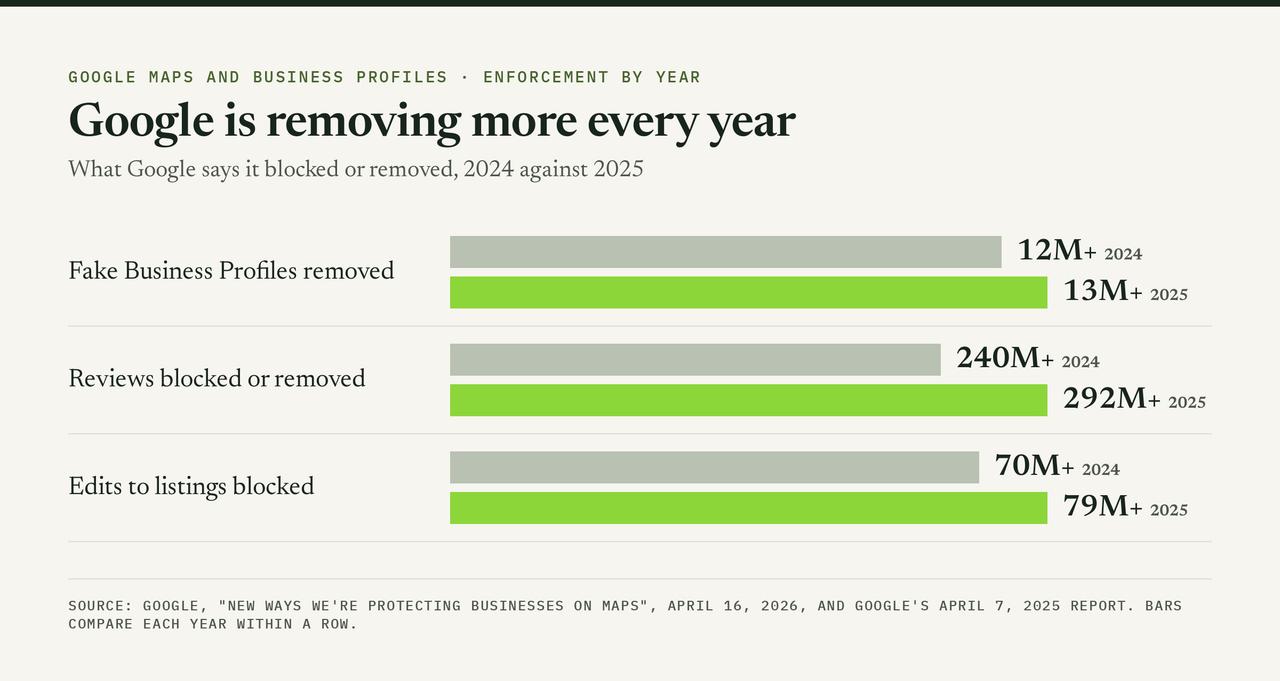
The scale explains the speed. In its April 2026 report Google said that in 2025 it "blocked or removed over 292 million policy-violating reviews," blocked 79 million inaccurate or unverified edits and "removed over 13 million fake Business Profiles." No team of people reads 13 million listings. Most of this work is automated, and automated systems make mistakes in both directions.
Why real businesses get caught
The reason Google gives is often brief, and Williams was given several over the months. But Google's guidelines for representing your business list the rules that matter, and a handful of them account for most of the trouble.
The name comes first. "Your name should reflect your business's real-world name," the guidelines say, and "including unnecessary information in your business name isn't permitted." A plumber who lists himself as "Smith Plumbing Emergency Plumber Houston" is asking for trouble. The address comes next. "P.O. boxes or mailboxes located at remote locations aren't acceptable," and a business that serves customers at their homes "can't list a 'virtual' office unless that office is staffed during business hours." Those businesses, which Google calls service-area businesses, "should hide your business address from customers." Then duplicates: "There should only be one profile per business." And some businesses are not eligible at all: lead generation agents, for example, "aren't eligible for a Business Profile."
The businesses most exposed are the ones that work out of a van rather than a shopfront. A moving company, a pest control firm or a contractor often runs from a home or a yard, serves a wide area and has no customers walking in. Every one of those facts sits close to a line in the rules. None of them is a violation on its own, but together they look, to an automated system, a lot like the fake listings it was built to remove.
The first days: what not to do
The first instinct of many owners is to start again: make a new profile and carry on. Google's help page answers that in bold before it explains anything else: "Important: Do not create a new Business Profile for the same business." A second profile for the same business breaks the duplicate rule, and it does nothing to fix whatever caused the first suspension.
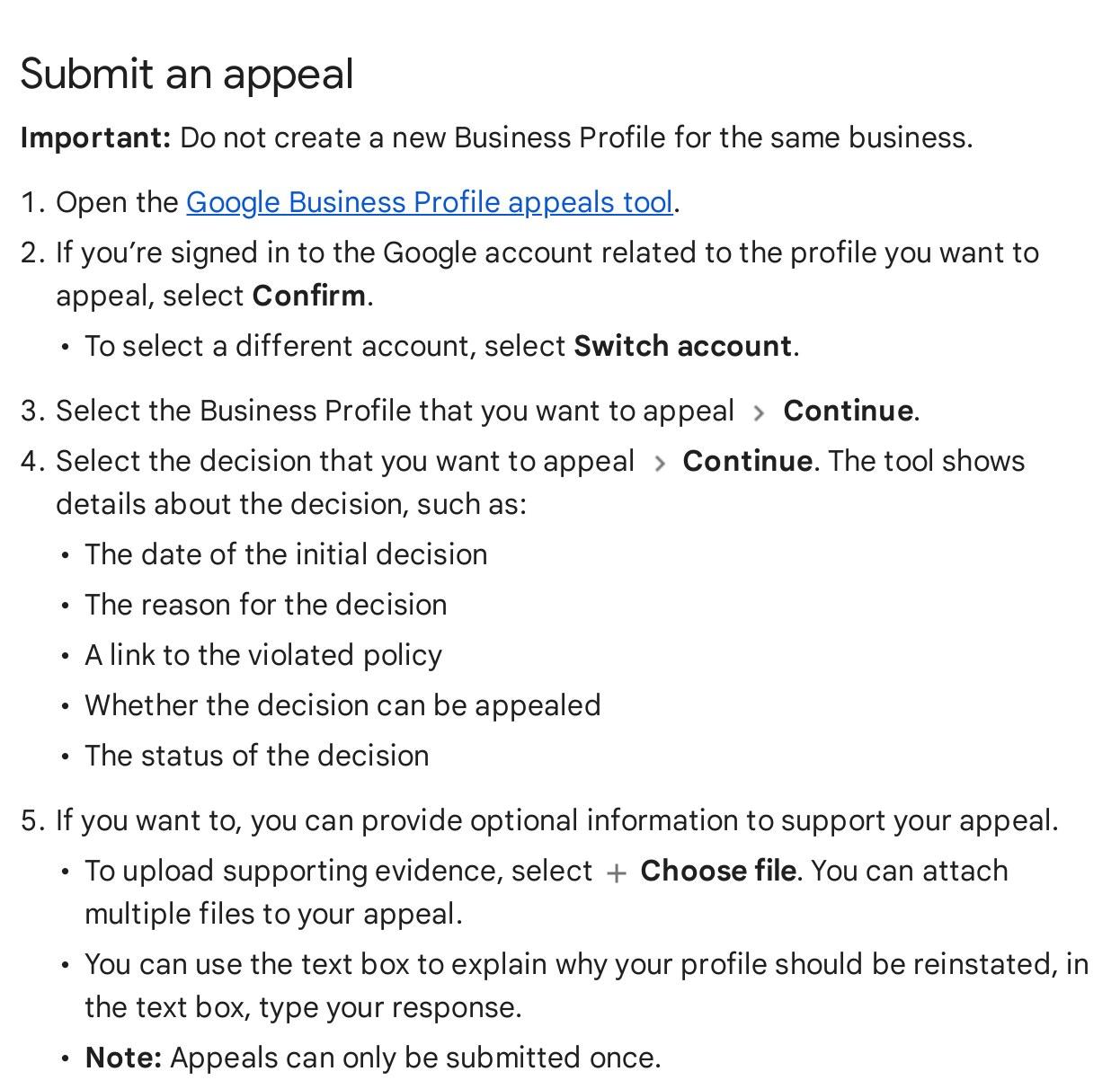
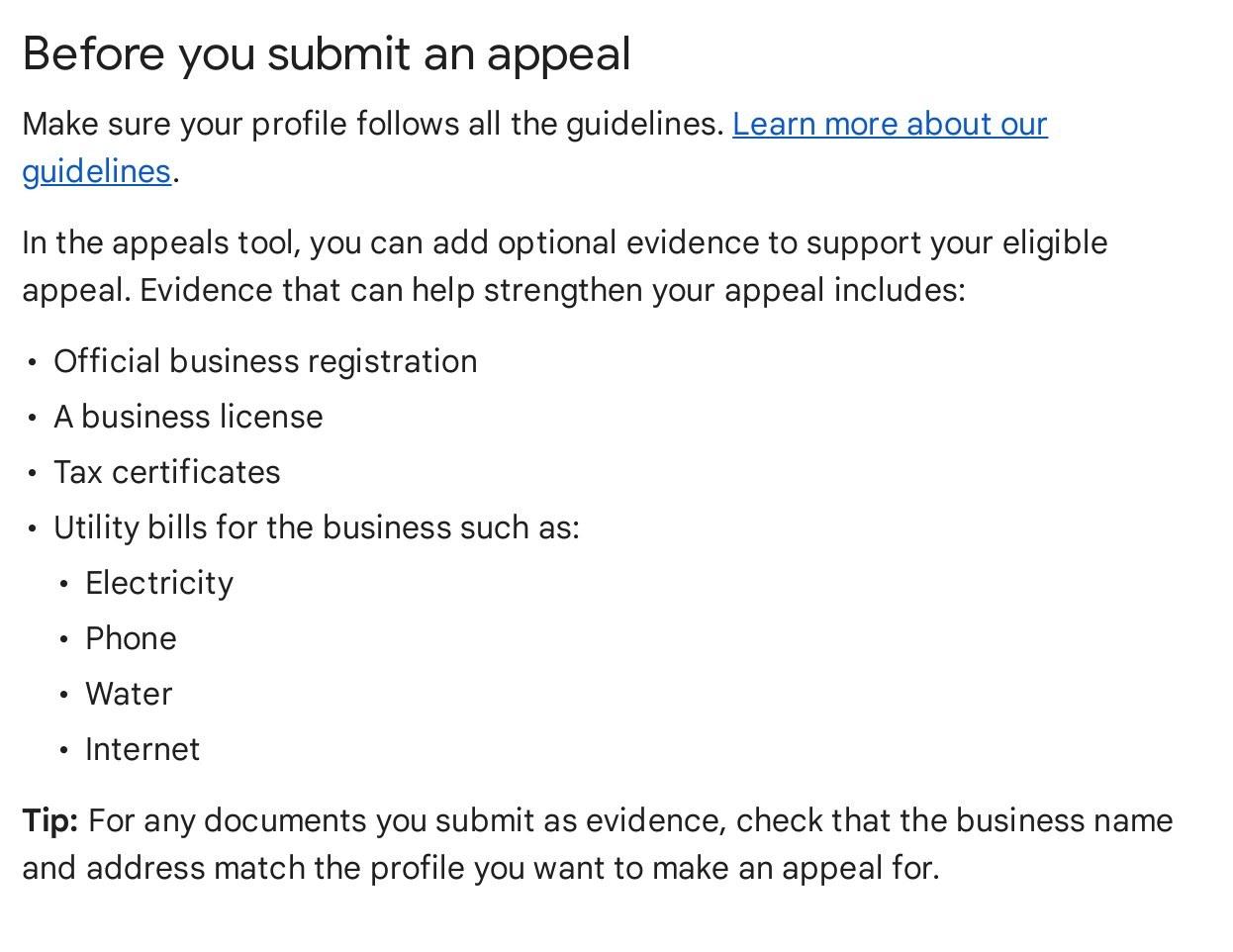
The second instinct is to appeal immediately. That is also a mistake, because of the line at the bottom of Google's instructions: "Appeals can only be submitted once." Google's own advice is to "make sure your profile follows all the guidelines" before you appeal. In practice that means reading your profile the way a suspicious stranger would. Is the name exactly what is on your sign and your registration? Is the address one where customers can find you, or is it hidden if they cannot? Is there an old duplicate listing from a previous owner or a previous agency? Fix what you find first. An appeal sent against a profile that still breaks a rule is an appeal wasted.
The appeal tool itself tells you more than most owners realise. When you open it, Google says it shows "the date of the initial decision," "the reason for the decision," "a link to the violated policy" and "whether the decision can be appealed." Read all of it. The status can also read "Can't be appealed," which changes the question entirely, and is a moment to bring in someone who does this work every week. If you would rather have a second pair of eyes before you spend your one appeal, that is what an SEO audit of the profile is for.
Building the appeal
An appeal is an argument with evidence, and Google says which evidence helps. Its list: official business registration, a business licence, tax certificates, and utility bills for the business, such as electricity, phone, water or internet. Then comes the line most appeals fail on: "check that the business name and address match the profile you want to make an appeal for." A licence in the owner's personal name, or a utility bill at a different address, proves nothing to the reviewer.
The text box matters as much as the files. Keep it short and factual. Say what the business is, where it operates, what you have changed since the suspension, and which documents prove it. Search Engine Roundtable reported in July 2026 that documents are now attached inside the appeal itself, so gather everything before you begin. Then wait. Google says it will "send you an email with the appeal decision," and on a related help page it puts review times at up to five business days.
The video Google may ask for
Increasingly, Google asks the business to prove itself on camera. Its page on how to verify your business with a video recording is precise. The footage must be live, because "pre-recorded videos aren't allowed." It must be "an unedited, unique, and complete recording with no breaks," "at least 30 seconds long," and "recorded and uploaded from a mobile device through your Business Profile."
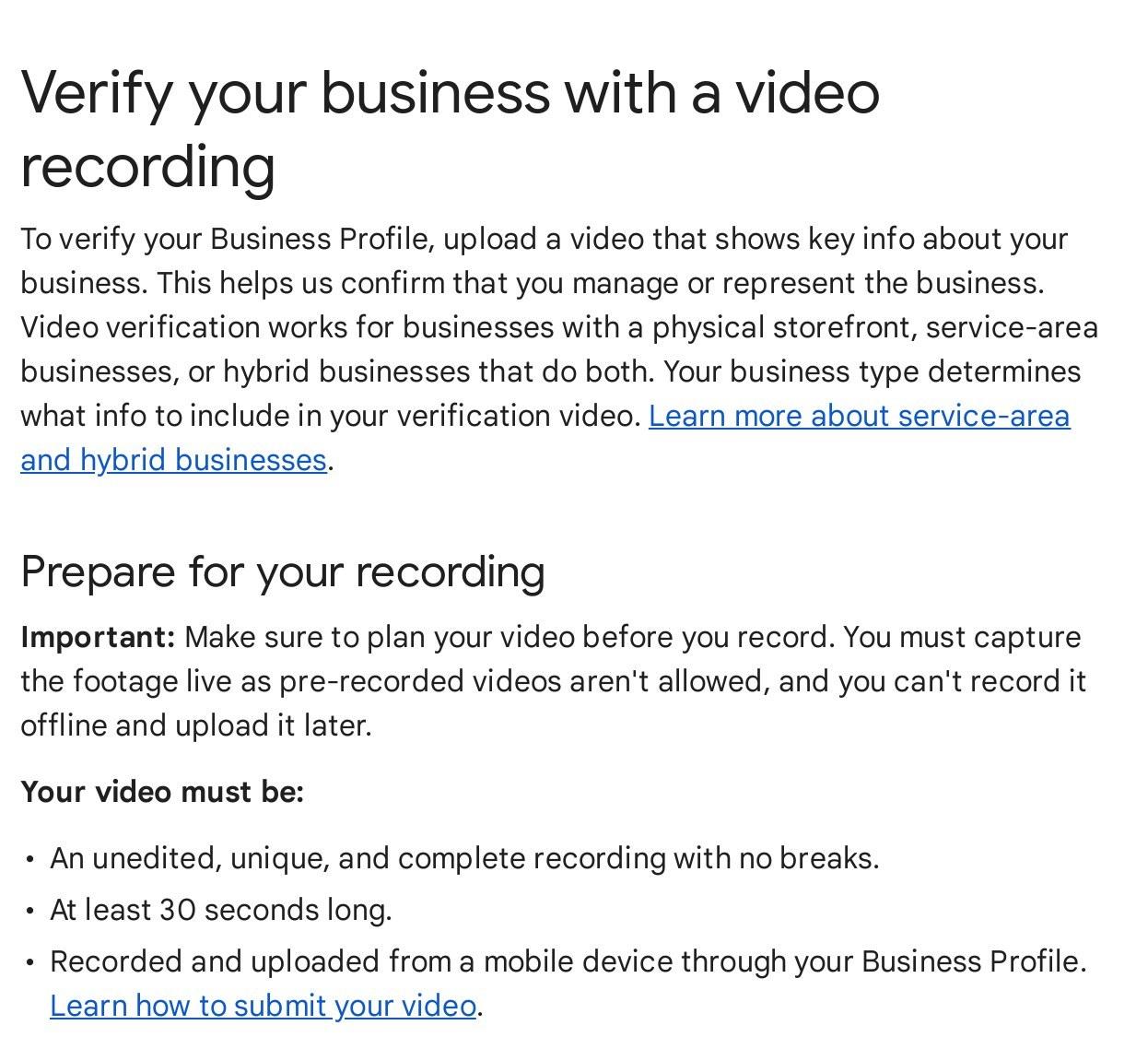
For a business without a shopfront, Google wants to see that the work is real: "the professional tools, equipment, or products you use for work," which can include "specialized machinery, your workspace, business cards, or branded apparel." A lettered van, a trailer of equipment and a uniform do more here than any document. Google says the review "can take up to 5 business days," and if the video is rejected it will share the reasons and let you record a new one.
Video verification for the profile is a separate process from the screening for Google's paid lead ads, which runs its own background, licence and insurance checks. We covered those in our piece on Local Services Ads.
If the answer is no
A rejected appeal is not quite the end. Google says that "only if your reinstatement request is denied, we may be able to do an additional review," and that you can add evidence that was not in the original appeal. The form asks for the date of the suspension, the email that manages the profile and the profile's ID, and it wants two matching documents: a registration or licence, and "a utility bill displaying the same business name and address." It also warns: "you will not receive an email confirmation." Keep a record of what you sent and when.
This is where most owners stop being able to do it alone. Williams's own case moved only after the media coverage, and he told MyNorthwest there are "so many other people out there that haven't had the good fortune or haven't been able to be loud enough about this subject to actually have their businesses reinstated."

After you are reinstated
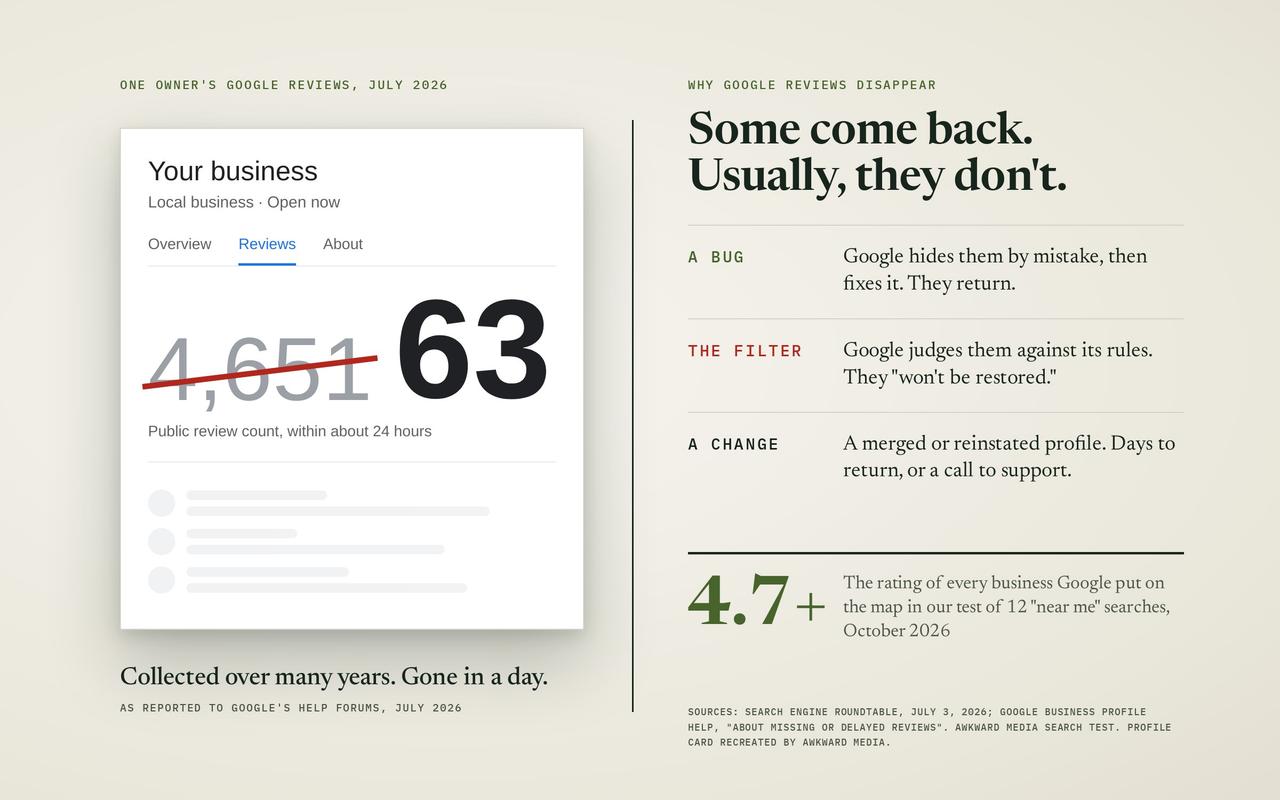
When it works, Google says, "we reinstate both the profile and its owner and managers." What it does not say is anything about rankings or reviews afterwards, and owners report bumps on the way back. Search Engine Roundtable reported in July 2025 that more reinstated profiles, mostly service companies, were being sent through verification again, and in August 2026 that some came back with "the profile is live, but the reviews are missing." Google had not confirmed the second report. Check your profile the day it returns, and again a week later, and keep screenshots.
Then rebuild. Reviews are the fastest way back into the map, and how Google treats them, including the ones it removes, is its own subject, covered in our guide to Google reviews.
What a profile is worth, and the insurance against losing it
It is easy to underestimate what a single listing carries until it is gone. When we started with 360 Hazardous Cleanup, a biohazard cleanup company in Louisville, its eight most important searches averaged #50 on Google Maps. Twenty days later all eight were in the top three, as the case study shows. Shoreside Therapies in Glendale, Wisconsin, reached #1 on Maps for two searches, from #2 and #3, as its case study sets out. Every one of those positions belongs to the profile. Suspend the profile and they disappear together, which is why the work of our map pack expansion service starts with keeping a profile clean.
The insurance is the part of search that does not depend on the profile at all. A search for "mortgage brokers North York" shows Everything Mortgages twice: as a pin on the map and as the first ordinary result, with its own website page for that exact search. Google's help page says a suspended profile cannot be seen. It says nothing about a business's website in the ordinary results.
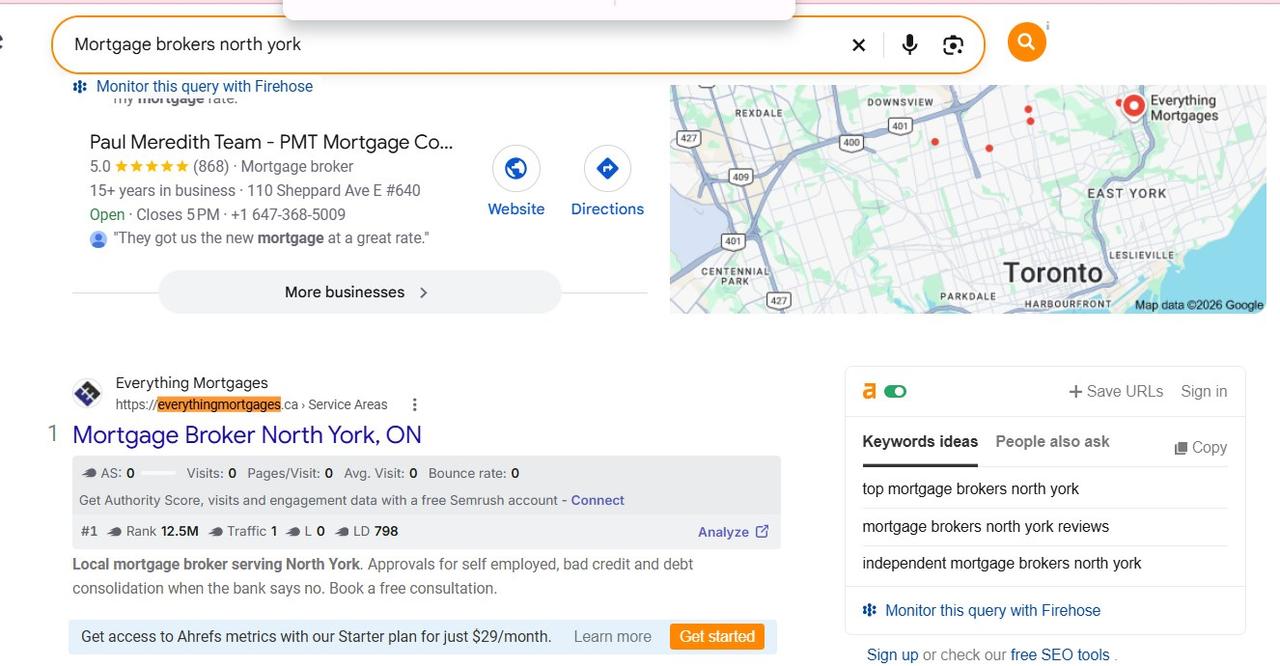
A business with a strong website keeps a door open while the appeal runs. That is the case for building both, here in Toronto or anywhere else, and it is the core of how we approach SEO for small businesses.
How to keep it from happening again
Most suspensions trace back to something that looked harmless when it was done: a few extra words in the name, a mailbox address, a second listing a former agency created, a batch of reviews from friends. Clean all of it up before Google finds it. Make sure your business name, address and phone number match everywhere they appear online, from directories to social profiles, because mismatches are exactly what automated checks notice; keeping those listings consistent is part of our off-page SEO work.
Be strict about reviews. In the United States the Federal Trade Commission's rule on fake reviews carries penalties of up to $53,088 per violation, and Canada's Competition Bureau has warned that businesses can be liable when employees post reviews without disclosing the connection. Google's systems look for the same patterns: when suspicious reviews spike, Google says it will pause new reviews on the profile and show customers a warning.
And know where you stand before anything goes wrong. Our free Google visibility check shows how your business appears on the map and in the results, so you can see what you would lose. If your profile has already gone dark, talk to us before you spend your one appeal. Ryan Williams fought his way back. Most owners would rather not have to.
Every fact in this story is linked to its source. Spot something out of date? Tell the editor and we will correct it.
Questions readers ask
Frequently asked questions
Why was my Google Business Profile suspended?
Google suspends profiles that break its guidelines for representing a business. Common causes are extra keywords in the business name, a P.O. box or unstaffed virtual office as the address, a visible address for a business that serves customers at their homes, duplicate profiles and business types Google does not allow. The appeal tool shows the reason and links to the policy.
How do I get my Google Business Profile reinstated?
Fix anything that breaks the guidelines first, then open the Google Business Profile appeals tool, select the profile and the decision, and attach evidence such as a business registration, licence, tax certificate or utility bill. The business name and address on the documents must match the profile. Google emails the decision.
How many times can I appeal a suspension?
Google says appeals can only be submitted once. If the appeal is denied, Google may allow one additional review, where you can add evidence you did not include the first time.
How long does a Google Business Profile appeal take?
Google's help pages put appeal reviews and video verification at up to five business days. Real cases can take far longer, especially when Google asks for more evidence or a new video.
Should I create a new Google Business Profile if mine is suspended?
No. Google's help page says in bold: do not create a new Business Profile for the same business. A second profile breaks the rule against duplicates and does not fix the original problem.
Will I get my reviews back after reinstatement?
Google says it reinstates the profile along with its owner and managers, but it makes no promise about reviews or rankings. Search Engine Roundtable reported in August 2026 that some reinstated profiles came back with reviews missing. Google had not confirmed it.
About the author