Industry guides
Law firm SEO in 2026: how clients find a lawyer now, and how to be the one they call
Law firm SEO in plain words: how clients find a lawyer on Google, Maps and AI answers in 2026, and the steps that put your firm there.
· Updated · 6 min read

In this story
On the afternoon of October 17, 2026, we searched "probate lawyer" on a phone in Tampa, Florida, the way someone might the week after a parent dies. The first thing on the screen was not a law firm. It was a paragraph written by Google's AI, explaining that a probate lawyer "guides families through the court-supervised process of settling a deceased person's estate," and that in Tampa the process runs through the 13th Judicial Circuit Court in Hillsborough County.
Under that paragraph sat a short row of sources: the websites Google's AI had read to write it. One of them was floridaprobatelawgroup.com, the site of Florida Probate Law Group, a firm we work with. Below the AI answer came a map with three local firms on it. Below the map came the regular list of websites. Florida Probate Law Group was sixth, with a page written for Hillsborough County alone.
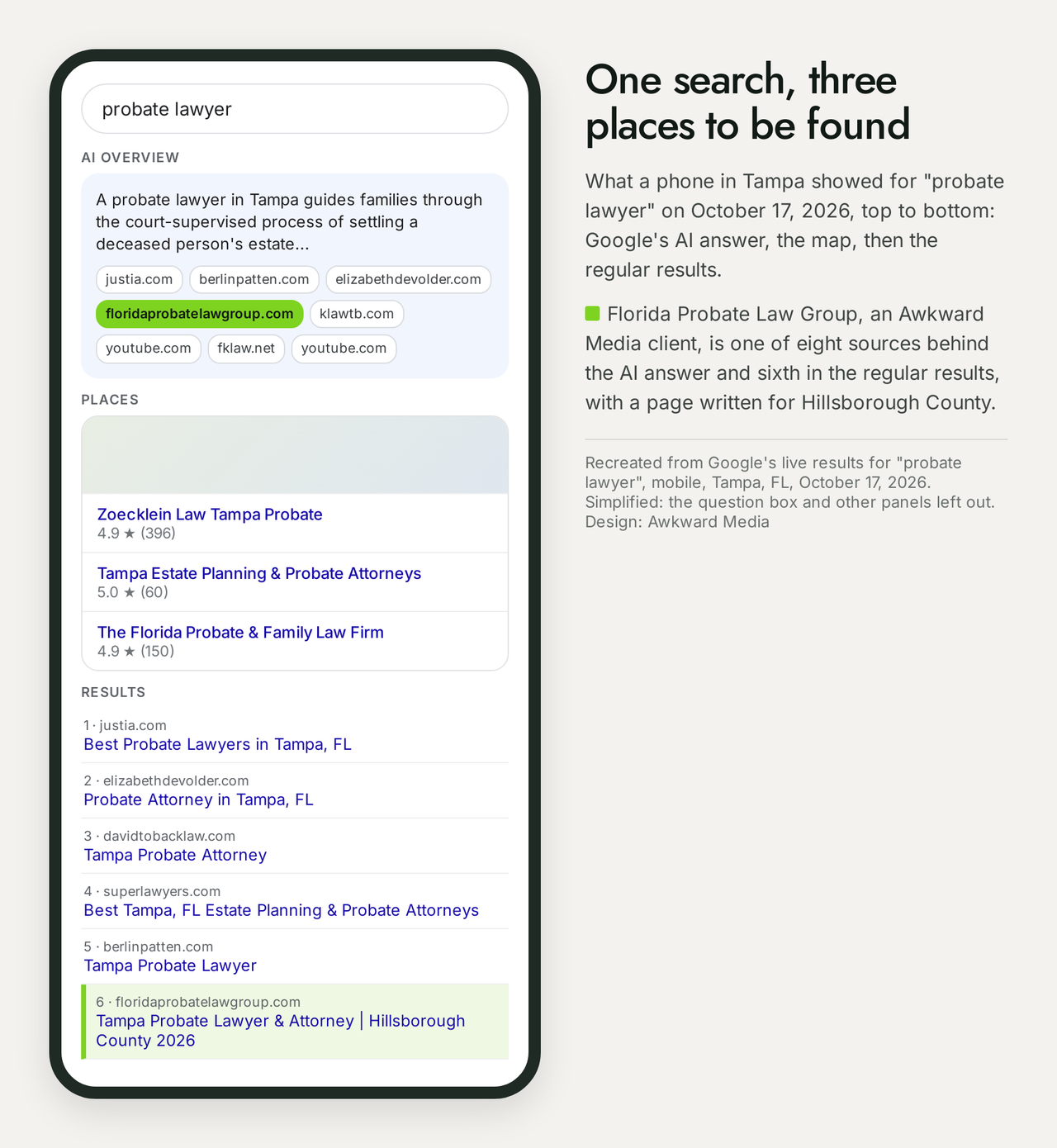
That one screen holds most of what a law firm needs to understand about being found online in 2026. A person with a legal problem now meets three things before they meet a lawyer: an AI answer, a map and a list. A firm can appear in all three, in one of them, or in none. The firms that appear in all three are not necessarily the ones with the biggest advertising budgets. They are the ones that wrote down, clearly and specifically, what they do, where they do it and what a client should know before calling.
The name for the work of earning those places is law firm SEO. This guide explains it in plain words for lawyers and firm owners who have never had to think about it, walks through each part step by step, and shows what it looks like when it works, using searches we checked live in October 2026.
What law firm SEO means, in plain words
SEO stands for search engine optimization. It is the work of getting a business shown, for free, when people search on Google and on the AI tools that now answer questions. Law firm SEO is the same work applied to the way people look for a lawyer.
For a legal search, there are three places on the screen where your firm can show up:
- The AI answer. Google now often writes a short answer at the top of the page, called an AI Overview, and lists the websites it drew on. ChatGPT, Perplexity and Google's Gemini do the same when someone asks them a question directly.
- The map. For searches like "divorce lawyer near me" or "probate lawyer", Google shows a small map with three firms under it. These come from each firm's Google Business Profile, the free listing with your address, hours, phone number and reviews.
- The regular results. The list of websites under the map. This is where guides, practice area pages and directories compete.
None of these places can be bought. Ads can sit above them, and we will come to ads later, but the AI answer, the map and the regular results are earned. That is the whole point of the work: a client who finds you there did not cost you a fee per click.
Law firm SEO covers several kinds of work that we also sell separately: local SEO for the map, organic SEO for the regular results, AI Overviews and ChatGPT work for the AI answers, and the content, technical and link work underneath all of them. For a law firm they are one job, because the same pages and the same reputation feed all three places at once.
Why legal search is different from other trades
A plumber and a family lawyer both want the phone to ring. But Google treats their websites differently, the rules on what they may say are different, and the money at stake on each search is different. Four things set legal search apart.
Google holds legal pages to a higher standard
Google is open about the fact that it judges some topics more strictly than others. Its guidance for site owners says its systems "give even more weight to content that aligns with strong E-E-A-T for topics that could significantly impact the health, financial stability, or safety of people." Google calls these "Your Money or Your Life" topics. A divorce, a criminal charge, an estate or an injury claim fits that description as well as anything does.
E-E-A-T is Google's shorthand for experience, expertise, authoritativeness and trust. Google is clear about which of the four comes first: "Of these aspects, trust is most important." And for these sensitive topics, it says the content "must be highly accurate and consistent with established expert consensus." In practice, that means a legal page written by nobody in particular, with no named lawyer behind it and no sign of who checked it, starts at a disadvantage against a page signed by a lawyer whose credentials a reader can look up.
The rules on what you may say are stricter
Most businesses can call themselves the best in town. Lawyers can't, or at least not freely. In the United States, the American Bar Association's Model Rule 7.1, the basis for most state rules, says: "A lawyer shall not make a false or misleading communication about the lawyer or the lawyer's services." In Ontario, the law society's Rule 4.3-1 says a lawyer "shall not advertise that the lawyer is a specialist in a specific field unless the lawyer has been so certified by the Law Society." Every page your firm publishes is advertising under those rules, and we cover what that means for SEO in its own section below.
A single click can cost more than $200
The clearest sign of what a legal client is worth is what firms pay Google for a single visitor. In October 2026, Google's own estimates put the average cost of one ad click for "car accident lawyer near me" at $205.31 in the US. For "personal injury lawyer near me" it was $163.07. Even quieter practice areas cost real money: $24.85 a click for "divorce lawyer near me", $16.73 for "probate lawyer near me".

That is the business case for law firm SEO in one chart. A personal injury firm that earns a place on the map for "car accident lawyer near me" is collecting, for free, visits that its competitors are paying about two hundred dollars each for.
Legal searches come in two kinds
The last difference is in how people search. Legal searches split roughly into two groups, and a firm needs to be found for both.
- "I need a lawyer now" searches. "Car accident lawyer near me", "DUI lawyer", "probate attorney Tampa". The person has decided to hire someone. These are won mostly on the map and on practice area pages.
- "What do I do?" searches. "What to do after a car accident", "do I need a lawyer for probate", "how much does a divorce cost". The person hasn't decided anything yet. These are won by firms that answer the question better than anyone else, and they are exactly the searches where Google now shows an AI answer.
The second group is easy to underrate. Google estimates that 8,100 people a month in the US search "how much does a divorce cost" and 4,400 search "what to do after a car accident". Each of those people is a potential client, and in October 2026 the websites Google's AI quoted to answer them were mostly law firms' own.
What clients type, practice area by practice area
Before any of the steps below, it helps to know the size of the prize in your own practice area. These are Google's estimates of monthly searches across the US for the most common "near me" search in each area, read in October 2026. Your own town's numbers will be a small slice of these, but the order tends to hold.
| Practice area | Search | US searches a month | Google Ads cost per click |
|---|---|---|---|
| Personal injury | personal injury lawyer near me | 301,000 | $163.07 |
| Car accidents | car accident lawyer near me | 165,000 | $205.31 |
| Family law | family lawyer near me | 110,000 | $30.94 |
| Criminal defense | criminal defense lawyer near me | 90,500 | $52.82 |
| DUI | dui lawyer near me | 60,500 | $67.14 |
| Employment | employment lawyer near me | 49,500 | $26.82 |
| Estate planning | estate planning attorney near me | 49,500 | $6.57 |
| Divorce | divorce lawyer near me | 40,500 | $24.85 |
| Immigration | immigration lawyer near me | 27,100 | $13.09 |
| Probate | probate lawyer near me | 9,900 | $16.73 |
Two things stand out. The first is how much of legal demand ends in "near me": people want a lawyer close by, which makes the map central for almost every practice. The second is that a high price per click doesn't always mean high demand. Estate planning draws as many searches as employment law at a quarter of the price, which usually means fewer firms are fighting over it.
Step 1: Set up your Google Business Profile the way Google wants for lawyers
Your Google Business Profile is the free listing that puts your firm on the map. If you have never claimed yours, search your firm's name on Google, find the listing and choose the option to claim it. Google will ask you to prove you run the firm before you can edit it. Our step-by-step guide to local SEO covers the basics that apply to any business. Here is what is specific to law firms.
Decide between a firm profile and lawyer profiles
Google treats lawyers as "individual practitioners", alongside doctors, dentists and financial planners, and has rules written for them. A lawyer "should create their own dedicated Business Profile" if they operate in a public-facing role and "can be contacted directly at the verified location during stated hours." Support staff should not have profiles.
The rules then depend on how many lawyers work at the office:
- Several lawyers at one office. Google says "the organization should create a Business Profile for this location, separate from that of the practitioner," and each lawyer's profile "should include only the name of the practitioner, and shouldn't include the name of the organization."
- One lawyer, practising under a firm brand. Google says "it's best for the practitioner to share a Business Profile with the organization," named in the format "[brand/company]: [practitioner name]".
- One lawyer with several practice areas. Google says a practitioner "shouldn't have multiple Business Profiles to cover all of their specializations." One lawyer, one profile.
Lawyer profiles can help a firm take up more room on the map, but they can also compete with the firm's own profile for the same searches. Plan them as a set, and make sure every profile points to the right page: the firm's profile to the home or office page, each lawyer's profile to that lawyer's own page.
Use your real name, and nothing else
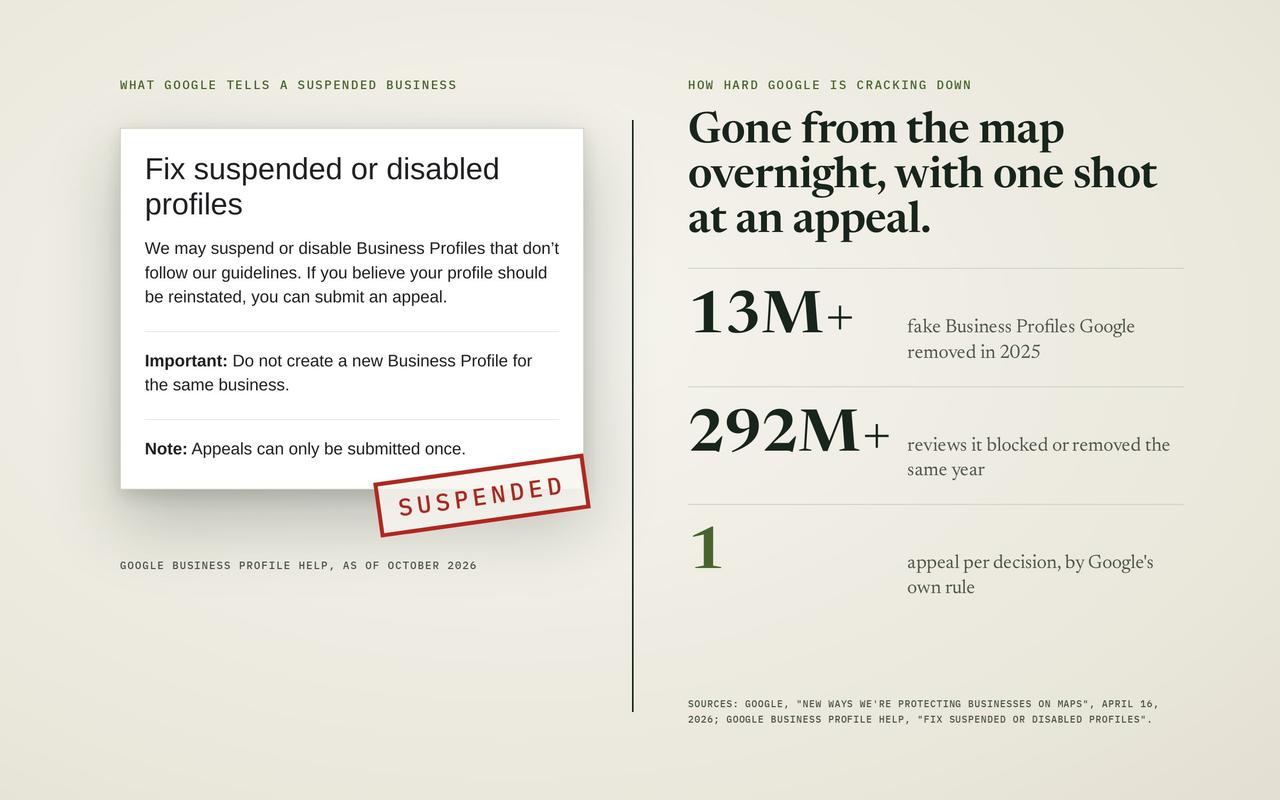
Google's rules say your profile should represent your business "as it's consistently represented and recognized in the real world across signage, stationery, and other branding." Adding "Best Car Accident Lawyer Tampa" to your name breaks that rule, and it is one of the common reasons a profile gets suspended. If your firm's real name already says what you do, as "Florida Probate Law Group" does, you have an advantage that took years to build. If it doesn't, the steps that follow are how you make up for it.
Choose the main category for the cases you want most
Google lets you pick one main category, such as "Personal injury attorney", "Family law attorney" or "Estate planning attorney", and several extra ones. Google asks you to "choose the fewest number of categories it takes to describe your overall core business." Pick the main category for the work you most want more of, not for everything you do.
Keep hours true
Industry surveys of local search specialists rank being open at the time of the search among the top factors for the map. Some injury firms list themselves as open around the clock because someone genuinely answers the phone at night. If that's true for your firm, say so. If it isn't, don't, because a client who calls at 2am and reaches voicemail is a client you've lost twice.
Reviews, within your rules
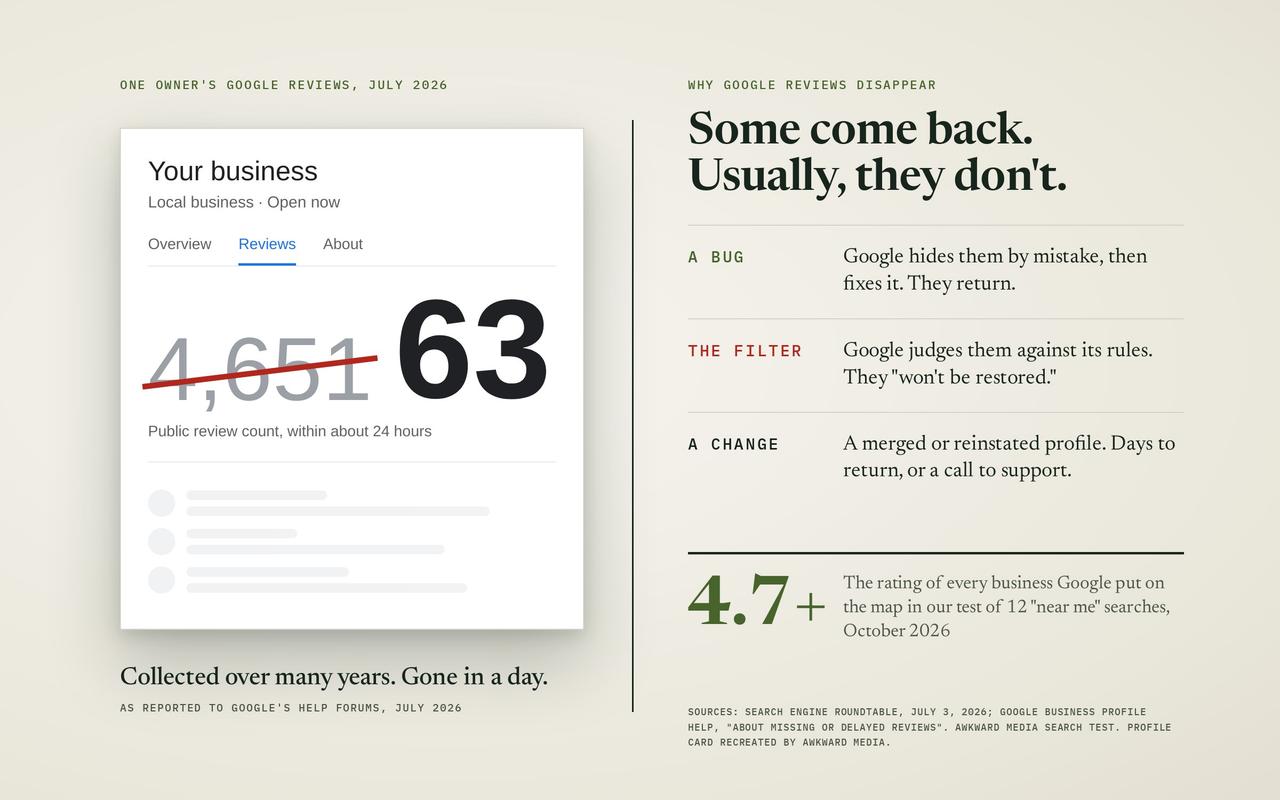
Clients read reviews before they call, and reviews are one of the signals Google uses to judge how well known a firm is. They are not the only one. The case below makes the point: a firm with 44 reviews ranked first for one of the most expensive searches in law. Ask satisfied clients for a review in a way your bar or law society allows, reply to what they write without revealing anything confidential, and work on every other step in this guide at the same time. Our pieces on why Google removes reviews and the review you can't remove cover the rest.
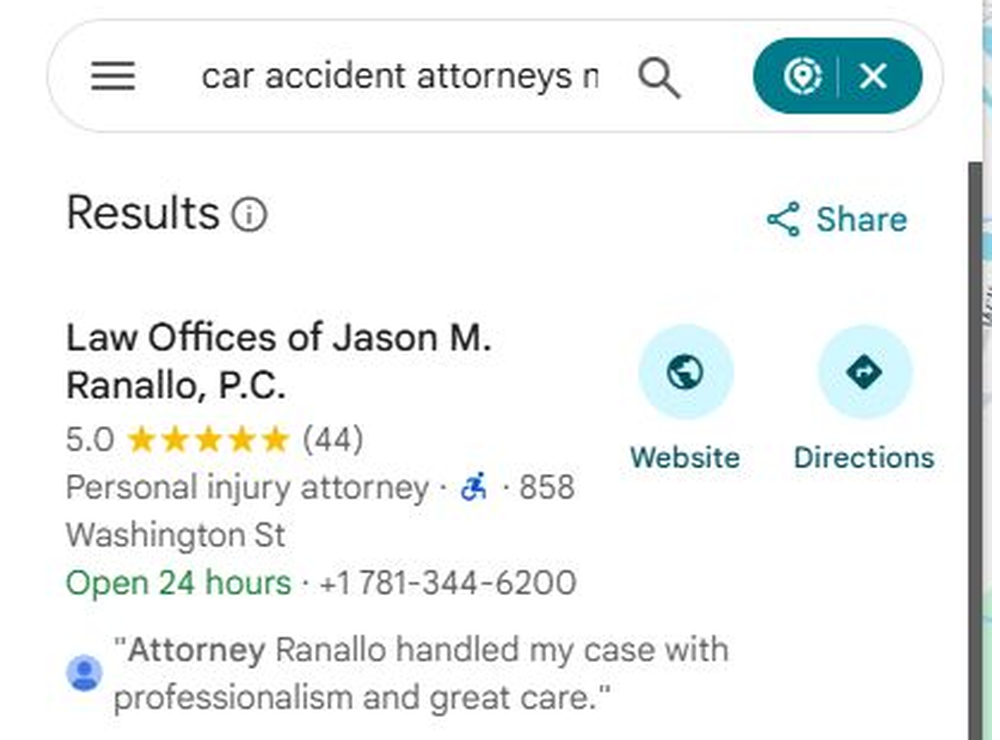
That firm is the Law Offices of Jason M. Ranallo, a personal injury practice in Canton, Massachusetts, south of Boston. In our 20-day report, checked from a point 9.2 miles from the office, it had moved from tenth to first on Google Maps for "car accident attorneys near me", and from tenth to first for "motorcycle accident attorney Dedham". It did not get there by out-reviewing everyone. It got there by being the clearest, most complete answer Google could find for those searches.
Step 2: Give every practice area, and every place you serve, its own page
Your profile tells Google who you are. Your website tells it what you do, in enough detail to match the exact problem someone typed. This is where most firm websites fall short. A single "Practice Areas" page that lists ten kinds of law in one paragraph gives Google nothing to match against "contested will lawyer" or "slip and fall attorney". A firm with a page for each gives it something to match against every one.
One page per practice area
Each main practice area needs a page of its own, and the best ones go further, with a page for each kind of case inside it. A personal injury firm might have separate pages for car accidents, truck accidents, slip and falls, dog bites and wrongful death. A family firm might separate divorce, custody, support and separation agreements. Each page should explain the problem in the client's words, what the process looks like, what it might cost, how long it usually takes, and who at the firm handles it.
One page per place you take cases
If you take clients across a county, a state or a province, every place that brings real work deserves its own page, with detail a competitor can't copy. Florida Probate Law Group is the example we know best. It serves clients across the state, and its website has a section organised county by county, built around each county's probate court. The Tampa page that ranked sixth in our search was its Hillsborough County page, titled "Tampa Probate Lawyer & Attorney | Hillsborough County 2026". That page exists because probate runs county by county, and a family in Tampa wants to know about the court in Tampa.

The same firm ranks first on Google for "Florida probate lawyer" and second for "probate lawyers in Florida", "attorneys probate" and "Florida probate attorneys". Look at its result in the screenshot: the short description under the title says it serves all 67 counties, charges a flat fee and works remotely. Those are the three things a grieving family wants to know, and they are said before anyone clicks. Statewide reach like that is the job of multi-location SEO, and for firms that take clients across the whole country, national SEO.
What to send whoever runs your website
If someone else manages your site, you can send them this:
Please make sure each of our practice areas, and each main type of case within them, has its own page. On each page, include: what the problem is in plain words, who it affects, what the legal process looks like step by step, typical timelines, how our fees work for this type of case, the counties or cities we take these cases in, five or six common client questions with short answers, and the name and photo of the lawyer who handles it, linked to their profile page. Put the practice area and our main city in the page title. Add our firm name, address and phone number to the footer of every page, written exactly as they appear on our Google listing.
Writing those pages well is the core of what our content writing and on-page SEO teams do for law firms.

Step 3: Put a real lawyer's name on every page
Because legal topics sit in Google's strictest category, the question of who wrote a page matters more than it does for a bakery. Google tells site owners to ask themselves whether their content presents information "in a way that makes you want to trust it, such as clear sourcing, evidence of the expertise involved, background about the author." It adds: "We strongly encourage adding accurate authorship information, such as bylines to content where readers might expect it."
For a law firm, that comes down to a few concrete things:
- A profile page for every lawyer. Their photo, where they studied, when and where they were admitted, the practice areas they handle, notable work they are allowed to describe, and any articles or talks. These pages are also what an individual lawyer's Google Business Profile should link to.
- A named author on every guide and practice page. "Written by" or "Reviewed by" a named lawyer, with a link to their profile, and the date it was last checked.
- Dates that mean something. Law changes. A page about filing deadlines that shows when it was last reviewed is more trustworthy than one that doesn't.
- The firm's real details everywhere. The same name, address and phone number on the website, the Google profile and every directory.
Lawyers are often wary of putting their name on marketing. The good news is that this step asks for nothing promotional: just the facts a client would want before trusting someone with their case.
Step 4: Answer the questions clients ask before they call
For the "what do I do?" searches, the firm that answers best gets read by Google's AI, quoted in its answer and listed among its sources. We checked three common ones on October 17, 2026, on a phone, searching as someone in the US. Each had an AI Overview at the top of the page.
- For "what to do after a car accident", the AI answer cited ten different websites. Six were law firms' own sites, most of them writing about the rules in a single state. The regular results under it were led by law firm guides too.
- For "do I need a lawyer for probate", the AI answer cited seven different sites. At least five were law firms, mostly writing about the rules in their own state.
- For "probate lawyer" in Tampa, as described at the top of this piece, one of the cited sources was our client's county page.
The pattern is consistent. Google's AI answers legal questions by reading law firms' explanations, and it favours the ones written for a specific place and situation. A firm in Mississippi that wrote "10 things to do after a car accident in Mississippi" was cited in a national answer. Google says there are "no additional requirements to appear in AI Overviews"; the same careful pages that rank in the regular results are what its AI reads.
Which questions to answer first
Start with the questions you already answer on the phone every week. A few that work for most practices:
- How much does it cost, and how do your fees work?
- How long does it take, from first call to the end?
- What happens at the first meeting, and what should I bring?
- Do I even need a lawyer for this?
- What are the deadlines in this state or province?
- What mistakes do people make before they call a lawyer?
Write each answer as a page or a section of a practice page, in plain language, signed by the lawyer who would give the answer in person. Be specific to your jurisdiction. "How long does probate take in Florida" is a better page than "how long does probate take", because it is the question your clients actually have.
Write for the reader, not for the search engine
Google's guidance asks whether someone reading your content will "leave feeling like they've had a satisfying experience." For a legal reader that means the answer comes first, the caveats are honest, and the page tells them what to do next. A page stuffed with the phrase "Tampa probate lawyer" twenty times is the opposite, and both readers and Google can tell.
Step 5: Get your firm named on the sites AI reads
When we asked four AI assistants "Who is the best probate attorney in Yakima, WA?" on October 17, 2026, they leaned on the same small set of sources. Perplexity cited Super Lawyers, Martindale, Justia, Cornell's lawyer directory and Expertise.com, along with one law firm's own site. ChatGPT cited four firms' websites and Super Lawyers. Legal directories and firm websites were most of what the assistants read.
That matches what the legal directories have long been for people, and it gives a firm a practical list:
- Complete your profiles on the major legal directories. Justia, Martindale, Avvo, Super Lawyers, FindLaw, and in Canada the directories your provincial bar or law society runs. Use the same firm name, address and phone number on each as on your Google profile.
- Keep your bar or law society listing current. It is the most authoritative record of who you are.
- Get mentioned by local and legal publications. A quote in the local paper, an article in a bar journal, a talk at a community event that is listed online. Each is a trusted site that names your firm.
- Earn links from sites that matter to your clients. Google says prominence is "based on info like how many websites link to your business and how many reviews you have." A link from a local charity you support, a referral partner or a university clinic counts for more than a hundred from sites nobody reads. This is the work of our link building and off-page SEO teams.
Directories also compete with you in the regular results. In our Tampa search, Justia's page of probate lawyers was the first regular result and Super Lawyers was fourth. A firm can't usually outrank Justia for a city-wide search on day one. It can make sure it appears inside Justia's list, and then win the more specific searches with pages that Justia doesn't have.
Step 6: Fix the technical floor under all of it
None of the steps above work on a website that is slow, broken on phones or hard for Google to read. You don't need to understand the technical side yourself. You need to know it has been checked. Send this to whoever runs your website:
Please check our website and tell me, in writing: how long our home page and our three main practice pages take to load on a phone; whether any pages show errors or broken links; whether every page has its own title and description; whether our contact forms and click-to-call buttons work on a phone; and whether Google can see all our practice area pages. Please fix anything that fails, and tell me what you changed.
Two legal-specific points belong in that conversation. Your contact form should never ask for confidential details about the case before an engagement, and it should say plainly how the firm will respond. And if your firm moves to a new website, have someone plan how the old addresses will point to the new ones, because a careless move can lose rankings that took years to earn. Those are the jobs of our technical SEO and website migration work.
Step 7: Write within your bar's advertising rules
Every page on a firm's website is a communication about the lawyer's services, which means the profession's advertising rules apply to it. SEO advice written for other trades often ignores this. Three points come up most often.
Nothing false or misleading
The ABA's Rule 7.1 says a communication is misleading "if it contains a material misrepresentation of fact or law, or omits a fact necessary to make the statement considered as a whole not materially misleading." That applies to how past results are described. A page that celebrates a large settlement without context can mislead a reader about what their own case is worth. Most states have their own rules on this, so check yours before publishing results.
Be careful with "specialist" and "expert"
The ABA's Rule 7.2(c) says a lawyer "shall not state or imply that a lawyer is certified as a specialist in a particular field of law" unless they have been certified by an approved organization and "the name of the certifying organization is clearly identified in the communication." In Ontario, Rule 4.3-1 reserves "specialist" for lawyers the Law Society has certified. Ontario's Law Society Tribunal Appeal Panel has since confirmed, as reported by Slaw, that saying a firm "specializes" in an area does not breach the rule when it is accurate. Other provinces and states draw the line in different places, so use "focuses on" or "practises exclusively in" when in doubt.
Reviews, testimonials and endorsements
Rules on client testimonials and on asking for reviews vary by state and province. Some require disclaimers, some restrict what can be said about outcomes. Before you start asking clients for Google reviews or put quotes on your website, read your own rules, or ask your bar's ethics line. An agency that writes your pages should know these rules exist and should show you every page before it goes live.
Law firm SEO and AI search in 2026
The biggest change in how people look for a lawyer this year is not on Google's map. It is in the AI tools. Every year, iLawyerMarketing, a legal marketing agency, asks a panel of Americans which online sources they would use to research a lawyer for a very important legal issue. Its 2026 survey of 1,110 adults found that 71.9% would use Google, down from 86.7% a year earlier. The share that would use ChatGPT rose from 28.1% to 41.9%. Half, 50.1%, said they would use at least one AI assistant, and 9.5% said they would use only AI.
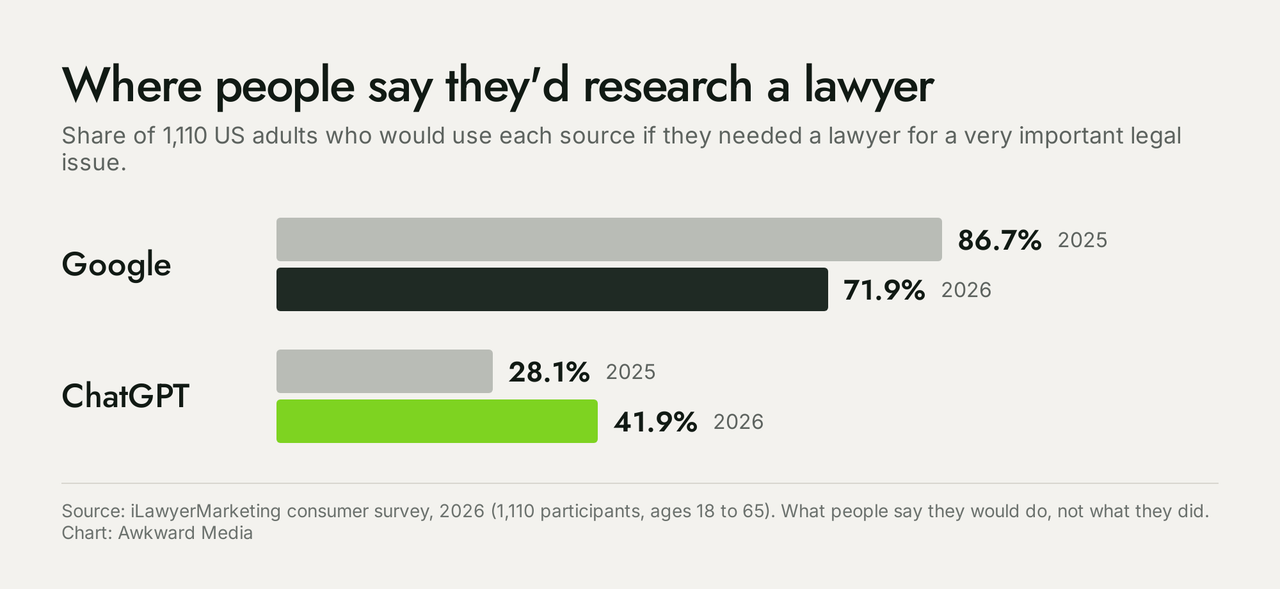
Two cautions belong next to those numbers. They describe what people say they would do, not what they did. And Google is still, by a wide margin, where most people go. The right reading is not that Google stopped mattering. It is that the work that ranks a firm on Google now also has to be readable by the assistants, because a growing share of clients will meet the firm there first.
What the assistants actually said
To see how this plays out, we asked ChatGPT, Perplexity, Gemini and Google's AI Mode the same question on October 17, 2026: "Who is the best probate attorney in Yakima, WA?" The four gave four different answers. ChatGPT named four local firms. Gemini and AI Mode each named others. Perplexity named a lawyer listed on Super Lawyers and then suggested comparing him with Skyview Law, "which maintains a Yakima office and specifically advertises probate services."
Skyview Law is a firm we work with. A month earlier, Google's own AI Overview for "probate attorney yakima wa" listed Skyview Law among the sources it drew on.
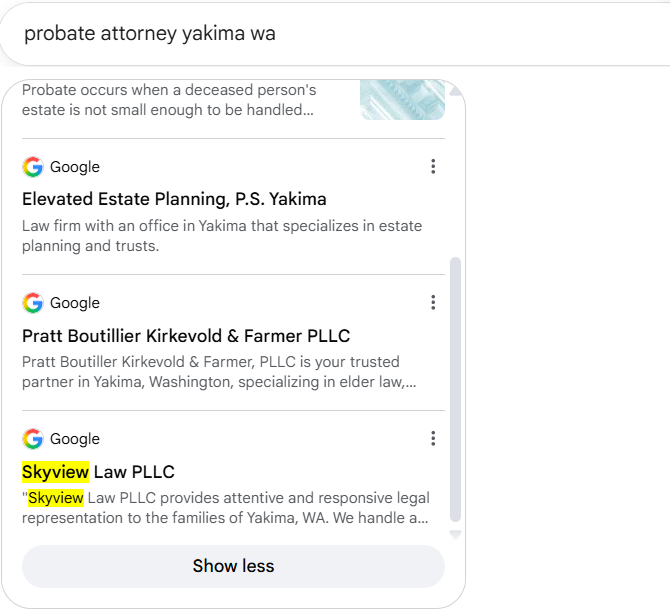
Before that work, Skyview's website wasn't in Google's top 100 for its main Yakima probate searches. By September it was sixth for "Probate Attorney in Yakima, WA" and on the first page for three similar searches. The assistants noticed the same thing Google did: a firm that says clearly, on its own pages, that it handles probate in Yakima.
Two lessons follow. AI answers change from one asking to the next, so no firm "owns" an assistant's recommendation; one test is a sample, not a ranking. And the firms that get named are the ones whose own websites, directory listings and Google profiles all say the same clear thing. That is the same work as the steps above, not a separate project. We cover the AI side in depth in our AI Search Guide and our report on Google's AI Overviews.
SEO, Google Ads and Local Services Ads
Many firms that ask about SEO already spend money on Google Ads, and many use Google's Local Services Ads, the boxes at the very top of some legal searches where a firm pays per lead rather than per click. The honest answer to "which is better?" is that they do different jobs.
- Google Ads buy a visitor today. At $205 a click for "car accident lawyer near me", that is an expensive way to be found, but it is immediate.
- Local Services Ads charge per lead, and in some categories show a Google Verified badge for firms that pass Google's checks. We explained how they work, and what they cost compared with SEO, in our piece on Local Services Ads versus SEO.
- SEO earns places that don't charge per visit and keep working after a budget stops.
One change is worth knowing about now. Google is moving Local Services Ads into its main Google Ads system. Its migration timeline, read on October 17, 2026, starts with home service trades in the US in August 2026, expands in late 2026, and moves "all remaining business categories that were not migrated in 2026" in 2027. Legal isn't named in the 2026 phases. Google also says that "performance reports will not transition," so firms using Local Services Ads should download their history before their account moves.
Many firms run all three and lean more on SEO as their rankings grow, because every case that comes from the map or the regular results is one they didn't pay a per-click price for.
How to tell whether it's working
You don't need to learn an analytics tool to know whether law firm SEO is paying off. Four habits are enough.
- Ask every new client how they found you, and write it down. "Google", "the map", "ChatGPT", "a friend", "Avvo". Your intake form or your receptionist can do this on every call.
- Count signed cases, not just calls. A page that brings ten calls a month for work you don't take is worth less than one that brings two calls for work you do.
- Search for yourself once a month. On your phone, search your three most valuable practice areas the way a client would, from a few places across your area. Note where you appear on the map, in the regular results and in the AI answer. Ask an AI assistant who it recommends for the same problem in your city.
- Ask whoever runs your website for one monthly report. Google gives website owners a free tool called Search Console. Send this: "Each month, please send me the top 20 searches people used to find our website on Google, how many clicks each one brought, and our average position for each, compared with the month before."
How long law firm SEO takes
It depends on how far behind a firm starts, how crowded its practice area is in its city, and how much of the work above is already done. Some changes move fast. Here is a selection from the firms we work with:
- Law Offices of Jason M. Ranallo, personal injury, Massachusetts: tenth to first on Google Maps for "car accident attorneys near me" in 20 days.
- Omni Law: new leads arriving inside the first 20 days.
- Lai and Turner Law Firm, family and criminal law: 11,000 clicks from Google in 45 days.
- Skyview Law, probate, Washington: from outside the top 100 to the first page for its main Yakima searches.
- Uche Litigation, criminal defense, Chicago: a 250% increase in the estimated value of its traffic from Google.
- Chapman McAlpine, family law, Barrie, Ontario: first for "Barrie family lawyers", with seven searches at number one.
- Florida Probate Law Group: first on Google for "Florida probate lawyer", statewide.
The map tends to move first, because a well-built Google profile and a clear practice page can change a firm's position within weeks. The regular results for competitive city-wide searches take longer, and statewide or national searches longest of all. Anyone who promises a specific position by a specific date without studying your market is guessing. Our own promise is written down on our guarantees page: page one of Google in 60 days for qualifying searches, or we keep working free until you are.
What law firm SEO costs
What a firm pays for SEO depends on how many offices, practice areas and cities it wants to rank for, and how strong the firms above it are. Our own prices are public. Google Maps work starts at $1,497 a month. Google rankings in the regular results start at $2,697 a month. Both go up for several offices, several websites and more complex markets. Our SEO pricing page has the details.
Some firms want advice before they commit to monthly work, or want a second opinion on what their current agency is doing. That is what our SEO consulting is for: a one-hour, advice-only session for $497.
A useful way to think about the cost is against the chart near the top of this guide. A personal injury firm paying $205 a click needs fewer than ten ad clicks a month to spend what Google Maps work starts at. The question is never whether SEO is cheap. It is whether the cases it brings are worth more than what they cost to win any other way.
Choosing who does it
Everything in this guide can be done by a firm on its own, and the Google profile, the lawyer pages and the client questions are a good place for any firm to start. Practice and place pages, directory listings, links and the technical work take steady hours that most lawyers don't have, which is where most firms bring in help.
If you are comparing agencies, ask each one, us included: which law firms have you ranked, for which searches, and can I see the screenshots? Do you know my state's or province's advertising rules? Who writes the pages, and will a lawyer at my firm review them? How will you report what happened each month, in calls and cases rather than jargon? Our guide to choosing an SEO partner has the full list of questions.
Awkward Media is a full-service SEO agency: organic SEO, national SEO, local SEO, ecommerce SEO and AI search, for firms across the US and Canada. Our law firm work is described on our law firm SEO page. It is for established firms already doing $20,000 a month or more. If you want to see where your firm stands today, our free Google Visibility Check shows how you appear on Google now. Or talk to us directly.
Back in Tampa, the family looking for a probate lawyer will probably never know why one firm's name appeared in the answer at the top of their screen. They will just know it was there, written for their county and its court, in words they could follow. That is law firm SEO. It is not a trick. It is a firm writing down, more clearly than anyone else, what it does and for whom, and then making sure Google, the map and the assistants can all read it.
Every fact in this story is linked to its source. Spot something out of date? Tell the editor and we will correct it.
Questions readers ask
Frequently asked questions
What is law firm SEO?
Law firm SEO is the work of getting a law firm found, without paying per click, when people search for a lawyer or a legal problem on Google, Google Maps and AI assistants like ChatGPT. It covers the firm's Google Business Profile, a page for each practice area and place it serves, profiles of its lawyers, answers to the questions clients ask, listings on legal directories, links from trusted sites and the technical health of the website.
How is SEO for lawyers different from SEO for other businesses?
Google judges legal pages more strictly, because a legal problem can affect someone's money, family or freedom, so named lawyers and accurate, dated information matter more. Bar and law society advertising rules limit what a firm may say. And legal clicks are among the most expensive on Google Ads, over $200 for "car accident lawyer near me" in the US in October 2026, so every earned visit is worth more.
How long does law firm SEO take to work?
The map can move within weeks: one personal injury firm we work with went from tenth to first on Google Maps for "car accident attorneys near me" in 20 days. Competitive city-wide and statewide searches in the regular results take longer. It depends on where the firm starts and how strong the firms above it are.
How much does law firm SEO cost?
It depends on how many offices, practice areas and cities you want to rank for. At Awkward Media, Google Maps work starts at $1,497 a month and Google rankings in the regular results start at $2,697 a month, higher for several offices, several websites and complex markets. A one-hour, advice-only consultation is $497.
Should every lawyer at my firm have their own Google Business Profile?
Google allows a profile for each public-facing lawyer who can be contacted at the office during its stated hours, separate from the firm's own profile. A solo lawyer under a firm brand should share one profile named "[firm]: [lawyer name]". Plan lawyer profiles together with the firm's profile so they don't compete for the same searches.
How do I get my law firm on Google Maps?
Claim and verify your Google Business Profile, use your firm's real name, choose the main category for the cases you want most, keep your hours true, add real photos, and link to the right page on your website. Then build practice area pages, directory listings and links, which tell Google your firm is well known. Reviews help too, as one part of that picture.
How do I get my firm recommended by ChatGPT and Google's AI answers?
The AI tools read firm websites, legal directories and Google profiles. Clear practice and place pages signed by named lawyers, complete directory profiles with the same details everywhere, and answers to common client questions written for your state or province give them something to quote. No firm can guarantee a recommendation, because the answers change each time.
Is SEO or Google Ads better for a law firm?
They do different jobs. Ads buy a visitor today at a price per click. SEO earns places on the map, in the regular results and in AI answers that don't charge per visit and keep working after a budget stops. Many firms run both and lean more on SEO as their rankings grow.
Can I say my firm "specializes" in an area of law?
It depends on where you practise. The ABA's model rule bars implying you are a certified specialist unless you are, and the certifying body is named. Ontario reserves "specialist" for lawyers certified by the Law Society, though its appeal panel has said "specializes" is allowed when accurate. Check your own state's or province's rules, and use "focuses on" when in doubt.
Can lawyers ask clients for Google reviews?
In most places, yes, within rules that differ by state and province on testimonials and what can be said about outcomes. Ask in a way your rules allow, never offer anything in return, and reply to reviews without revealing confidential information. If you're unsure, ask your bar's ethics line.
Do legal directories like Justia, Avvo and Super Lawyers still matter?
Yes. They often rank above firms for city-wide searches, and in our October 2026 tests the AI assistants cited them when recommending lawyers. A complete profile on each, with the same name, address and phone number as your Google listing, helps you appear inside their lists and in AI answers.
Can I do law firm SEO myself?
Much of it, yes. Claiming your Google profile, writing lawyer pages, answering common client questions and completing directory profiles cost time rather than money. Practice and place pages at scale, links and technical work take steady hours most lawyers don't have, which is where firms usually bring in help.
About the author