Guides
AEO vs SEO: what changes when customers ask ChatGPT instead of Google
SEO is the work of ranking in Google. AEO is the work of being named in the answers ChatGPT and Google's AI give. We asked both the same question in Dallas and read what Google and OpenAI say, to show what really changes for a business.
· Updated · 6 min read

In this story
SEO (search engine optimization) is the work that gets your website ranked in Google's regular results. AEO (answer engine optimization) is the work that gets your business named, and your pages cited, inside the answers that ChatGPT, Perplexity and Google's own AI give. AEO is built on SEO, not instead of it: the same website, the same reputation, with a new layer on top.
That's the short answer. The longer one matters more, because a lot of owners are now being told to pick a side. You don't have to, and the clearest evidence for that comes from Google and OpenAI themselves.
What is the difference between AEO and SEO?
Both start with the same customer: someone with a question and money to spend. What changes is where they ask it and what they get back.
| SEO | AEO |
|---|---|
| Where the customer asks | |
| Google’s search box | ChatGPT, Perplexity, Gemini, Google’s AI Overviews and AI Mode |
| What they get back | |
| A page of links, a map and ads | A written answer, often with a handful of names and a few source links |
| What you are aiming for | |
| A high place for your pages | Your business named, your pages cited |
| What it is built on | |
| Your website, the sites that mention you, your Google profile | The same things, plus the lists, directories and articles the assistants read |
| How you measure it | |
| Position, showings and clicks in Google Search Console | Partly in Search Console; the rest by asking the questions yourself, again and again |
You'll also see GEO (generative engine optimization). In practice it covers the same ground as AEO: getting into answers written by AI. We do all three under one roof, and our answer engine optimization page sets out what that work includes.
What happens when you ask Google and ChatGPT the same question?
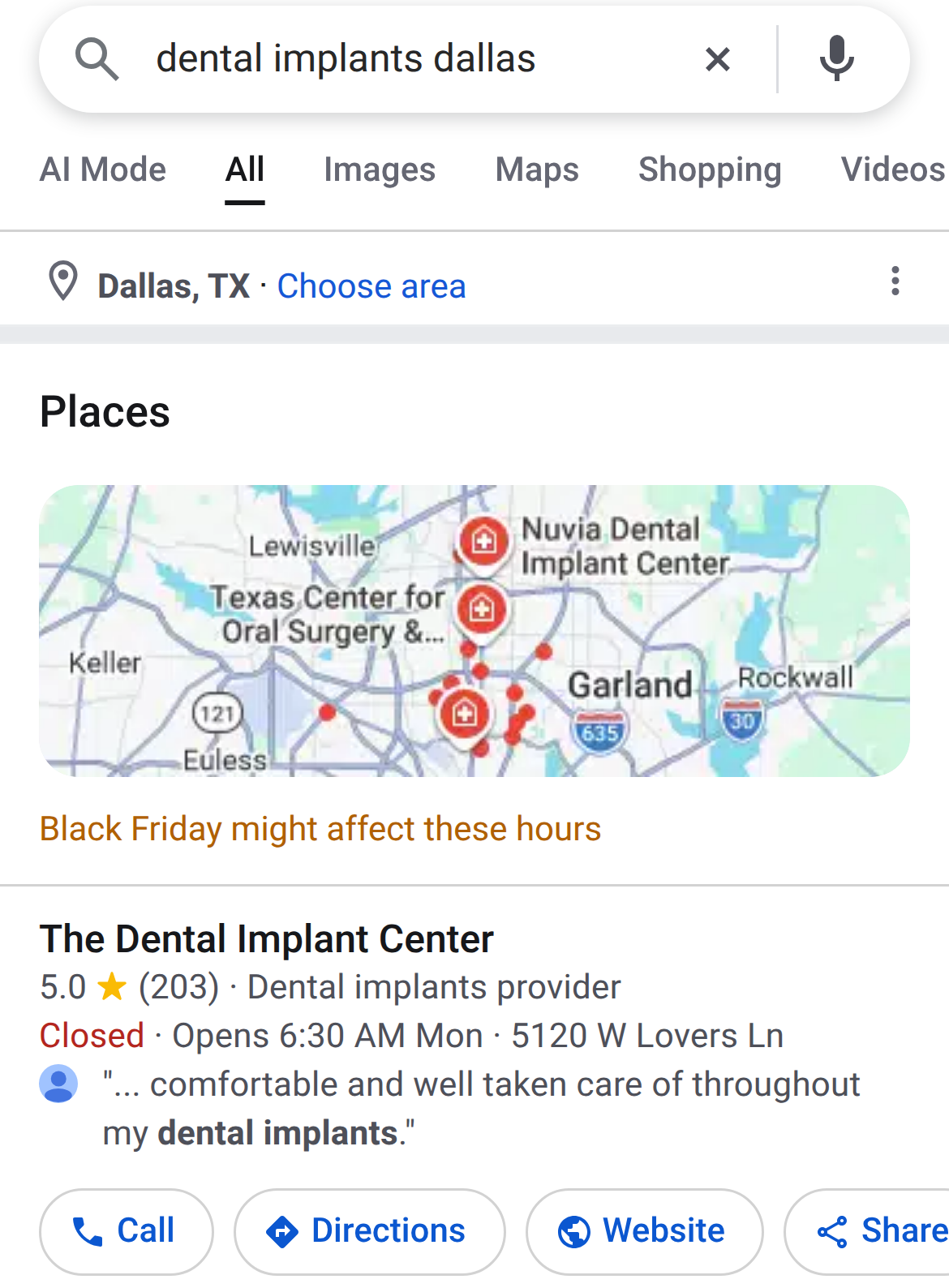
On the morning of November 27, 2026, we searched "dental implants dallas" on Google from Dallas, on a phone. The map at the top of the page, the three businesses Google shows before any regular result, opened with The Dental Implant Center, then Nuvia Dental Implant Center, then Texas Center for Oral Surgery & Dental Implants.
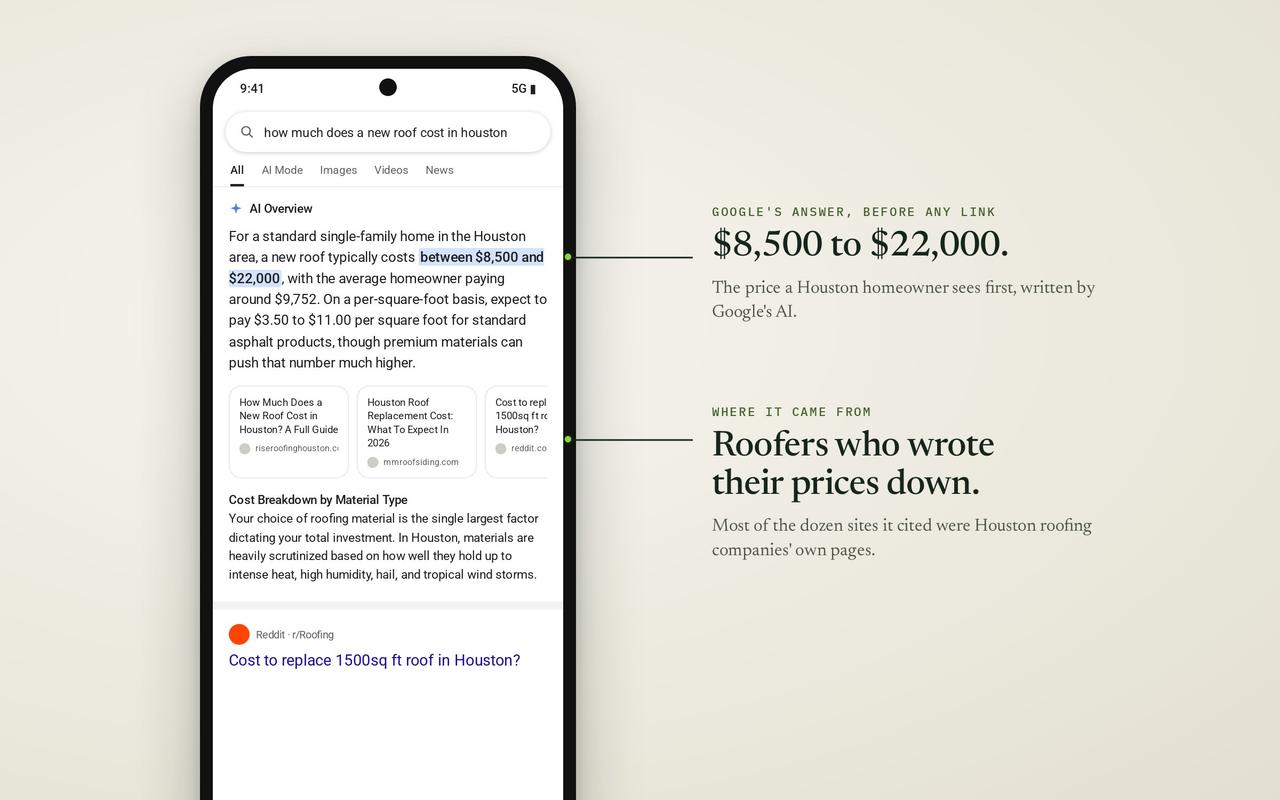
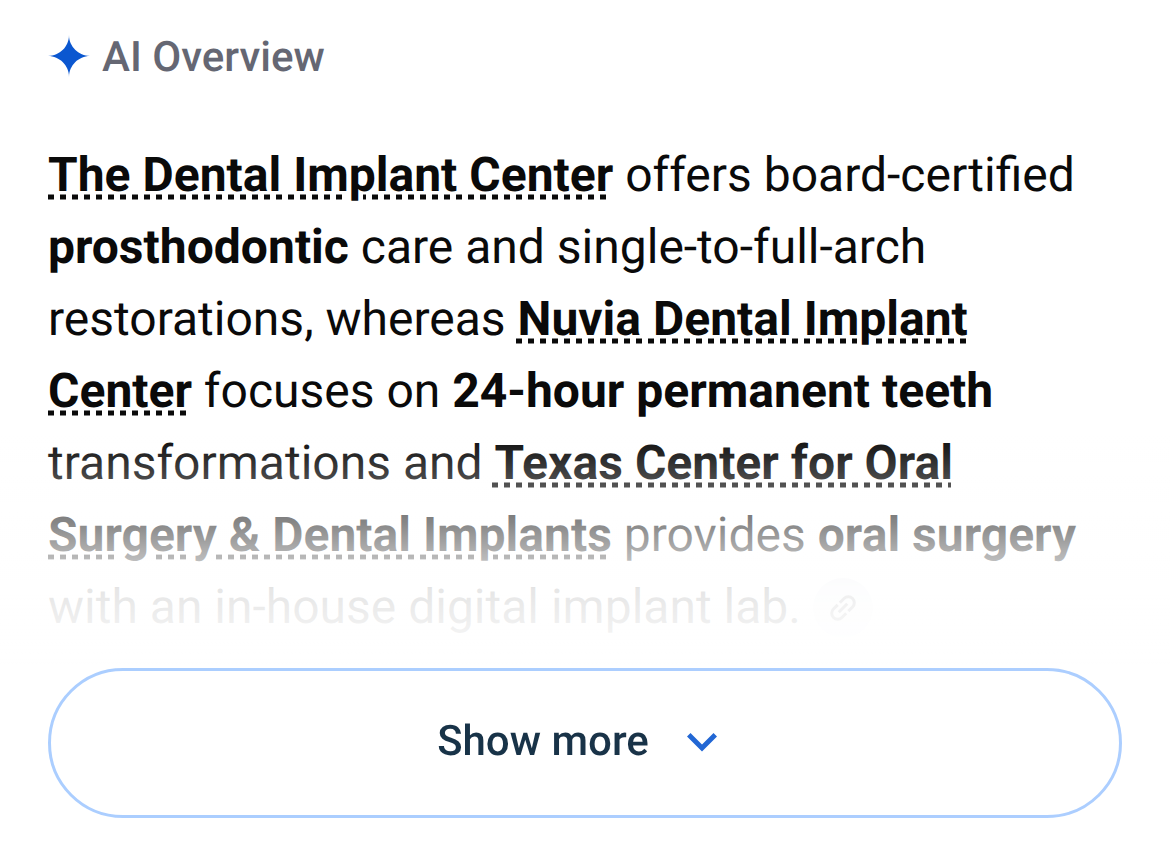
Just below the map, Google's own AI Overview named the same three practices as the map, in the same order.
Then we asked ChatGPT, Perplexity and Google's AI Mode, also from Dallas: "Who is the best dental implant dentist in Dallas?" (Gemini didn't answer that morning.) The three answers didn't match each other. ChatGPT gave a shortlist of three practices. Perplexity led with one dentist by name. AI Mode explained the difference between a prosthodontist and a general dentist before naming anyone.
In that first round, all three cited the same website: The Dental Implant Center's own site, the business Google had put first on its map.
Around it, each assistant leaned on different sources. ChatGPT cited a Dallas business directory. Perplexity cited ten sites, among them dentist-rating lists, a "best of" roundup and a regional magazine. None of those is the practice's own website, and none is Google.
We asked ChatGPT the same question again later that morning, signed out, in a browser not set to Dallas, at about 9:50 AM Eastern. This time it put that practice second, and its only sources were three directory sites, none of them a practice's own website.
One morning in one city is a sample, not a rule: ask an assistant twice and you can get two answers. But it shows both halves of the story. The business with the strongest footing in Google was the one every assistant reached for in our first round. And the assistants also went looking in places a business doesn't control directly.
Does AEO replace SEO?
No, and Google says so in plain words. Its guide for site owners, "AI features and your website," read on November 27, 2026, says: "There are no additional requirements to appear in AI Overviews or AI Mode, nor other special optimizations necessary." It adds that you "can apply the same foundational SEO best practices for AI features as you do for Google Search overall."
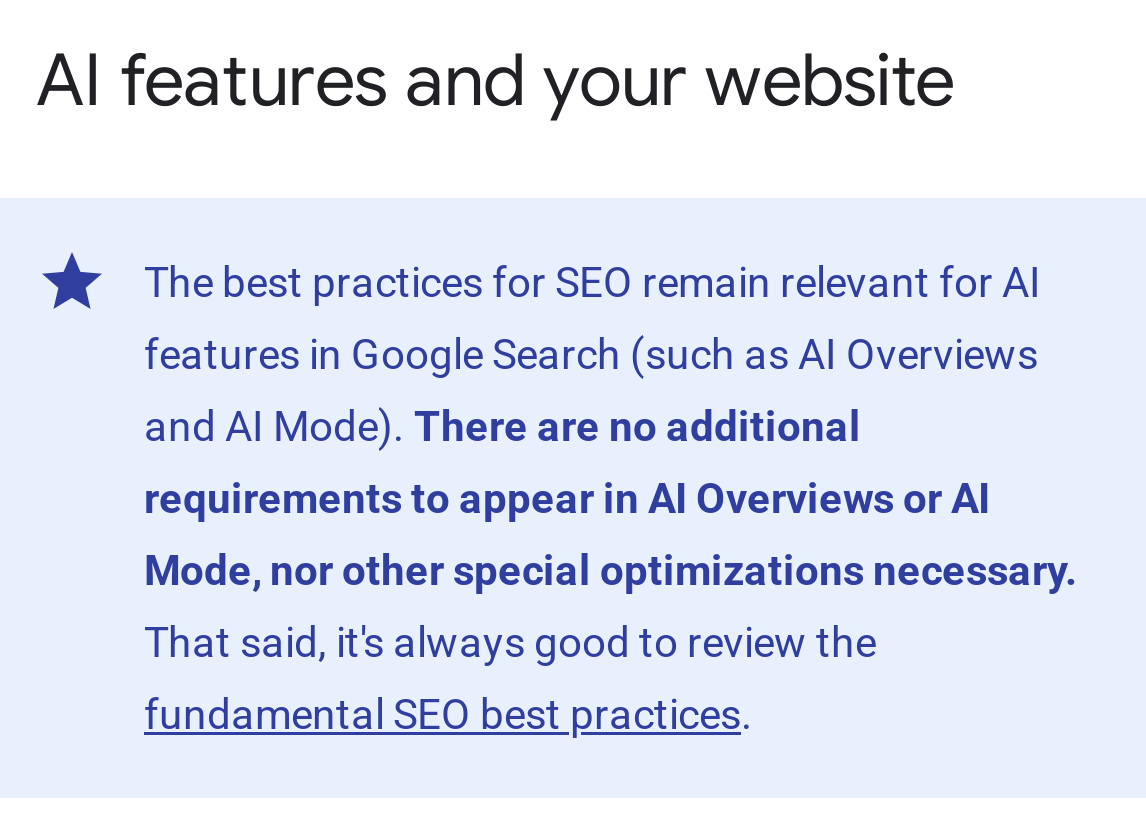
The same page sets the entry ticket. To be shown as a link in AI Overviews or AI Mode, "a page must be indexed and eligible to be shown in Google Search with a snippet." In other words: if Google hasn't filed your page for its regular results, its AI can't link to it either. Our guide on how to rank higher on Google starts with exactly that step.
Google also says you "don't need to create new machine readable files, AI text files, or markup to appear in these features," and that there's "no special schema.org structured data that you need to add." If someone is selling you a special AI file as the key to AI answers, that's worth knowing.
ChatGPT works in a similar way, through a different door. OpenAI's page on its web crawlers says its search crawler, OAI-SearchBot, "is used to surface websites in search results in ChatGPT's search features," and that sites which block it "will not be shown in ChatGPT search answers." OpenAI's help page adds that ChatGPT search "sometimes partners with other search providers," and the provider it names in its privacy links is Microsoft, which runs Bing. So a website that search engines can read, file and trust is the starting point for both.
Is SEO dead, then?
No. Google still shows its regular results under every AI Overview, and Google says AI Overviews "often don't trigger" at all. Where they do appear, the pages they link to are pages Google has already filed. The work that gets a business into Google is the same work that makes it eligible for Google's AI answers.
What actually changes when customers ask AI?
Three things change, and they're worth taking seriously.
Fewer clicks on some searches
Pew Research Center tracked the browsing of 900 US adults in March 2025. When a Google search showed an AI summary, people clicked a regular result in 8% of visits. When it didn't, they clicked in 15% of visits. They clicked a link inside the AI summary itself in just 1% of visits.
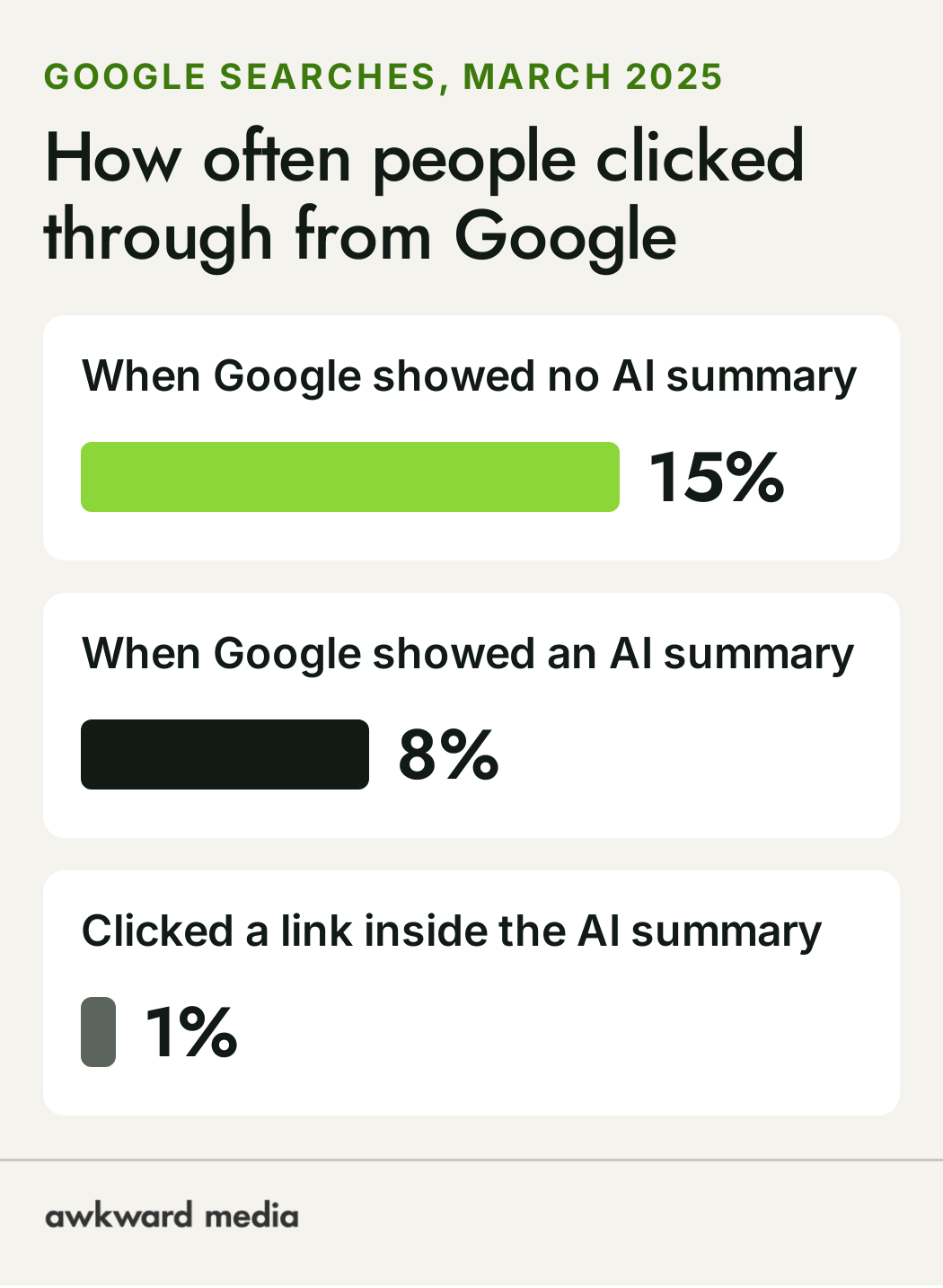
Pew found AI summaries on 18% of the Google searches in its study, so on more than four in five searches there was no summary at all. But where a summary did appear, fewer people went past it. Being one of the sources it cites matters more than it did.
One name instead of ten
A results page shows ten links and a map. An AI answer often names three businesses, sometimes one. For a dental implant practice, a personal injury firm or a plastic surgeon, a place on that short list is worth working for.
The answer moves
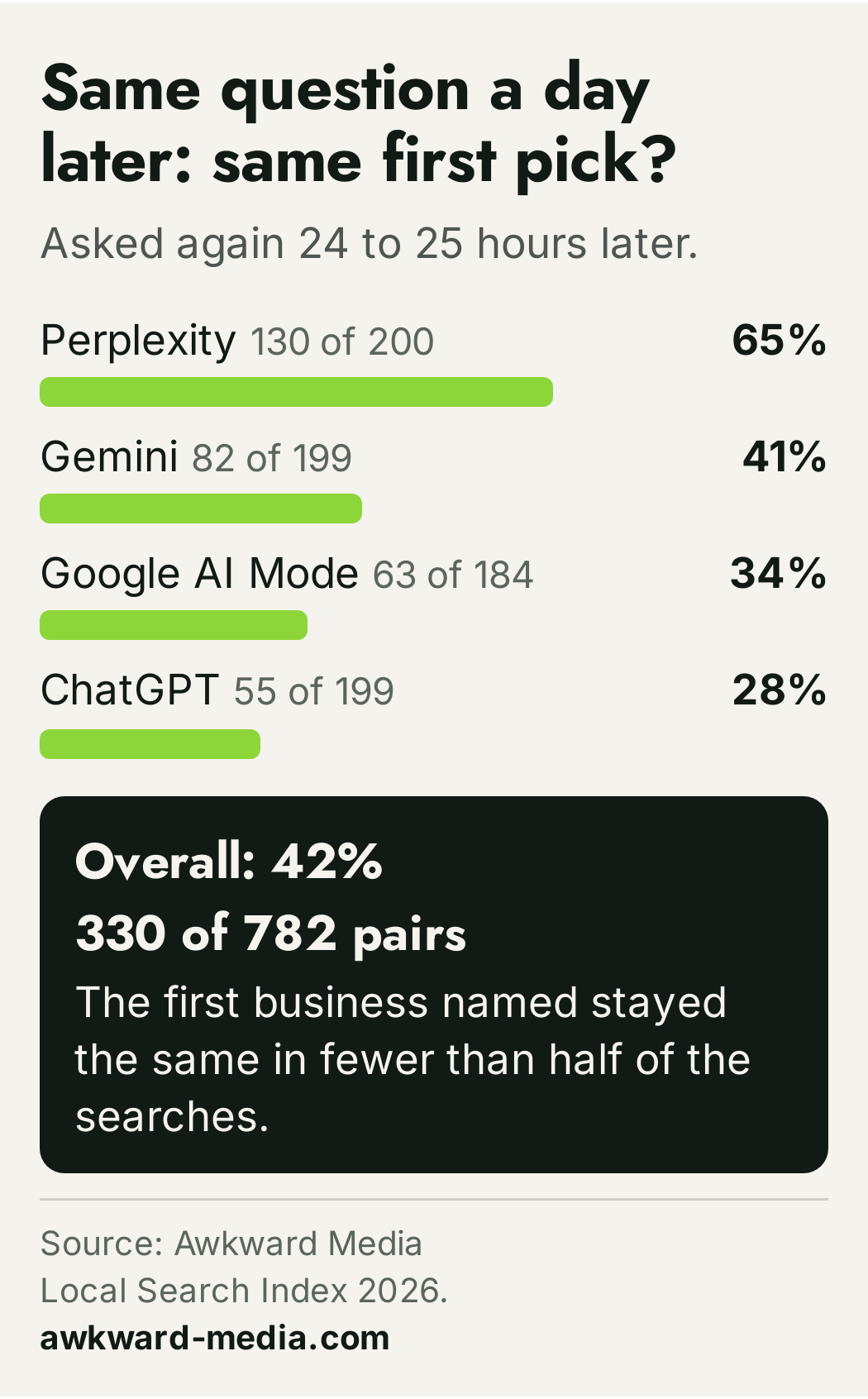
In our own study, Does AI agree with Google on who's best in town?, we asked four assistants to name the best business in 200 local searches, twice, a day apart. A day later, the first business named was the same in only 42% of cases (330 of 782). In 102 of the 200 searches, no two of the four assistants named the same business first. A place in an AI answer isn't a position you hold like a page-one ranking. It's a likelihood you build.
What does AEO add on top of SEO?
If SEO is the foundation, AEO is the work on the parts of the web that AI reads beyond your own site and Google's index. Here is what that means in practice.
Be on the lists the assistants read
In Dallas, the assistants cited local directories, rating sites and a magazine roundup. In our study, they leaned on directories and "best of" lists across every trade we checked. Finding which lists the assistants cite for your service and city, and getting a correct, complete entry on the ones that are free and real, is new work. It's also old-fashioned reputation work, done where AI is looking.
Answer the questions customers ask, in their words
People ask an assistant whole questions: "what should I look for in a dental implant dentist," "how long does a personal injury case take in Texas." A page that answers those questions plainly, near the top, with the facts a customer needs, is easy for both Google and an assistant to quote. This is the same advice Google gives for its regular results: helpful, reliable content written for people.
Keep your facts the same everywhere
Your name, address, services, prices you publish and credentials should read the same on your website, your Google profile and every listing. An assistant pulls from several sources at once. When they disagree, it has less reason to trust any of them.
Let the crawlers in
Check that your website doesn't block Google, Bing or OpenAI's search crawler. It sounds basic. It's also one setting in one file, and it can be switched on by accident in a website rebuild. Our technical SEO work checks it.
How do you measure AEO?
Partly with the tools you already have. Google says that when your site appears in AI Overviews or AI Mode, it's counted in Google Search Console with the rest of your search traffic, in the Performance report under the "Web" search type. Search Console doesn't split it out, so you can't see the AI part alone.
For ChatGPT, Perplexity and Gemini there is no Search Console. The honest way to measure is to ask the questions your customers ask, from your city, on more than one day, and write down who gets named and which sites get cited. Our study did that 1,600 times. For one business, a short list of questions asked every month is enough to see the trend.
Which should a business work on first?
SEO first, because everything else stands on it. A website Google can't find or doesn't trust is a website Google's AI can't link to. Then add the AEO layer: the lists, the questions, the consistent facts, and the measuring.
If you're already ranking well in Google, you're closer to AI answers than you might think. Look at the Dallas search again: the practice at the top of Google's map was the one site all three assistants cited in our first round. If you're not ranking yet, start there. Our SEO services cover the foundation, and our AI SEO work covers ChatGPT and Google's AI answers on top of it.
What we don't know yet
Nobody outside OpenAI, Google and Perplexity knows exactly how their assistants choose which business to name, and they change their systems often. Anyone who promises you a guaranteed spot in ChatGPT's answer is promising something they don't control. What we can show is what we measure, with the date we measured it. We'll keep re-running our study and reporting what moves.
If you want to know where your business stands in Google today, and what the AI layer would add for it, the strategy call is free and takes 30 minutes.
Our work is for established businesses already doing $20,000 a month or more.
Every fact in this story is linked to its source. Spot something out of date? Tell the editor and we will correct it.
Questions readers ask
Frequently asked questions
What is the main difference between AEO and SEO?
SEO aims to rank your pages in Google's regular results. AEO aims to get your business named, and your pages cited, in the answers AI tools write, such as ChatGPT, Perplexity and Google's AI Overviews. AEO is built on the same foundation as SEO, with extra work on the sources those tools read.
Is AEO replacing SEO?
No. Google's guide for site owners says there are "no additional requirements to appear in AI Overviews or AI Mode," and that the same SEO best practices apply. A page has to be in Google's index to be linked from Google's AI answers.
Is SEO dead because of ChatGPT?
No. Google still shows its regular results, and it says AI Overviews "often don't trigger." The pages Google's AI links to are pages it has already filed. What has changed is that some searches now get fewer clicks, so being a cited source matters more.
Is AEO the same as GEO?
Close enough that a business owner can treat them as one job. GEO (generative engine optimization) is another name for getting into answers written by AI. Some people use AEO for direct answers and GEO for longer AI-written responses, but the work overlaps almost entirely.
Do I need an llms.txt file or special schema for AI answers?
Not for Google. Its guide says you "don't need to create new machine readable files, AI text files, or markup" for its AI features, and that there's "no special schema.org structured data" to add. What matters is that your pages can be crawled, filed and trusted.
How does ChatGPT find businesses to recommend?
When it searches the web, ChatGPT uses OpenAI's search crawler, OAI-SearchBot, and OpenAI says it sometimes partners with other search providers. Sites that block OAI-SearchBot "will not be shown in ChatGPT search answers." In our own checks, its answers also cited local directories and rating sites alongside business websites.
Can I see AI Overview traffic in Google Search Console?
Yes, but not on its own. Google counts appearances in AI Overviews and AI Mode in the Performance report under the "Web" search type, together with the rest of your search traffic.
Can anyone guarantee my business will be named by ChatGPT?
No one controls what an AI assistant says. In our study, the business named first was the same a day later in only 42% of cases. What a good agency can show you is dated measurement of where you're named and cited, and the work that improves your odds.
About the author