AI Search
Google now answers before anyone clicks. What that means for your business.
Google's AI now answers before anyone clicks. What the click studies show, what we found in real local searches, and what to do so your business is the answer.
· Updated · 6 min read
In this story
In the last week of May 2024, someone asked Google what to do when the cheese slides off a pizza. Google's brand new AI answer, sitting where the first search result used to be, had a suggestion: "Add about 1/8 cup of non-toxic glue to the sauce to give it more tackiness." The advice appears to have come from a joke posted on Reddit eleven years earlier. Another AI answer, asked how many rocks a person should eat each day, took its reply from a satirical article.
The screenshots went around the world. Two weeks earlier, at its annual developer conference, Google had introduced the feature under a confident headline: "Let Google do the searching for you." Now Elizabeth Reid, the vice president who runs Google Search, was writing a post called "About last week." Before the screenshots went viral, she wrote, "practically no one asked Google that question" about the rocks. The company said it had made "more than a dozen technical improvements."
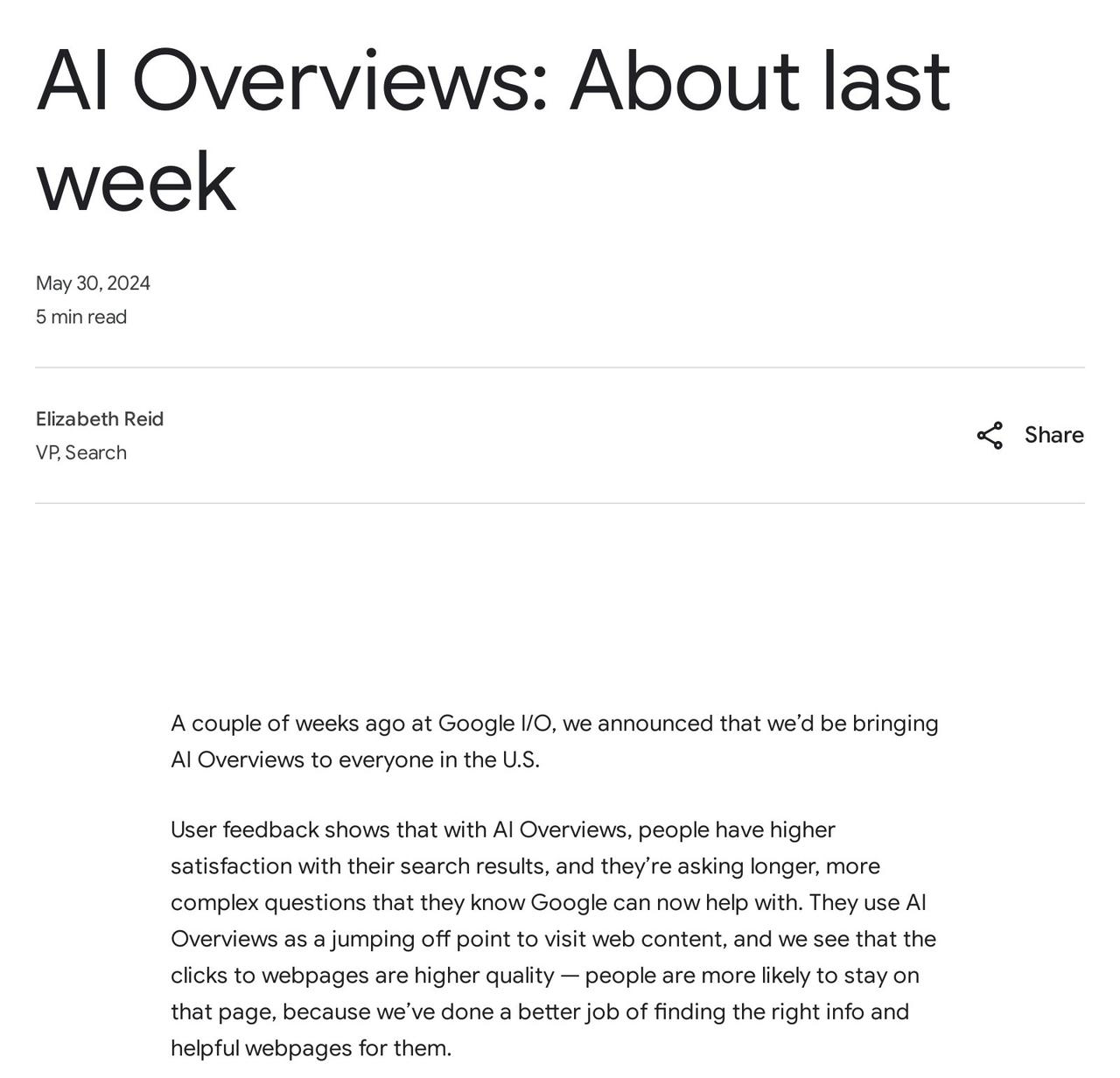
It would be easy to file that week under comedy. It is more useful to read it as a lesson in how these answers are made. Google's AI did not invent the glue. It found a sentence on the web, trusted it, and repeated it at the very top of the page, above every cook who might have given better advice. The same machinery now decides, every day, which roofers, dentists and plumbers a customer hears about first.
The answer above the answers
An AI Overview is the short written answer Google now puts at the top of many searches, above the ordinary list of websites. Google's AI writes it from pages it has found and adds small links to some of them. Google also offers AI Mode, a separate tab where people can keep asking follow-up questions, much as they would with ChatGPT.
Neither is an experiment any longer. In July 2025, Sundar Pichai, Alphabet's chief executive, told investors that AI Overviews had "over 2 billion monthly users across more than 200 countries and territories and 40 languages," and that AI Mode already had more than 100 million monthly users in the United States and India. The overviews, he said, were "driving over 10% more queries globally for the types of queries that show them." People are not searching less. They are searching more, and reading the answer instead of the results.
Fewer clicks, by every independent count
The question for a business is what happens to the click. Google's view is that the clicks that remain are better ones. "When people click from search results pages with AI Overviews, these clicks are higher quality," its guidance for site owners says, meaning visitors "are more likely to spend more time on the site." At the launch, Reid went further: links included in AI Overviews, she wrote, "get more clicks than if the page had appeared as a traditional web listing."
Independent measurements tell a less comfortable story. In March 2025, the Pew Research Center tracked the browsing of 900 American adults who agreed to share it, covering 68,879 Google searches. When an AI summary appeared, people clicked an ordinary result on 8 percent of visits. When none appeared, they clicked on 15 percent, nearly twice as often. A link inside the AI summary itself was clicked on just 1 percent of visits. And people were more likely to stop browsing altogether after reading one: 26 percent of the time, against 16 percent. The study does not prove that the AI took every lost click. It does show which way the clicks are going.
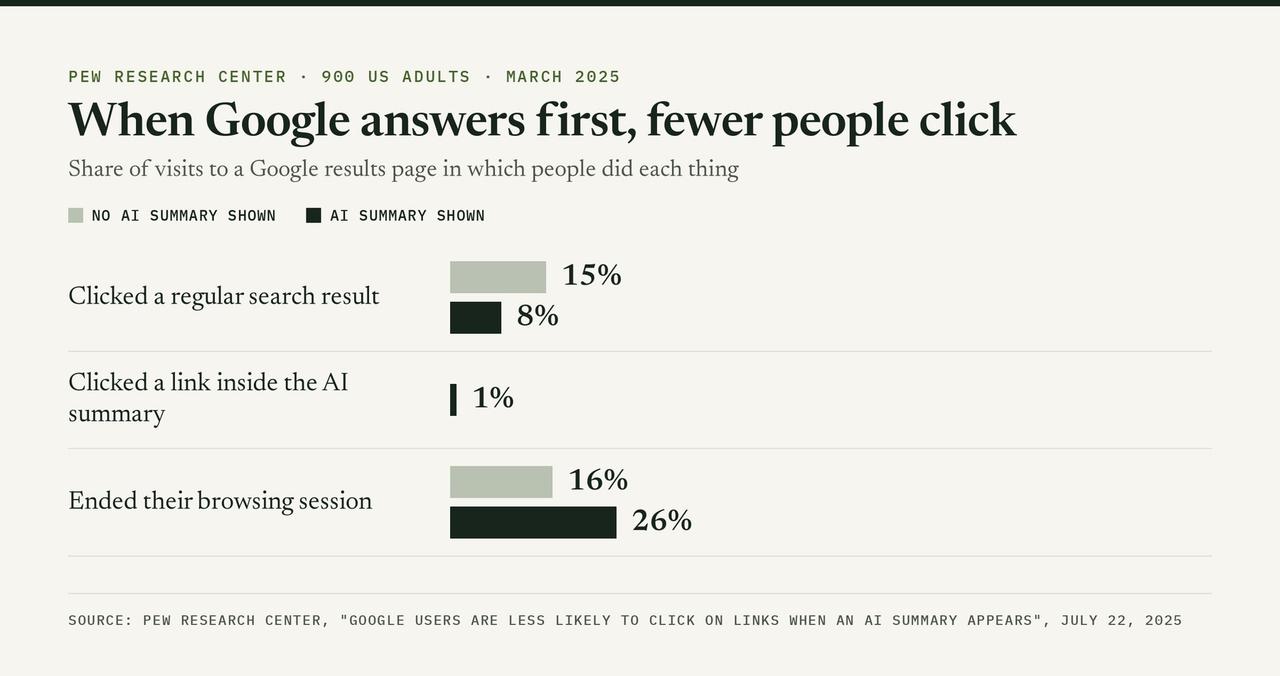
For a news site or a recipe blog, that is a crisis. For a business that sells a service in a place, it is something subtler: a change in who introduces the customer to the business, and which businesses get introduced at all.
What we saw when we searched
To see what that looks like on the ground, we ran three searches on October 12, 2026, the way a customer on a phone would.
The first was "is a root canal painful," searched from Toronto. Google's AI answered in plain language: generally no more painful than a filling, thanks to local anaesthetic. It cited seven links: Cleveland Clinic, the American Association of Endodontists twice, University of Utah Health, Delta Dental and two dental clinics. The dental practice whose page ranked first in the ordinary results, directly below the answer, was not among them. Ranking first no longer guarantees a place in the answer.
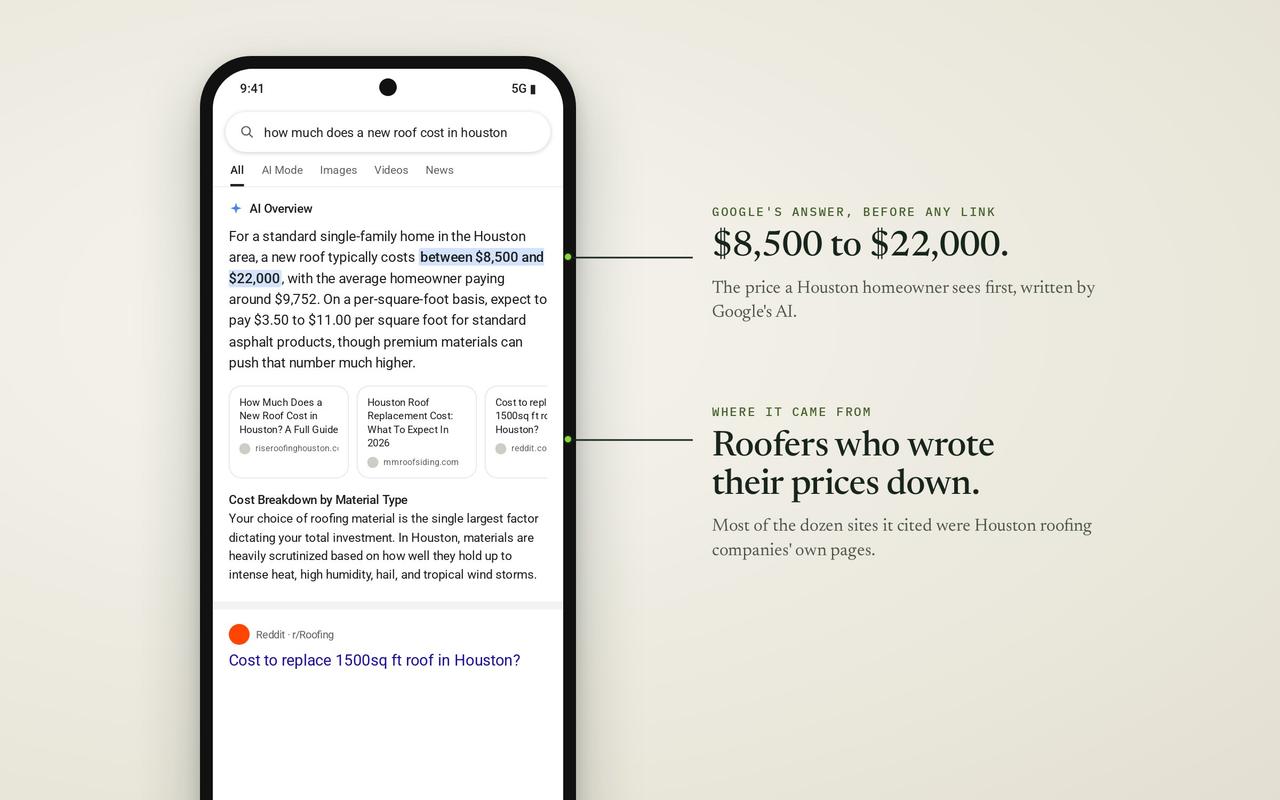
The second was "how much does a new roof cost in houston." The AI gave a range of $8,500 to $22,000 for a typical home and cited a dozen websites. Reddit and Angi were among them, but most were Houston roofing companies' own pages, the ones that had written a price down. A roofer with no prices on its website gives the AI nothing to quote.
The third search is the one that matters most to a trade: "emergency plumber near me," from Houston. Here the AI did not summarise an article. It picked the plumbers. Its answer named Jordan Plumbing Solutions, rated 5.0 from 25 reviews, and 1-Tom-Plumber, rated 4.9 from 577, with addresses, opening hours and buttons to call: the details a business keeps on its Google Business Profile, the free listing that appears on Google Maps. Most of the answer's links pointed back to Google's own pages. The first ordinary website result, further down, was a page about plumbers in Santa Clara, New Mexico, nearly 800 miles away.
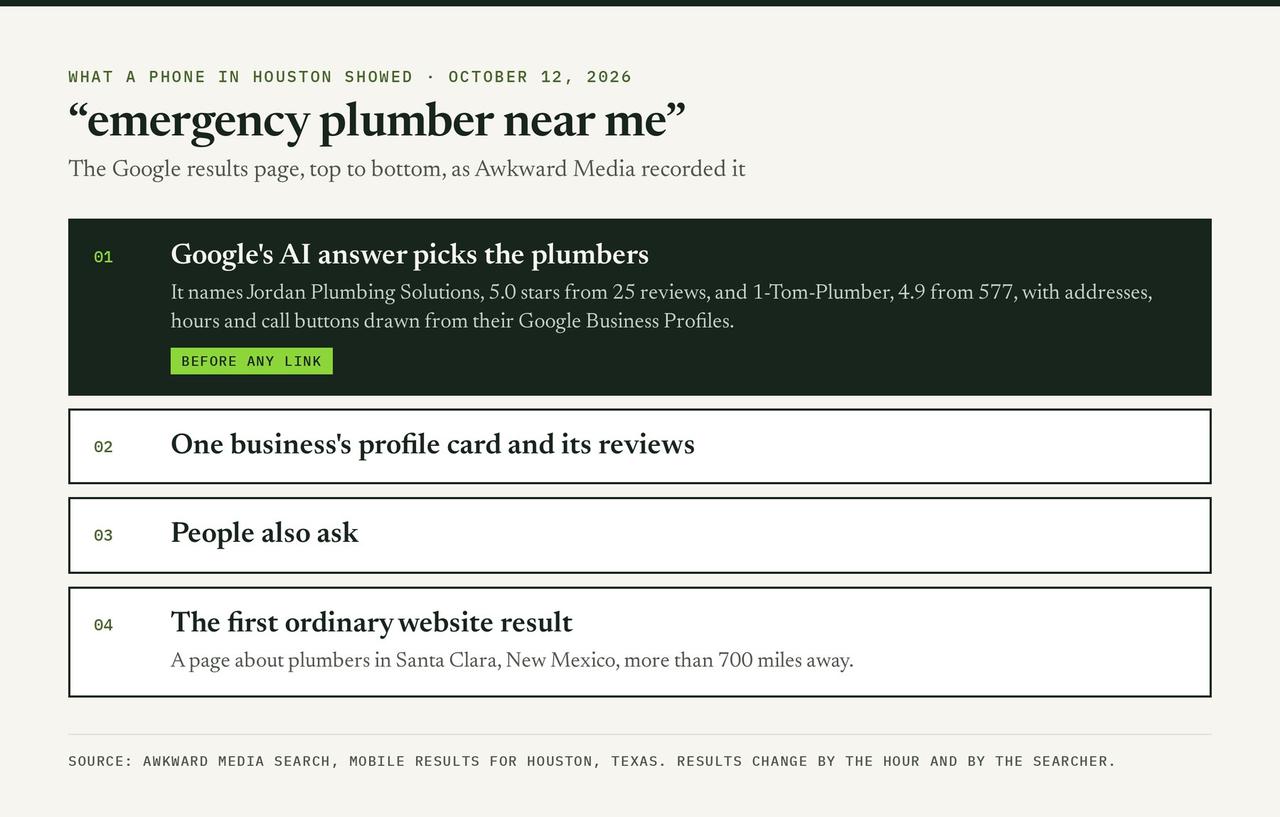
Change one word and the page changes. Results move by the hour and differ from one person to the next. But the shape is clear enough to plan around. For some local searches, Google's AI now does the shortlisting that customers used to do themselves, and it does it from what it can read about each business.

The map is not dead. Not yet.
None of this means the map has gone. To see how often each one appears, we ran a larger test the same day: 24 searches on a phone, eight each from Houston, Phoenix and Toronto. Half were the searches people make when they want a business: "plumber near me," "dentist near me," "roofer near me" and "personal injury lawyer near me." Half were the questions customers ask before they call: "is a root canal painful," "how much does a new water heater cost," "how long does a roof replacement take" and "do I need a lawyer after a car accident."
The split was close to total. The map, with its short list of businesses, appeared on all 12 business searches and on none of the 12 questions. Google's AI answer appeared on all 12 questions and on just 2 of the business searches, both for personal injury lawyers, in Houston and Toronto. Even there, the AI did not choose its own favourites. It opened with the same firms that topped the map below it.
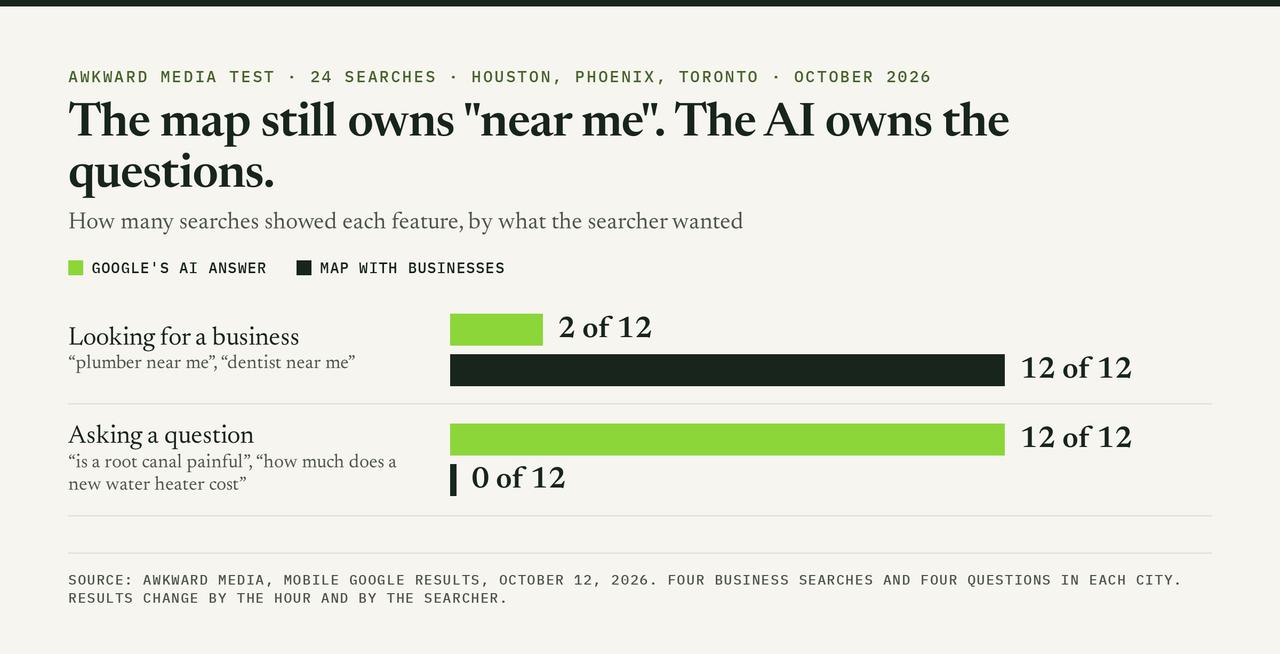
The questions are where the AI did its reading. Across the 12 answers it linked to 130 sources. By our count, 69 of them, about half, were the websites of businesses: plumbers, dentists, roofers and law firms that had written the answer down. The rest were YouTube, Reddit, trade bodies, manufacturers, directories and Google's own pages. In Houston, all 10 links in the answer about car accident lawyers went to law firms' own websites.
So the map still matters, and winning a place on it, the work of local SEO and of getting into the top three on Google Maps, is still where many calls come from. But the questions customers ask before they decide whom to call (what it costs, whether it hurts, how long it takes) are now answered by the AI first. A business that answers them well on its own website gets quoted. One that does not is left out of the conversation that comes before the call.
What Google says it wants
A small industry has sprung up selling ways to "optimise for AI": special files, new code, secret formats. Google's own guidance for site owners is blunt about all of it.
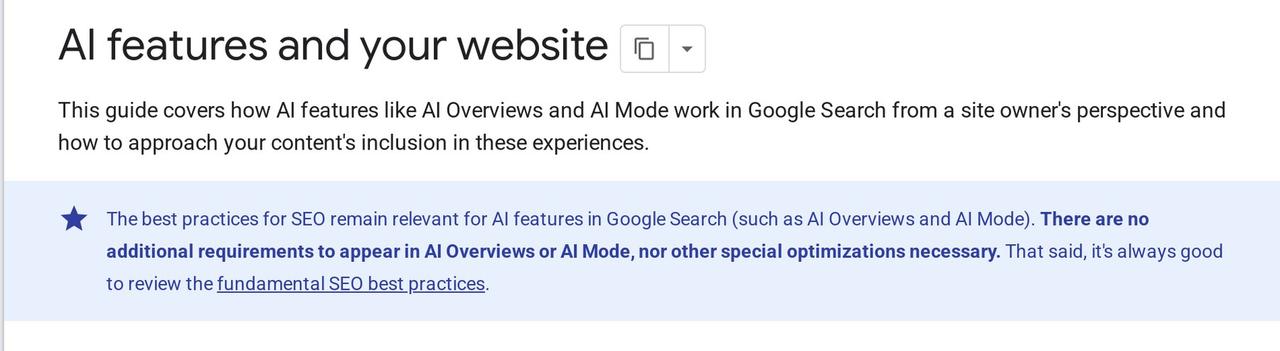
"There are no additional requirements to appear in AI Overviews or AI Mode, nor other special optimizations necessary," Google says. To appear as a link, "a page must be indexed and eligible to be shown in Google Search with a snippet," which means only that Google can find the page, read it and show a preview of it. There is "no special schema.org structured data that you need to add," and "you don't need to create new machine readable files, AI text files, or markup." Meeting every requirement, the page adds, still guarantees nothing.
That is less of a dodge than it sounds. Google's AI reads the same web its search engine ranks, and the pages it leans on tend to be the ones that already do well in ordinary search: sound enough underneath for Google to read easily, the work called technical SEO, and written clearly enough to answer a real question in plain words. Google says its AI may run several related searches at once to build a single answer, a technique it calls "query fan-out," so a page that also answers the follow-up questions has more ways in.
It is also why the glue happened. The AI found one confident sentence on a question almost nobody had asked, and nobody had written a better answer. For a great many local questions, that is still the situation. In plenty of towns, no business has written down what a new roof costs there, or what a first visit to the practice is like. The first one to do it well stands a real chance of becoming the answer.
We see it with our own clients. When people search for "luxury landscape designers" in Seattle, Google's AI Overview names Angkorscape alongside three of its competitors, and Angkorscape's website is the first ordinary result directly below.
What to do this week

- Search your customers' questions yourself. On your phone, search the five things customers ask you most, with your town in the search: what it costs, how long it takes, whether it hurts, what to do in an emergency. Note who the AI answer names and which websites it links to. Our free Would AI Recommend Your Business? check walks through it with you.
- Write the answers down on your own website. One clear page for each service or common question, with the answer in the first two sentences and the detail below. Give honest price ranges where you can. This is the heart of SEO content writing, and it is what the roofers who were quoted had done.
- Keep your Google Business Profile complete. Hours, services, photos and a steady flow of honest reviews. On our Houston search, those were the details the AI read out. If a bad review is worrying you, our story on what to do about a review you cannot remove explains the options.
- Be right wherever the AI looks for a second opinion. In our test, about half the links in Google's AI answers went to sites other than the businesses' own. Check that your listings on Yelp and the directories in your trade are accurate, and answer questions honestly where customers discuss your work.
- Measure calls, not clicks. If fewer people click through, website visits will tell you less than they used to. Count phone calls, booked jobs and enquiries, and ask every new customer how they found you.
- Be wary of anyone selling AI files. Google says none are needed. Our guide to choosing an SEO agency lists the other warning signs.
For the trades we work with, from dental practices to roofers and plumbers, this is now part of the same job: rank the pages, answer the questions, keep the listing right, and check what the AI says. It is the work behind our Google AI Overviews SEO service, and behind the wider AI SEO we do for ChatGPT and the other assistants. For the long version, our free AI Search Guide explains how these answers pick the businesses they name.
Two years ago, Google's AI told the world to put glue on its pizza because a joke was the only answer it could find. It has become far better at choosing since. But it still chooses from what is there. Somewhere in your town, a customer is about to ask Google a question about your trade. The answer will come from somebody. It might as well be you.
Every fact in this story is linked to its source. Spot something out of date? Tell the editor and we will correct it.
Questions readers ask
Frequently asked questions
What is a Google AI Overview?
It is the short written answer Google's AI puts at the top of many searches, above the ordinary list of websites. Google writes it from pages it has found and adds links to some of them. Google says AI Overviews had over 2 billion monthly users by July 2025.
Do AI Overviews reduce clicks to my website?
Independent studies say yes. Pew Research Center found people clicked an ordinary result on 8 percent of visits when an AI summary appeared, against 15 percent when none did, and clicked a link inside the summary on just 1 percent. Google says the clicks that remain are higher quality.
Do AI Overviews show up for local searches like "plumber near me"?
Less often than for questions. In our own test of 24 searches in Houston, Phoenix and Toronto, the AI answer appeared on 2 of 12 searches for a business and on all 12 questions, while the map appeared on every business search. On our own Houston search for "emergency plumber near me," the AI answer named specific plumbers before any website.
How does Google choose which businesses appear in an AI Overview?
Google says there is no special method. A page must be indexed and eligible to show a preview in Google Search, and the usual search best practices apply. In practice the answers draw on pages that rank well and answer the question clearly, plus listings and other websites that mention the business.
Do I need special code or an AI text file to appear?
No. Google says you do not need new machine readable files, AI text files, markup or special structured data to appear in AI Overviews or AI Mode.
What is Google AI Mode?
It is a separate tab in Google Search where people can ask longer questions and follow-ups in a conversation, and get an AI answer with links. Google said it had more than 100 million monthly users in the US and India in July 2025.
About the author