Awkward Media

Shopify SEO Agency · Canada and the USA

Shopify SEO agencyfor Google andAI answers.

Shopify gets your store live in a weekend. It doesn’t get it found. We fix the parts of Shopify that hold rankings back, then put your collections and products in front of buyers on Google and in AI answers, across Canada and the US.

GuaranteePage one in 60 days, or we work free.

30 minutes on Google Meet. For stores doing $20k a month or more.

Google result“jura coffee maker” · Canada
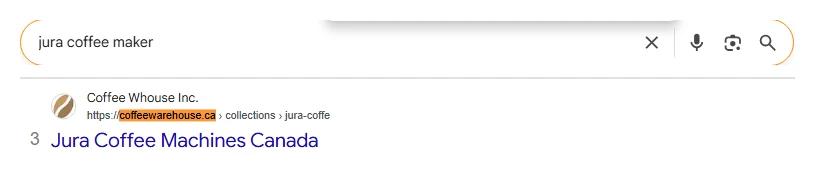
Google search for jura coffee maker: Coffee Warehouse at number 3 with its Jura Coffee Machines Canada collection page

Coffee Warehouse, a Shopify coffee store

Client result: from outside the top 100 to #3 for “jura coffee maker”, with its Jura collection page.

Shopify SEO results

Shopify SEO results: stores we've ranked

Just a few of the Shopify stores we've ranked. Each result names the search a shopper types and where the store sits now, so you can type it yourself and check.

Coffee Warehouse · Shopify store, Canada

Coffee and espresso machines

How did a Shopify coffee store get onto page one next to Walmart and Amazon?

Coffee Warehouse sells coffee and espresso machines on Shopify, shipped across Canada. Its rivals on Google are Walmart, Amazon.ca, Canadian Tire and Nespresso. We rewrote its collection pages around the words shoppers type, gave each brand and deal page its own clear title and description, and tidied what Google reads on the store. 6 searches below, all on page one, 5 of them from outside the top 100.

“jura coffee maker”from not in the top 100#3
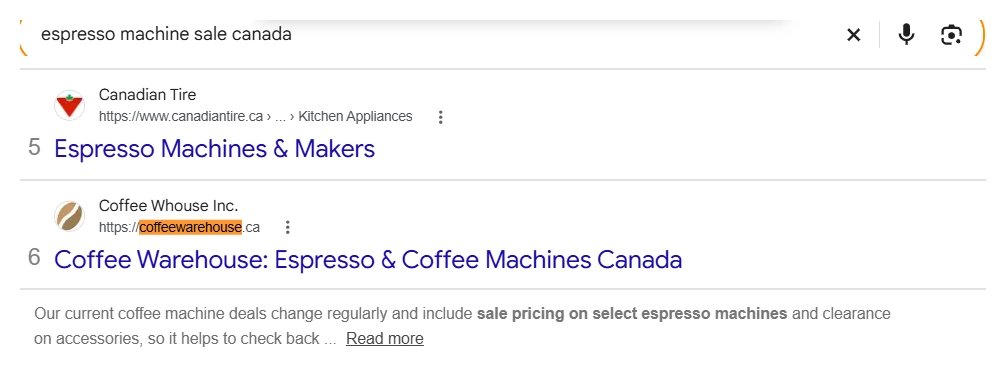
“espresso machine sale canada”from #14#6
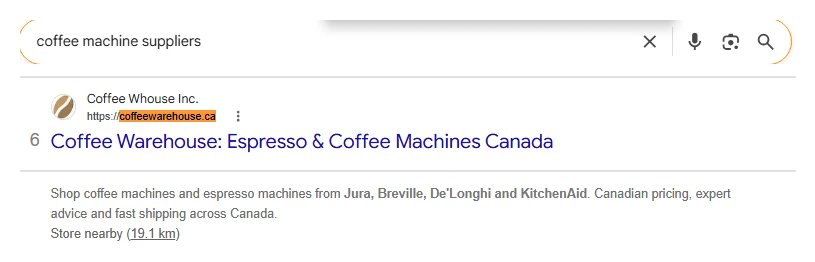
“coffee machine suppliers”from not in the top 100#6
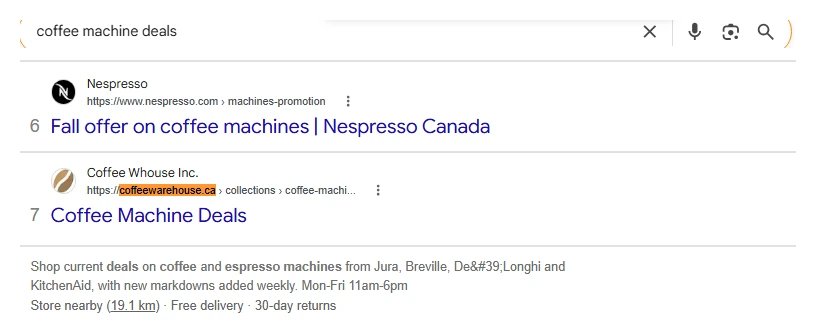
“coffee machine deals”from not in the top 100#7
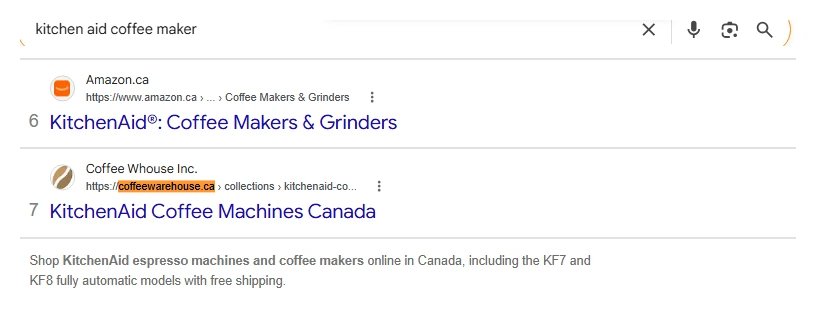
“kitchen aid coffee maker”from not in the top 100#7
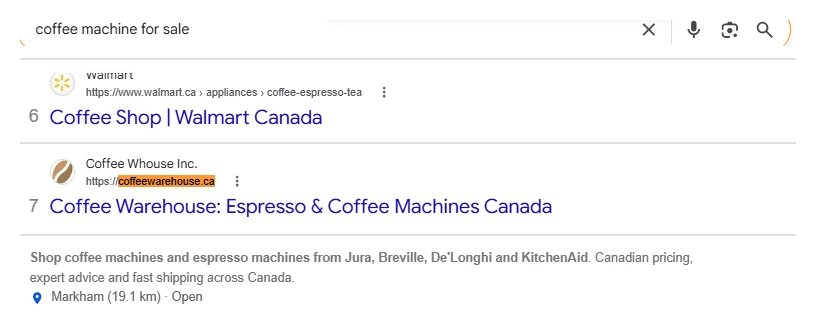
“coffee machine for sale”from not in the top 100#7

Google, normal results, Canada. Starting and current positions from our ranking report for Coffee Warehouse.

Google search for espresso machine sale canada with Coffee Warehouse at result 6
Search “espresso machine sale canada”: Coffee Warehouse at #6, one place below Canadian Tire.
Google search for coffee machine suppliers with Coffee Warehouse at result 6
Search “coffee machine suppliers”: Coffee Warehouse at #6.
Google search for coffee machine deals with Coffee Warehouse at result 7
Search “coffee machine deals”: the Coffee Warehouse deals collection at #7, right under Nespresso.
Google search for kitchen aid coffee maker with Coffee Warehouse at result 7
Search “kitchen aid coffee maker”: the KitchenAid collection at #7, right under Amazon.ca.
Google search for coffee machine for sale with Coffee Warehouse at result 7
Search “coffee machine for sale”: Coffee Warehouse at #7, right under Walmart.

Coffee Warehouse · Collection pages

Shopify collections

Can a Shopify collection page rank on its own?

Yes. Two of the searches above are won by collection pages, the Shopify pages that list one group of products: “coffee machine deals” and “kitchen aid coffee maker”, both at #7 from outside the top 100. Look at the address in each crop: it runs through /collections/. That is the page a shopper lands on, with every matching machine in one place.

US Vacuums · Shopify store, USA

Vacuums

Does it work for a bigger Shopify catalogue?

US Vacuums also sells on Shopify, across the US. It is #1 for “vacuum cleaners on sale”, up from #57, and its Henry Numatic brand page is #1 for “henry numatic vacuum”, up from outside the top 100.

See the full US Vacuums results on our ecommerce SEO page

See more client results

What it is

What is Shopify SEO?

Shopify SEO is the work that gets a Shopify store's collections and products found when people search on Google and in AI answers, without paying for each click. It covers the words on your collection and product pages, how your theme and apps load on a phone, the product details Google reads, and the other sites that mention your store.

What does a Shopify SEO agency do?

We find the searches your buyers type, decide which collection, product or blog page on your store should win each one, and then build and fix those pages until they rank. That means writing collection and product pages in shoppers' words, fixing what stops Google reading the store, speeding up your theme on phones, and earning links from real sites that make Google trust it.

Is Shopify good for SEO?

Yes. A Shopify store can rank at the top of Google, as Coffee Warehouse and US Vacuums show above. Shopify handles the basics on its own: it builds the list of pages Google reads (the sitemap) and keeps checkout and cart pages out of search. What it can't do for you is write pages that answer what shoppers search, pick which copy of a page Google should treat as the main one, or stop apps from slowing the store down.

How is Shopify SEO different from ecommerce SEO?

Shopify SEO is ecommerce SEO on one platform. The goal is the same: the right page wins the right search. The difference is knowing how Shopify builds its pages, collections, tags, apps and themes, and working with those habits instead of against them. Other platforms are on our ecommerce SEO page.

Do I need an agency, or can Shopify SEO apps do it?

Apps help with jobs that repeat: image file sizes, alt text, redirects when a product is removed. They don't decide which searches your store should chase, write collection pages a shopper wants to read, or earn mentions on other sites. And every app adds code to your store, so a pile of SEO apps can make the store slower, which works against you.

Who is Shopify SEO with Awkward Media for?

For established businesses doing at least $20,000 a month. Below that, there usually isn't enough trade behind the store for new rankings to turn into orders fast.

Do you work on Shopify Plus stores?

Yes. Shopify Plus stores are often bigger, with more countries, languages and collections. The work is the same, with more care over which store version shows in which country. If you're moving onto Shopify, website migration SEO keeps your rankings through the move.

What Shopify does on its own

What does Shopify handle for SEO, and what does it leave to you?

Shopify gets a few technical basics right on every store. The things that decide whether your store ranks are left to you. This is the line between the two.

What does Shopify do for you?

✓ A list of your pages for Google

Shopify makes a sitemap file on its own, with your products, collections, pages and blog posts, and updates it when you add one.

✓ Rules that keep junk out of search

Shopify's default rules file (robots.txt) keeps cart, checkout and account pages, and sorted or filtered copies of collections, out of Google.

✓ Basic product details for Google

Shopify themes carry some product details in their code (structured data) that Google can read, such as name and price.

From Shopify’s own help pages on sitemaps and the robots.txt file.

What do we fix on a Shopify store?

● Which address is the main one

The same product can open at its own address and again inside every collection it sits in. We check that Google is told which one is the main page, and that links inside your store point to it.

● Tag and filter pages

Tags and filters can create pages that list the same products in a different order. We keep the ones shoppers search for and keep the rest out.

● Words on collection pages

A collection with a title and a grid of products gives Google little to read. We write a short, useful introduction and answers to buyers' questions.

● Your own product descriptions

Text copied from the maker's site is on hundreds of other stores. We write your own, so Google has a reason to pick your page.

● Speed on phones

Themes and apps add code. We find the apps and scripts that slow your store down and tell you which to remove or replace.

● Full product details for Google

Reviews, stock, shipping and variants are often missing from what the theme sends Google. We fill the gaps so your products can show with stars and prices.

Should I edit my Shopify robots.txt file?

Only if someone who knows what they're doing has a clear reason. Shopify lets you change it, but its own help page names it an unsupported change and warns that a mistake can cost the store all its search traffic. We tell you whether it needs touching, and give your developer the exact lines if it does.

Why does my Shopify store show the same product at two addresses?

Because Shopify can open a product inside each collection, with the collection name in the address, as well as at its own address. That's normal. The job is making sure Google knows which is the main page. If you want a full list of what your store needs, start with an SEO audit or see our technical SEO work.

Shopify collection page SEO

How do we optimize a Shopify collection page?

Collection pages often win the biggest searches, because that’s where buyers start. Tap a number to see what we change, and why.

yourstore.com/collections/college-hats

College hats

Filter

Questions buyers ask

1 of 6

Heading and title

The page heading and the title Google shows both use the words buyers type: “College hats”, not “Shop the drop”. One search per collection, so two pages never compete for it.

All six, at a glance

  • 1Heading and title. The page heading and the title Google shows both use the words buyers type: “College hats”, not “Shop the drop”. One search per collection, so two pages never compete for it.
  • 2A few lines above the grid. Two or three sentences in plain words: what’s in the collection, who it’s for, what makes yours different. Enough for Google to know what the page is about, short enough that shoppers still see products first.
  • 3Filters that stay out of Google. Size, colour and price filters help shoppers. Left alone, each combination can become its own page in Google. We keep the useful ones and hide the rest.
  • 4Product links to one address. Every product in the grid links to its main address, not a copy inside the collection. Your links back the page that should rank.
  • 5Links to related collections. Sub-collections and close matches are linked from the page, so Google finds them and understands how your catalogue fits together.
  • 6Answers below the grid. The questions buyers ask before they order, such as sizing, shipping and fit, answered under the products, where Google and AI answers can read them.
See your own collections taken apart on the call →

Product pages

What makes a Shopify product page rank?

Collection pages win the broad searches. Product pages win the searches people type once they know what they want: a brand, a model, a size.

A Shopify product page, as we build it

Product name as people search it: brand, model, the plain word
Price, stock and delivery, in labels Google reads
Photos, each with a short written description
Your own description, with the questions buyers ask
Colours and sizes as options on this one page
Reviews from buyers
Links to the collection and to related products

Is the product named the way people search it?

Brand, model and the plain word for the product: “Jura E8 coffee maker”, not an internal code. Model numbers matter, because people type them when they are ready to buy.

Should every colour and size have its own page?

Usually not. One product page with the colours and sizes as options keeps everything that page earns in one place. A variant gets its own page only when shoppers search for it by name and it has enough to say on its own.

Should we write our own product descriptions?

For the products that matter, yes. When a hundred stores use the same manufacturer description, Google has little reason to pick yours. We start with your best sellers and best margins, and write descriptions that answer what buyers ask: size, fit, materials, care, shipping and returns.

Can Google show my price and stars in the results?

A short block of labels in the page code tells Google the price, whether the product is in stock and its star rating. Shopify’s own themes include some of these labels. We check what your theme sends and fill the gaps, so the details can show under your listing.

Do photos help a product page rank?

Each photo can carry a short written description in the page code, called alt text, that tells Google and screen readers what it shows. We write them in plain words with the product name, and shrink heavy photos so the page shows fast on a phone.

What should I do with sold-out products on Shopify?

If the product is coming back, keep its page live, marked out of stock, with links to similar products. If it’s gone for good, send visitors and Google to the closest replacement or its collection. Deleting the page outright throws away what it earned and leaves shoppers on an error page.

The same thinking for any online store, Shopify or not, is on our ecommerce SEO page. Writing the descriptions is part of our SEO content writing.

What our Shopify SEO services cover

What do our Shopify SEO services include?

Shopify and Shopify Plus stores, one catalogue or more. We fix what moves rankings first. Everything else waits.

01

Collection pages

Headings, titles and a few lines of copy matched to the searches your buyers type. Usually the biggest win on the store.

Before

Shop the drop | Store name

After

College Hats & Snapbacks for Every School | Store name

Example of a collection title rewrite.

02

Product pages

Titles, descriptions and image text written for the product searches that turn into orders.

03

Technical clean-up

Duplicate addresses, old links forwarded to the right page, the list of pages you hand Google, broken links and pages Google can’t reach.

04

Speed and apps

What each app and your theme cost you in load time, especially on phones, and what to remove.

05

Price and stars in Google

Your price, stock and review stars shown right in Google’s results, before anyone clicks.

06

Canada and the US

One store or two, with the right country version showing in each country’s results.

07

Buying guides and content

Guides and answers for the questions buyers ask before they buy, linked to the collections that sell.

08

Links and AI answers

Mentions on trusted sites in your niche, and pages shaped so Google’s AI and ChatGPT can name your products.

AI answers

Can my Shopify store show up in Google AI answers and ChatGPT?

Yes. Shoppers now ask Google's AI Overviews and ChatGPT what to buy, as well as searching the normal results. The same work that ranks your collection and product pages on Google is what those tools read, so your SEO now pays off in more places.

How does Google choose which store its AI answer names?

Google's AI answers quote pages that explain the product clearly: what it is, who it's for, the price and what makes it different. A collection or product page that answers those questions in plain words is the page Google can quote.

How does ChatGPT choose which products to show?

OpenAI says ChatGPT's product results are unpaid and picked for how well they match the question. It reads store pages across the web and product details such as price, stock and photos. Stores that describe each product clearly, and the same way everywhere online, give it the most to work with.

What do we change so AI tools name your store?

  1. 1

    Write the product facts once, clearly

    Name, size, materials, price, stock, shipping and returns on every product page, in words a person and a machine can read.

  2. 2

    Fill in what your theme sends Google

    Price, stock, reviews and variants, so products can show with stars and prices in results and AI answers.

  3. 3

    Answer the buying questions

    Shopify blog posts that answer “which one should I buy?” for your collections. These are the pages AI tools quote.

  4. 4

    Get mentioned elsewhere

    Reviews, gift guides and trade press that name your store. AI tools trust what other sites agree on.

  5. 5

    Track where you appear

    We check which AI answers name your store for your key searches, and show you the list.

More on each: AI SEO, AI Overview SEO, ChatGPT SEO and our free AI Search Guide.

Prices

How much does a Shopify SEO agency cost?

Our prices are on the website, and they're the same across the US and Canada. Google Maps starts at $1,497 a month. Google rankings start at $2,697 a month. Both go up for multiple locations, multiple websites and complexity. AI answers come with every plan.

Google rankings

$2,697+

a month. Higher for multiple locations, websites and complexity.

The plan a Shopify store needs: collection and product pages ranked across the country.

Google Maps

$1,497+

a month. Higher for multiple locations, websites and complexity.

For stores that also have a showroom or shop people visit.

AI answers

Included

AI answers come with every plan.

Google’s AI Overviews, AI Mode and ChatGPT.

What changes the price for a Shopify store?

How many collections you want to win, how many store versions or countries you run, and how strong the stores above you are. A store chasing fifty collections against national retailers is more work than one chasing ten. You get your number on the strategy call, after we've searched your collections the way your shoppers do.

Is there a long contract?

No. There are no long-term contracts. Results keep you here, not paperwork.

What happens if the rankings don’t come?

We put two promises in writing, one for the first 20 days and one for day 60. Both are set out in full in our SEO guarantees, and in the guarantees section further down this page.

See every plan on our SEO pricing page

SEO and ads

Shopify SEO or Shopify ads: which do I need?

Both put your products in front of shoppers on Google. They work differently, and they work well side by side.

Shopping and search ads

SEO

What you pay for

Every click, for as long as the ad runs

The work each month. No charge per click

Where you show

The sponsored spots and the paid Shopping row

The unpaid results, free Shopping listings and AI answers

When it starts

The day the ad goes live

Builds over weeks

When you stop

The listing goes when the spend stops

Ranked pages keep showing while they stay the best answer

Should a Shopify store run ads and SEO together?

Often, yes. Ads bring sales while the rankings build, and they show which searches turn into orders. SEO then wins those same searches in the unpaid results, where each extra visit costs nothing more.

Will SEO lower what I spend on ads?

It can, once your store ranks for searches you also pay for. Whether to keep both running for a search is your call: we show you where you rank so you can decide.

How our Shopify SEO works

How does our Shopify SEO process work?

The call and the audit cost nothing. You see what’s holding your store back before you spend a dollar, and the dates after that are in writing.

Start with the free audit

Day 0

The free call

  • 30 minutes on Google Meet, for stores doing $20k a month or more
  • We search your products live, the way your buyers do
  • You see which stores rank above you, and why

Week 1

The free Shopify SEO audit

  • Every collection and product page, as Google sees it
  • Duplicate addresses, tag pages, broken old links and speed
  • The searches worth the most to your store, in order

Day 20

First improvements

  • The fixes closest to a sale go first: collections, duplicates, speed
  • Our 20-day promise, set out in full in the guarantees section below

Day 60, and after

Page one, then more

  • Our 60-day promise, set out in full in the guarantees section below
  • More collections, more products, more of the AI answers
  • Your rankings in our app any time, and fast answers from your account manager

How long it takes

How long does Shopify SEO take?

Not every search moves at the same speed. Here’s what comes first, and why.

Which searches move first?

Narrow searches for a brand or a product line, like the Jura and KitchenAid searches in our results above. Pages that are already close to page one move before pages Google hardly shows.

Which searches take longer?

Big category searches where national retailers and marketplaces hold page one. We still go after them, once the store has wins on the narrower searches around them.

What decides how fast it moves?

How many products you sell, how strong the stores above you are, how fast your theme loads, and how often Google comes back to read your pages.

What can slow it down?

Changing theme or moving platform in the middle of the work, deleting pages that ranked, or apps that add copies of pages. We check changes like these with you before they go live.

Our process above shows what happens in which week. What we promise, and by when, is set out in full in our SEO guarantees. For the long answer, read how long SEO takes.

Moving to Shopify

How do you move to Shopify without losing rankings?

A move changes the web address of almost every page. Here’s how the rankings come with you.

A move to Shopify, in four steps

  1. 1List every old address that gets visits or links
  2. 2Match each one to its new Shopify page
  3. 3Upload the redirects and check the new store before launch
  4. 4Watch rankings and fix gaps in the weeks after

Why do stores lose rankings when they move to Shopify?

Moving to Shopify usually changes your page addresses, so every old address needs to point to its new one or the rankings go with it. We map them, check the new store before launch and watch rankings after.

How many redirects can a Shopify store hold?

A redirect forwards an old web address to its new one. Shopify allows up to 100,000 of them on a store, and up to 20 million on Shopify Plus. They can be uploaded together in one spreadsheet file.

What can’t Shopify redirect?

A redirect only works from an address that no longer loads. Shopify can’t redirect addresses that start with some of its fixed paths, such as /cart, /orders or /shop, or the filter addresses made from collection tags. An old address ending in .html can’t be sent to the same address without it. We plan around these before launch.

When should we bring you in?

Before the switch, ideally while the new store is still being built. Fixing addresses after launch works too, but the rankings lost in between take time to come back. Website migration SEO covers it step by step, and redesigning a website without losing rankings explains why it matters.

As seen in and rated on

USA Today LA Weekly Clutch TopSEO UpCity

Choosing a Shopify SEO agency

How to choose a Shopify SEO agency

Awkward Media

The usual agency deal

First results

A 20-day promise in writing, set out in full in our SEO guarantees

“Give it 3 to 6 months”

Page one

A 60-day promise in writing, set out in full in our SEO guarantees

No date in writing

Contract

Month to month

6 to 12 months

Proof

Shopify stores by name, with rankings you can search yourself

Logos and percentages

AI answers

Included in every plan: Google’s AI answers and ChatGPT

An add-on, or missing

Who it’s for: Shopify stores already doing $20,000 a month or more. Rankings bring buyers, and you need the stock, shipping and margins to serve them.

Not on Shopify? We rank stores on other platforms too. Start with our ecommerce SEO page.

Shopify SEO checklist

Shopify SEO checklist: 12 checks to score your store

The same checks we run first on every Shopify SEO audit. Tick what your store already does. Every box you can’t tick is a fix waiting to be made.

0/12

Start ticking

It takes about a minute, and you’ll know where you stand.

Get the full audit, free →

Shopify SEO terms

Shopify SEO terms, in plain English

The words agencies use, and what each one means for your store.

What is a Shopify collection?

A page that lists one range of products, like “espresso machines”. It wins the broad searches.

What is a variant?

One version of a product: a colour, a size, a model. Shoppers pick it from options on the product page.

What is a URL handle?

The last part of a page’s web address, after /products/ or /collections/. It can be edited, so it can carry the words people search.

What is a Shopify theme?

The design your store runs on. It decides how fast pages load and what details Google can read.

What does an app do to SEO?

Apps add features, and some add code that slows the store or makes copies of pages. We check what each one adds.

What is duplicate content?

The same text on more than one page, in your store or across stores. Google shows one copy and leaves out the rest.

What is a canonical tag?

A line in the page code that tells Google which copy of a page is the main one, so the copies don’t compete.

What is structured data?

Labels in the page code that tell Google the price, stock and rating in a form a machine can read.

What is a sitemap?

A list of your pages, made for Google, so new products are found quickly.

What is robots.txt?

A small file that tells Google which parts of the store to skip, like the cart and checkout.

What is a redirect?

A permanent forward from an old web address to a new one. It keeps what the old page earned.

What is Google Merchant Center?

Google’s free tool where your product list lives. It feeds Shopping ads and the free Shopping listings.

Want someone to check these on your store? A Shopify SEO audit covers every one, and technical SEO fixes what it finds.

Our SEO guarantees

Two promises, in writing.

Guarantee 01

20days

If you don’t see visible improvement in your key metrics within the first 20 days, we refund $200 on top of returning your payment for that period.

What we measure: your traffic, what that traffic is worth, how much authority your site and its pages carry, and how many other sites link to you, against the day we start.

Guarantee 02

60days

If your qualifying keywords aren’t on the first page of Google within 60 days, we keep working for free until they are.

What counts: at least one high-value search for your business on page one of Google.

No long-term contracts. Results keep you here. Paperwork doesn't.

Your next step

Book a free Shopify SEO strategy call.

On a free 30-minute call we search your products live, show you which stores rank above you and why, and name what we would fix first on your Shopify store.

Bring with you

Your websiteYour main serviceTowns you serveCompetitors you see
  1. 01

    We search your market live

    The way your customers do, in the towns you serve.

  2. 02

    We show who's above you, and why

    On Google, on Maps and in the AI answers.

  3. 03

    You leave with a road map

    Yours to keep. If we can help, we'll invite you to work with us.

For established businesses doing at least $20,000 a month.

Questions

Shopify SEO questions, answered.

What Shopify store owners ask us before they hire a Shopify SEO agency.

Get my free Shopify SEO audit
01 What are Shopify SEO services?

Shopify SEO services are the work that gets a Shopify store found on Google: fixing the theme and app habits that hold rankings back, matching collection and product pages to the searches buyers type, speeding the store up, and earning mentions on trusted sites. With us it also covers Google’s AI answers and ChatGPT.

02 What is a Shopify collection page?

It’s the page that lists a group of your products, like “Jura coffee machines” or “sale”. On Shopify its address has /collections/ in it. Shoppers who want to compare a range land there first, which is why a collection page with a clear heading and a few lines of text can win the broader searches.

03 Should my collection pages or my product pages rank?

Both, for different searches. Collection pages tend to win the broader searches where a shopper wants to compare, like “jura coffee maker”. Product pages win the exact ones, like a model name. We give each search one page, so your own pages never compete with each other.

04 Do the /products/ and /collections/ parts of my addresses hurt rankings?

Not on their own. They’re part of how Shopify builds addresses. What matters is the words after them, your page titles and your headings, so those have to name what shoppers search for.

05 Do product reviews help Shopify SEO?

Reviews are one of the things Google weighs, alongside how well the page matches the search and the links pointing at your store. They also add the words shoppers use, and star ratings can show in the results when your product details are set up so Google can read them. We help you collect them and show them properly.

06 Do you need to change my Shopify theme?

Usually not. The fixes happen inside your current theme: headings, links, filters, the product details Google reads, and speed. If your theme is the problem, we tell you on the audit and explain what a change would gain you before anyone touches it.

07 Can you help us sell in Canada and the US from Shopify?

Yes. Whether you run one store for both countries or a store for each, we make sure the right country version shows up in each country’s Google results, with the right currency and prices.

08 Our Shopify store lost its rankings. Can you find out why?

Yes. We line up when the visits fell against the changes made on your store and the updates Google announced, then look at which pages and searches dropped. A new theme, a platform move, deleted products or a new app are the usual places to look first. Then we fix the cause before building anything new.

09 What does a Shopify SEO audit check?

Which of your pages Google has found and which it skipped, products open at more than one address, tag and filter pages, broken and redirected product pages, speed on a phone, the product details Google reads, and which collections rank against who. You get the findings in plain words, with the fixes in the order that pays first.

10 Does a Shopify blog help SEO?

It can, when each post answers a question buyers ask before they order and links to the collection that sells the answer. A guide like “best bean-to-cup machine for a small kitchen” catches shoppers before they know which product to buy. We plan posts around searches that lead to a purchase, and skip the rest.

11 Do links from other websites still matter for a Shopify store?

Yes. Google ranks the stores other websites vouch for. We earn links from real sites your buyers read, like product reviews, gift guides and trade press. No link farms and nothing that could get your store penalized.

12 Can I do Shopify SEO myself?

You can do the basics yourself: clear collection titles, a few lines of text on each collection, photo descriptions and your full list of pages handed to Google. The checklist on this page is a good start. The harder parts are picking which searches to win, cleaning up theme links and app code, and earning links. That’s the work an agency is for.

13 Who writes the content, you or us?

We do. We write the collection intros, product descriptions and buying guides, and you check them for accuracy before they go live. You know your products, so a short note from you on what buyers ask goes a long way.

14 Do you need access to our Shopify store?

Access lets us make the changes ourselves, which is faster. If you’d rather keep it in-house, we hand your developer a clear list in plain words, page by page.

15 Do you work with our Shopify developer or agency?

Yes. If someone already builds your store, we tell them exactly what to change and why, in plain words, and check the result once it’s live.

16 How do I know Shopify SEO is working?

You can see where each target search ranks, how many visitors Google sends to your collections and products, and what they buy. Ask your account manager about any of it and get a fast, straight answer. Every ranking is one you can search on Google yourself.

17 Who do I talk to once I sign up?

Your own account manager. Ask what’s happening with your rankings and you get a fast, straight answer, and changes you ask for go live quickly.

18 Is Shopify SEO a one-time project?

No. Your competitors keep publishing, Google keeps changing what it shows, and your catalogue keeps changing. The first months fix the store and build the pages that should win. After that the work is new collections, guides, links and keeping what you’ve won.

19 Do you only work with Shopify stores?

No. We rank online stores on other platforms too, and our ecommerce SEO page covers that work.

20 Can you take on my Shopify store this month?

The work is for established stores doing $20,000 a month or more. Very limited spots left for the month of October. We put a cap on clients we can take in to keep our promises.

21 Do you guarantee results?

Yes, two promises in writing, with dates on them. Both are set out in full in the “Our SEO guarantees” section on this page.

Where can I read more before I decide?